
For centuries, France has been one of the great centres of Jewish life outside Israel. French Jews helped shape the country’s intellectual, commercial, artistic and political history. Paris developed one of the largest Jewish populations in the world, while communities flourished from Strasbourg and Marseille to Toulouse, Lyon and the suburbs surrounding the capital.
Today, however, something profound is happening.
Europe’s largest Jewish community is shrinking.
Not through one dramatic departure, nor through an organised evacuation, but family by family. Some leave for Israel. Others choose Montreal, Miami or New York. Some retain apartments and businesses in France and divide their lives between countries. Others leave with little intention of returning.
What is emerging is not simply another migration cycle. It is a gradual reconfiguration of French Jewish life.
And behind it lies an increasingly difficult question: can France persuade its Jewish citizens that their future still lies in France?
A community that once seemed permanent
France’s Jewish population is generally estimated at roughly 430,000 to 480,000 people, depending on the definition used. It remains the largest Jewish community in Europe.
Its modern composition was heavily shaped by the transformation of North Africa during the twentieth century. Large numbers of Jews from Algeria, Morocco and Tunisia settled in metropolitan France, particularly during and after decolonisation. They brought with them a deeply rooted Francophone culture, while rebuilding Jewish communal life on European soil.
Paris and its suburbs became home to synagogues, Jewish schools, kosher restaurants and businesses. Marseille developed another major centre. For generations, French Jewish identity managed to combine several loyalties without obvious contradiction: French citizenship, Jewish tradition and, for many, a strong attachment to Israel.
But beneath that apparent stability, the demographic direction has been changing for years.
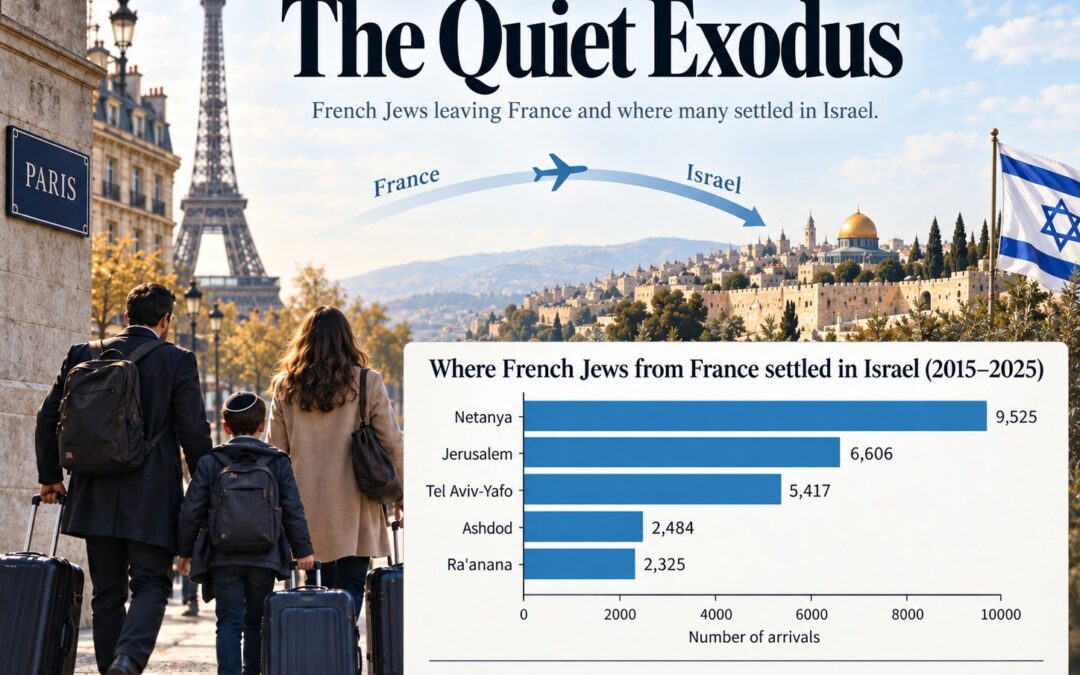
Israel has become the principal destination of French Jewish emigration. More than 80,000 French Jews are estimated to have moved there over recent decades, helping transform places such as Netanya, Ashdod, Jerusalem, Herzliya and parts of Tel Aviv into recognisably French-speaking Jewish environments.
Toulouse changed the psychology
One of the defining moments came on 19 March 2012.
A gunman attacked the Ozar Hatorah Jewish school in Toulouse. Rabbi Jonathan Sandler was murdered together with his young sons Gabriel and Arié. Eight-year-old Myriam Monsonego was also killed.
The murders were explicitly antisemitic.
The French state reacted forcefully, increasing security around Jewish institutions. Yet the psychological effect of Toulouse extended far beyond the immediate victims.
A Jewish school — a place where parents had entrusted their children each morning — had become a terrorist target.
The attack reinforced a question that had already begun circulating within Jewish families: not whether France considered them citizens, but whether France could continue protecting them as Jews.
Official French accounts subsequently described the victims as having been murdered because they were Jewish, and security around Jewish schools was reinforced nationwide.
Then came Hyper Cacher
Three years later, the fear became even more concrete.
On 9 January 2015, during the wider terrorist attacks surrounding the assault on Charlie Hebdo, Amedy Coulibaly entered the Hyper Cacher kosher supermarket at Porte de Vincennes in Paris.
Four Jewish customers were murdered.
The symbolism was impossible to ignore. They had not been attending a political rally or participating in a conflict. They had simply entered a kosher supermarket before Shabbat.
France’s domestic intelligence service records the Hyper Cacher attack as part of the wave of jihadist terrorism that struck the country during this period.
For many French Jews, Toulouse and Hyper Cacher formed a psychological sequence.
First a school.
Then a supermarket.
Ordinary Jewish life itself appeared increasingly capable of making someone a target.
The extraordinary migration of 2015
The consequences became measurable.
In 2015, roughly 8,000 French Jews moved to Israel — an extraordinary figure for a prosperous Western democracy and, at the time, the largest annual aliyah from a Western country.
Entire neighbourhoods in Israel began acquiring unmistakably French characteristics.
French bakeries appeared beside Israeli cafés. French-speaking estate agents advertised apartments. French newspapers circulated in synagogues. Doctors, lawyers, entrepreneurs and retirees reconstructed elements of their previous lives under the Mediterranean sun.
Netanya became perhaps the clearest symbol of this phenomenon.
Walk through parts of the city during the summer and French can sometimes seem almost as common as Hebrew. Restaurants print French menus. Estate agents advertise directly in Paris. Families who initially purchased holiday apartments eventually began treating them as permanent homes.
Ashdod developed its own large Francophone population, often attractive to middle-class and more traditional families.
Jerusalem attracted religious families and those motivated particularly strongly by Zionism.
Tel Aviv drew professionals, entrepreneurs and more secular newcomers.
Herzliya and its coastal surroundings became attractive to wealthier families seeking a standard of living closer to what they had left behind.
The movement did not produce a single French Israel. It produced several of them.
October 7 reopened the question
For a period after the record departures of the mid-2010s, French aliyah declined.
The reason was important.
Moving to Israel was not easy.
Some immigrants struggled with Hebrew. Others discovered that professional qualifications were difficult to transfer. Salaries could be lower while housing costs remained high. French doctors, lawyers and regulated professionals sometimes faced lengthy accreditation procedures.
Some eventually returned to France.
Earlier research cited by organisations assisting French immigrants suggested that a meaningful minority returned within several years because integration had proved harder than expected.
Then came the Hamas attacks of 7 October 2023 and the war that followed.
The effect inside France was immediate.
The Israeli-Palestinian conflict moved into French streets, universities, workplaces, demonstrations and social media. Jewish institutions again increased security. Political disputes surrounding Israel became intertwined with questions of Jewish identity.
The number of recorded antisemitic incidents surged.
France recorded 436 antisemitic acts in 2022.
In 2023, that number rose to 1,676.
In 2024, 1,570 incidents were recorded.
The French Interior Ministry subsequently said antisemitic incidents remained at historically high levels.
And although the total fell during 2025, the level remained dramatically above the pre-October 7 norm.
The Interior Ministry recorded 1,320 antisemitic acts in 2025, down 16 per cent from 2024 but still among the highest levels recorded during the previous quarter-century. Antisemitic incidents accounted for 53 per cent of all recorded anti-religious acts in France that year, despite Jews representing only a small fraction of the national population.
The significance lies precisely in that contradiction: the numbers declined from the immediate post-October 7 spike, yet remained historically abnormal.
Aliyah begins rising again
Migration followed.
Around 3,300 people moved from France to Israel in 2025, according to figures reported from Israel’s Ministry of Aliyah and Integration — approximately 45 per cent more than the previous year. France became one of the largest sources of new Israeli immigrants, behind Russia and the United States.
Those numbers remain below the exceptional 2015 peak.
But numbers tell only part of the story.
Applications, inquiries and discussions about emigration have become a normal feature of French Jewish family life.
The important question is no longer simply how many people have already left.
It is how many are preparing the possibility.
An apartment purchased in Netanya.
A Canadian immigration application.
Children placed in an English-language school.
Money transferred abroad.
A professional licence researched in Florida.
A second passport renewed.
These are not always acts of immediate emigration. They are insurance policies.
Two different anxieties
The documentary highlights another important feature of contemporary French antisemitism: Jews describe pressure arising from different political and ideological environments.
One source has been Islamist extremism, dramatically demonstrated by Toulouse and Hyper Cacher and by subsequent threats against Jewish institutions.
Another concern expressed within parts of the Jewish community relates to forms of radical anti-Zionism that Jews say can cross from criticism of Israeli policy into hostility toward Jews collectively.
Those phenomena are not identical and should not be conflated.
Nor does criticism of Israel inherently constitute antisemitism.
But the distinction can become blurred when Jewish institutions or individual Jews are targeted over actions of the Israeli government, or when classic antisemitic themes are incorporated into political rhetoric concerning Israel.
At the same time, France also continues to confront antisemitism associated with the traditional extreme right.
The result is an unusual sense among some French Jews of pressure from several ideological directions simultaneously.
It helps explain why the present movement cannot be reduced to a single political cause.
Israel: the natural destination
For most emigrating French Jews, Israel remains the obvious destination.
The reasons go far beyond physical security.
Israel offers automatic immigration rights to eligible Jews under the Law of Return. It possesses established French-speaking communities, Jewish schools, synagogues and religious infrastructure.
Family connections are often already there.
A French family arriving in Netanya may discover cousins, childhood friends, former neighbours and schoolmates within kilometres.
French Jewish culture itself has become woven into Israeli life.
Bakeries sell baguettes and pâtisserie.
Radio programmes target Francophone listeners.
Estate agents conduct business almost entirely in French.
Restaurants reproduce the culinary traditions of Paris, Marseille, Tunis, Casablanca and Algiers.
Israel therefore offers something few destinations can reproduce: migration without complete cultural rupture.
But Israel is not for everyone
Security is only one element of migration.
Quality of life matters.
Professional opportunity matters.
Education matters.
Language matters.
And this explains why increasing numbers of French Jews consider destinations beyond Israel.
For some highly educated professionals, the United States offers economic opportunities that Israel cannot easily match.
For others, Canada’s combination of French language, North American prosperity and substantial Jewish infrastructure provides a compelling alternative.
This produces several distinctive migration corridors.
Montreal: France without France
Montreal is perhaps the most culturally intuitive alternative.
It offers something extraordinary to a French Jewish immigrant: the possibility of moving across the Atlantic while continuing to live largely in French.
Montreal already possesses one of North America’s most important Jewish communities and has long-standing Sephardic and North African Jewish populations.
For families originally descended from Morocco or other parts of Francophone North Africa, the cultural transition can therefore be remarkably natural.
French language.
Jewish schools.
Kosher food.
North American economic opportunity.
And geographical distance from the political tensions many families associate with contemporary France.
Montreal can feel less like cultural exile than transplantation.
Miami and South Florida: the wealthy alternative
Another destination has grown in prominence: South Florida.
Miami, Miami Beach, Aventura and Boca Raton already contain extensive Jewish infrastructure.
For affluent French Jews, particularly entrepreneurs and internationally mobile families, Florida offers several attractions: favourable taxation, warm weather, private schools, strong Jewish institutions, luxury real estate and access to the enormous American economy.
French-speaking Jewish networks have consequently expanded.
For some families, Florida functions initially as a secondary residence.
Then the balance gradually shifts.
Three months become six.
Children enrol in American schools.
A business is incorporated.
The French residence becomes the secondary home.
Migration sometimes occurs without a single definitive moment of departure.
New York: the professional migration
New York attracts a somewhat different demographic.
Finance.
Law.
Technology.
Medicine.
Academia.
Media.
For internationally oriented French Jewish professionals, New York offers professional opportunities combined with one of the largest and most institutionally developed Jewish communities on earth.
The price is considerable — housing, schooling and healthcare are expensive — but for families whose priority is professional continuity, New York can provide something Israel sometimes cannot: the ability to transfer an international career almost intact.
And London
London has also historically attracted French Jewish professionals and wealthy families, particularly because of its proximity to Paris.
Eurostar turned the two cities into something approaching a single professional corridor.
A banker or entrepreneur could move a family to London while maintaining business activity in France.
Brexit complicated that route, but did not eliminate its attraction.
The broader pattern therefore becomes clear.
Different destinations correspond to different priorities.
Israel offers Jewish national belonging.
Montreal offers linguistic continuity.
Miami offers lifestyle and economic flexibility.
New York offers professional scale.
London offers geographical proximity and established European networks.
The people leaving are not necessarily rejecting France
This is perhaps the most important nuance.
Many departing Jews remain deeply French.
They speak French at home.
They follow French politics.
They read French newspapers.
They support French football teams.
They return for holidays.
They maintain businesses and property in France.
Some retain both emotional and practical connections for decades.
Their departure therefore cannot necessarily be interpreted as a rejection of French civilisation.
For some, it is precisely because they feel French that leaving is painful.
France was not simply a temporary host country. It was home.
That distinguishes the current movement from historic Jewish expulsions.
No government is ordering French Jews to leave.
The French state officially condemns antisemitism and spends substantial resources protecting Jewish institutions. Since the terrorist attacks of the previous decade, soldiers and police have regularly guarded synagogues and schools.
The Interior Ministry says nearly €48 million has been allocated over ten years to help protect places of worship.
Yet therein lies the paradox.
Protection reassures communities.
But the sight of armed soldiers outside a child’s school simultaneously reminds parents why the soldiers are necessary.
Security can therefore create safety while making insecurity visible.
What France risks losing
The consequences extend beyond Jewish demography.
French Jewish history is French history.
From philosophy and medicine to literature, commerce, mathematics, fashion, cinema, journalism and politics, Jewish citizens have participated disproportionately in many areas of French intellectual and cultural life.
A gradual departure therefore represents something larger than the movement of several thousand people per year.
Communities depend upon critical mass.
A synagogue does not disappear because one family leaves.
But if twenty leave, maintaining the congregation becomes harder.
A kosher butcher loses customers.
A Jewish school loses pupils.
Young adults discover fewer potential partners within their community.
More families then consider leaving.
Demographic decline can become self-reinforcing.
This is how communities can contract surprisingly quickly even without mass migration.
France’s dilemma
French governments have repeatedly declared that antisemitism is incompatible with the Republic.
Police guard Jewish institutions.
Presidents and ministers attend memorial ceremonies.
Antisemitic attacks are prosecuted.
Educational programmes attempt to combat hatred.
Yet the persistence of the problem shows the limits of government action.
The state can guard a synagogue.
It cannot station a police officer beside every Jewish child.
It can prosecute an antisemitic assault.
It cannot legislate away every prejudice circulating through social networks, political movements or extremist organisations.
The challenge is therefore not merely preventing violence.
It is restoring confidence.
And confidence is much harder to measure.
A government can publish statistics showing that incidents have fallen.
A family deciding whether to remain does not experience life statistically.
Its decision may depend upon a remark at school.
An insult in the street.
A mezuzah removed from an apartment door.
A child advised not to wear a Star of David.
A synagogue surrounded by soldiers.
Or simply the knowledge that several close friends have already left.
Migration ultimately occurs through accumulated perceptions.
The numbers tell two stories
There is one reason to avoid describing the situation as an inevitable disappearance of French Jewry.
More than 400,000 Jews still live in France.
The overwhelming majority have not emigrated.
France continues to possess vibrant synagogues, Jewish organisations, schools, cultural institutions and businesses.
Paris remains one of the great Jewish cities of the diaspora.
And even among those considering departure, motivations are varied.
Some leave because of antisemitism.
Some because of Zionism.
Some because their children already live in Israel.
Some because of taxation or professional opportunity.
Some because they prefer the climate.
Migration almost never has only one cause.
That complexity matters.
But so does the direction of travel.
When thousands of citizens from one small minority repeatedly consider whether they require a second country in which to feel secure, the phenomenon deserves attention even if most ultimately stay.
A French question, not merely a Jewish one
The most consequential question raised by the migration of French Jews is therefore not simply where they are going.
It is what their departure says about France.
The Republic historically offered Jews an extraordinary proposition: citizenship as individuals, equality before the law and participation in a national identity that transcended religion.
For generations, French Jews accepted that bargain enthusiastically.
The current anxiety tests whether that model can still command the same confidence.
Israel will continue welcoming French Jews.
Montreal will continue attracting Francophone families.
Miami and New York will continue offering economic opportunities.
Planes leave Paris every day.
The real question is what happens before anyone purchases the ticket.
At what moment does a family that has lived in France for three generations begin looking at schools in Netanya?
At what moment does an apartment in Miami cease being a holiday residence and become an escape route?
At what moment does Montreal begin to look more like home than Paris?
Large migrations rarely begin with borders.
They begin in the imagination.
A family imagines another future.
Then another family does the same.
Eventually statistics appear to describe what has already happened quietly around thousands of kitchen tables.
France’s Jewish community is not disappearing tomorrow.
But its demographic centre of gravity is shifting.
And the question facing France is whether that movement can still be reversed — not simply by protecting Jewish buildings, but by convincing Jewish families that they do not need an alternative country in which to imagine their future.



Receive Breaking News
Sign up for our newsletter and stay up to date! Be the first to receive the latest news in your mailbox: