
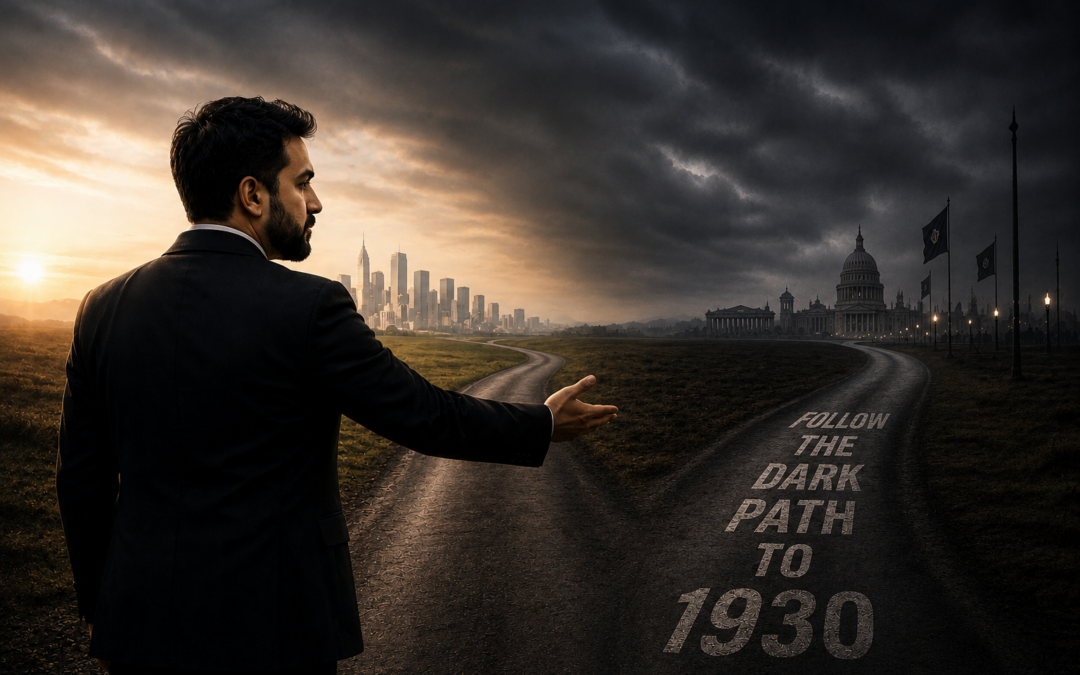
America’s most dangerous political shift is not simply that the Democratic Party has moved left. Parties move. Coalitions change. Generations revolt against their parents’ assumptions. The deeper danger is that a growing faction of the American left has stopped treating capitalism, national strength, private property, and constitutional restraint as imperfect instruments of liberty and has begun treating them as moral crimes.
That is the real meaning of the new radicalism. It is not merely progressive reform. It is not old liberalism. It is not the New Deal. It is a politics that divides society into oppressors and victims, treats wealth as evidence of guilt, treats national interest as shameful unless it serves a global ideological cause, and increasingly regards Israel and Jewish political self-determination as the central moral test of public life. The phrase “woke communism” is polemical, but it captures something real: a fusion of identity-crisis politics, anti-capitalist economics, anti-Western foreign policy, and administrative coercion.
The comparison to 1930s Germany is in plain sight. National Socialism was not modern progressivism, and the Nazi Party was a far-right, racist, antisemitic, anti-democratic, and anti-Marxist movement—if only to distinguish itself from the Communist Party. But the lesson of the 1930s is not that every radical movement is identical. The lesson is that democratic societies can be hollowed out when politics becomes a theology of resentment: one enemy class, one purified future, and one state powerful enough to remake society.
In Germany, that enemy was constructed through race, nation, and antisemitism. In today’s American left-wing radicalism, the old nationalist element has largely disappeared. It cannot work in the same way, because it is aimed at voters who hate the United States, most of whom are people who either cannot acclimatize to the United States or feel left behind while innovation makes capitalism shine for others. The new urban left is built from highly fragmented coalitions: students, professional activists, public-sector unions, racial and sexual identity blocs, immigrants and the children of immigrants, and voters alienated from traditional American patriotism. A politics of “blood and soil” cannot bind that coalition. So something else does. The substitute is a globalized morality play: capitalism as sin, whiteness as inherited guilt, Israel as colonial evil, imported Islamic antisemitism, and America as the imperial machine behind it all.
That is why the rise of Zohran Mamdani matters beyond New York City. Mamdani did not merely win the mayoralty as a charming local progressive with an affordability agenda. He became a national symbol of the new Democratic left. He ran as a democratic socialist on promises including free childcare, free buses, rent freezes, affordable housing funded by higher taxes on the wealthy, and even city-run grocery stores—exactly what the Soviet Union was all about before it collapsed. Once in office, his rent-freeze policy damaged maintenance, investment, and housing supply. Communism lowers the level, not to increase the well-being of those left behind, but simply to keep it as low as possible for everyone. Then came the more important sign: Mamdani-backed congressional candidates swept New York Democratic primaries, ousting two sitting incumbents and demonstrating that his movement intends to reshape the Democratic Party from inside safe blue districts.
The Democratic Socialists of America’s own program shows that this is not merely about helping the poor. It calls for the largest corporations to be put under “public ownership and democratic control,” universal rent control, tuition-free public higher education, cancellation of student debt, wealth taxes, public ownership of major energy and transportation infrastructure, a major reduction in the U.S. military budget, ending military and economic aid to Israel, ending sanctions on regimes such as Cuba, Venezuela, and Iran, demilitarizing the border, ending deportations, and giving immediate amnesty to all immigrants regardless of status to increase its electoral base. This is not liberal capitalism with a safety net. It is a program for transferring economic power away from private ownership and constitutional limits toward political control.
The voters are moving with it. Gallup found in 2025 that Democrats were the only major partisan group that viewed socialism more positively than capitalism, by 66% to 42%. For the first time in Gallup’s measurement, fewer than half of Democrats viewed capitalism positively. That does not mean every Democrat is a communist. It does mean that the party’s center of gravity has shifted. A party once built around working-class aspiration now contains a powerful faction that treats aspiration itself as suspect unless it is mediated through the state.
The foreign-policy shift is just as revealing. The Democratic Party’s growing hostility toward Israel is not simply ordinary criticism of Israeli governments. The danger begins when Israel becomes the unique obsession, when Jewish national self-determination is treated as uniquely illegitimate, and when “anti-Zionism” becomes the respectable doorway through which antisemitic ideas re-enter elite politics. Pew found in 2026 that eight in ten Democrats and Democratic-leaning independents had an unfavorable view of Israel, up sharply from 2022. In New York’s 2026 primaries, The Guardian reported that opposition to Israel and claims of genocide had become a litmus test on the left; AP likewise reported that Mamdani’s candidates vowed to abolish ICE, condemned Israel’s war in Gaza as genocide, and promised to tax the rich.
This is where the historical warning becomes unavoidable. Antisemitism does not always arrive wearing the same uniform. In one era, it speaks the language of racial nationalism. In another, it speaks the language of anti-capitalism. In another, it speaks the language of anti-colonial liberation. The rhetoric changes; the obsession remains. The ADL recorded 6,274 antisemitic incidents in the United States in 2025, a figure lower than that of 2024 but still five times higher than a decade earlier, and noted that Israel- or Zionism-related incidents remained far above pre-October 7 levels. That was the date on which those admired by the new left carried out the largest pogrom against Jews since WWII.
Meanwhile, many Americans still imagine that what happens overseas is secondary. That has always been partly true. U.S. voters rarely cast ballots because of events on the other side of the Atlantic or in the Middle East. But America’s prosperity was never isolated from the world. “America First” never truly meant America alone. It meant America as the dominant power, defending a world order in which American industry, capital, shipping, technology, energy, and finance could flourish.
The dollar is the clearest example. The Bretton Woods system made the dollar central to global settlement, convertible into gold at $35 an ounce until Nixon ended gold convertibility in 1971. Yet the dollar remained dominant because the world still trusted the United States more than any alternative. The Federal Reserve’s 2025 analysis found that the dollar still made up 58% of disclosed global official foreign reserves in 2024, far ahead of the euro, yen, pound, or renminbi. That trust does not rest on sentiment. It rests on markets, law, innovation, military reach, and the belief that America will defend the conditions under which capital can safely operate.
That is why the attacks on President Trump’s Iran policy are so shortsighted. Critics denounce military pressure as reckless, but what is their alternative? To allow a religious dictatorship that still hosts “Death to America” chants to approach nuclear-weapons capability while controlling leverage over one of the world’s most important energy corridors? The IAEA estimated Iran’s enriched uranium stockpile included 440.9 kg enriched up to 60% U-235, and the Arms Control Association describes 60% enrichment as close to weapons-grade, with no practical civilian application.
Military action is imperfect. Negotiation is imperfect. But seriousness requires both the stick and the carrot. Bombs can delay a nuclear program. Sanctions can impose costs. Negotiations can test whether the regime wants survival more than confrontation. And if a deal ever opens parts of Iran’s economy, including its oil sector, to Western capital and global contact, that may do what airstrikes cannot: expose the Iranian people more directly to the outside world and weaken the regime from within. A closed dictatorship feeds on siege psychology. Openness can become subversion.
The great irony is that the greatest danger to “America First” may not come from Tehran, Beijing, or Moscow. It may come from Americans who no longer understand what made America powerful in the first place. The American dream was not built by committees allocating virtue. It was built by property rights, risk-taking, cheap energy, deep capital markets, technological ambition, limited government, and a culture that honored success more than envy. Yes, capitalism produces inequality. But socialism produces stagnation, dependency, and political control over every serious economic decision.
The Mamdani model should therefore be treated as a warning shot. Its acolytes are not merely campaigning for cheaper rent or better buses. They are normalizing a politics in which government is expected to freeze prices, punish wealth, override markets, erase borders, subordinate foreign policy to ideological grievance, and define democracy as whatever advances “the people” against “the rich.” That language has appeared many times before in history. It always promises liberation. It often ends with concentrated power and concentration camps.
America can survive external enemies. It has done so repeatedly. What it may not survive is an internal elite that teaches young voters to despise the very system that made the United States rich, free, and dominant. National Socialism is not the same as woke communism. But both remind us that anti-liberal politics does not begin with camps or secret police. It begins when resentment becomes virtue, when enemies replace citizens, when the state becomes the instrument of moral purification, and when people forget that freedom is easier to destroy than to rebuild.



Receive Breaking News
Sign up for our newsletter and stay up to date! Be the first to receive the latest news in your mailbox: