
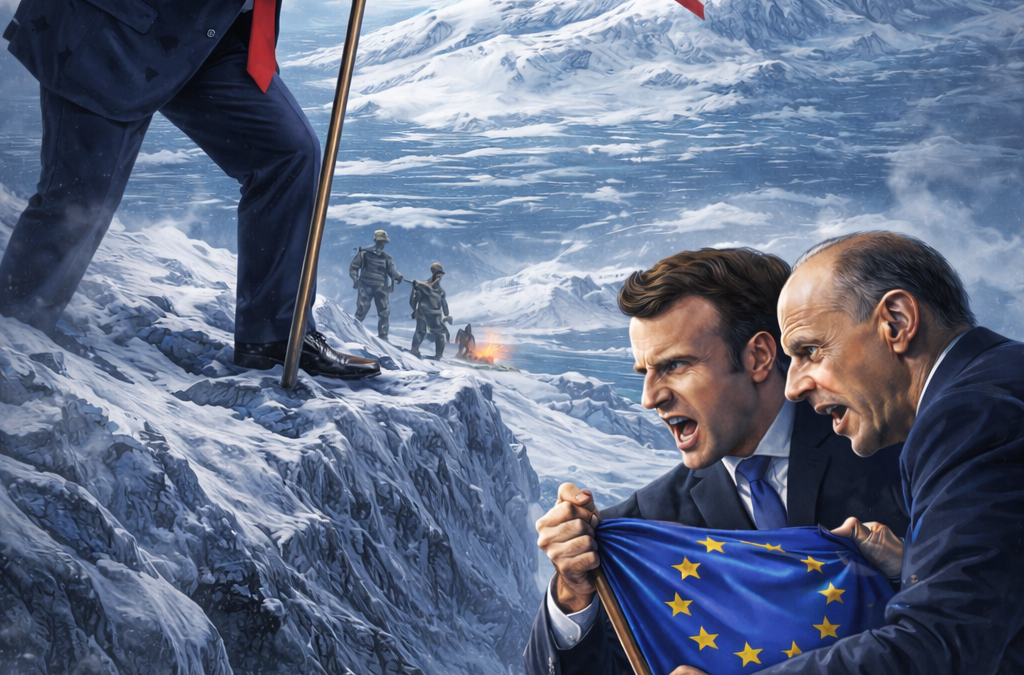
The Greenland dispute is suddenly being fought on two fronts at once: a visible security front (troops, sovereignty signals, NATO messaging) and a less visible political front inside Europe (who leads, who sets the line, and who benefits when Europe confronts Washington).
Who sent how many soldiers to Greenland — and why it matters
European governments have not deployed large combat formations to Greenland. They have sent small “scouting” and liaison teams that are politically loud precisely because they are militarily modest.
According to reporting on the initial deployments:
- Germany: 13-person reconnaissance team
- France: about 15 mountain specialists (with Macron indicating further reinforcement by land, air and naval assets)
- Sweden: 3 officers
- Norway: 2 officers
- Finland: 2 military liaison officers
- Netherlands: 1 navy officer
- United Kingdom: 1 officer (joining the reconnaissance group)
Denmark’s own baseline presence in Greenland includes about 150 military and civilian personnel at its Joint Arctic Command, and Danish officials have said there are roughly 200 U.S. troops stationed in Greenland already.
In other words: the deployments are not about “taking Greenland.” They are about signaling—to Washington, to Moscow, and to European publics—that European capitals will not sit still while the U.S. openly links Arctic security to the purchase of allied territory.
Trump’s tariff escalation turns Greenland into a trade weapon
President Trump’s announcement pushes the crisis into a much more dangerous phase by explicitly tying tariffs to a territorial outcome.
Reuters reports that Trump vowed additional tariffs on eight European allies—Denmark, Norway, Sweden, France, Germany, the Netherlands, Finland and Great Britain—starting with an extra 10% on February 1, 2026, escalating to 25% on June 1, and continuing until a deal is reached for the U.S. to purchase Greenland.
This is not a conventional trade dispute. It is an attempt to use market access to force leverage on sovereignty. The moment tariffs become “rent” paid until territory changes hands, the argument stops being about trade balances and starts being about whether alliances still run on rules—or on coercion.
Europe’s economic backdrop makes tariffs far more painful than the rhetoric suggests
Europe is not confronting Washington from a position of economic comfort.
Recent indicators show a eurozone that is improving at the margins but remains fragile:
- Eurozone investor morale improved early in 2026, but remains negative overall, and “current conditions” are still described as strongly recessionary, especially in Germany.
- Germany’s export engine continues to struggle; Reuters reported German exports fell 2.5% in November, and the trade surplus declined.
- German institutes have described the economy as stuck in a meagre-growth phase, with expectations around 0.1% growth in 2025 and improvement only gradually into 2026.
- France’s public finances are under sustained pressure; Reuters noted a deficit near double the EU’s 3% limit and debt heading toward 118% of GDP, with markets sensitive to political turmoil.
This matters because a transatlantic tariff cycle hits Europe at exactly the wrong time: weak export momentum, politically constrained fiscal policy, and high sensitivity in bond markets.
So when European leaders talk tough about Greenland, they are also gambling with a real economic downside at home.
Ukraine peace talks: Europe is reactive, not central — and it shows
A major reason Greenland escalated so quickly is that Europe is carrying a second frustration: the growing sense that it is not central to the negotiation architecture around Ukraine.
Two recent signals are hard to ignore:
- The main negotiation traffic is in Washington.
Reuters reported Ukraine’s peace negotiators arriving in the United States for talks with Trump administration officials, and that Ukraine and the U.S. have drafted a 20-point proposal, with Russia not yet commenting. - Moscow openly frames Europe as outside the room.
Reuters reported the Kremlin saying it has an ongoing dialogue with the United States about peace efforts, but that no such dialogue currently exists with European governments.
Europe is not absent—far from it. In late 2025, Europeans pushed back against a U.S.-backed plan that, as Reuters described it, would require severe Ukrainian concessions, and Europe drafted a counter-proposal through the E3 (Britain, France, Germany).
But the sequence matters: Europe is repeatedly positioned as reacting to U.S.-driven frameworks, rather than defining the first draft.
Even the financial debate reflects this. Reuters reported the EU accelerated efforts to agree on a scheme using frozen Russian assets after a U.S.-backed peace plan “set out different ideas.”
The cumulative effect is political: Europe feels strategically exposed, economically strained, and diplomatically second-tier. Greenland then becomes a stage where Europe can prove it still has agency.
The Euroclear failure: a blow to German leadership, enabled by Europe’s own divisions
The EU’s inability to mobilize frozen Russian sovereign assets held largely at Belgium-based Euroclear became a visible symbol of European constraint.
What happened, in plain terms:
- The EU wanted to leverage frozen Russian assets to help finance Ukraine, but Belgium resisted, warning of legal and financial risks.
- In early December, German Chancellor Friedrich Merz and European Commission President Ursula von der Leyen went to Brussels for talks with Belgian Prime Minister Bart De Wever; Reuters described them as “constructive,” but the political blockage remained.
- By mid-December, EU leaders opted for “Plan B”: borrowing to loan 90 billion euros to Ukraine, while the “reparations loan” based on Russian assets remained unworkable for the moment due above all to Belgium’s resistance.
This outcome did more than delay funding mechanics. It signaled something bigger: Germany could not force alignment, even when it tried with the Commission president at its side.
And here France’s posture matters. France has structural reasons to be cautious: it has an ownership stake in Euroclear and has been publicly associated with worries about destabilizing the institution if the assets are seized.
That caution does not need to be shouted from the rooftops to have political impact. When Germany pushes for maximal financial instruments and France stays comparatively restrained, Germany is left holding the risk of “failure to deliver.” The perception of leadership shifts—even if nobody says so out loud.
Macron’s domestic weakness fuels his international posture
President Macron’s hard line against Trump on Greenland cannot be read only as foreign policy. It is also a political strategy shaped by domestic constraints.
At home, France is wrestling with:
- A fraught fiscal picture and high political sensitivity in markets; Reuters described a deficit near double the EU limit and debt trending toward 118% of GDP, with turmoil raising doubts about fiscal control.
- A fragile political environment that makes compromise difficult and increases the incentive to project control and stature elsewhere.
- Renewed domestic political pressures, including high-salience protests (for example around trade issues) that highlight the gap between international ambition and homefront consent.
In that context, a strong international role is not a luxury. It becomes a substitute for domestic authority: if you cannot look dominant at home, you look decisive abroad.
The Putin-call episode: why France’s Russia channel carries baggage
Macron’s recorded calls with Putin speaks to a real diplomatic scar.
In 2022, a French documentary released content from Macron’s calls with Putin, and the episode was widely viewed as breaking diplomatic secrecy norms; it provoked Russian criticism and intensified an already bitter Paris–Moscow information conflict.
The practical consequence is not that France “cannot negotiate.” It is that France’s engagement posture became easier for critics to attack:
- For Moscow: as proof Paris weaponizes leaks.
- For European hawks: as proof dialogue is naïve.
- For domestic opponents: as proof Macron’s diplomatic theater did not stop the war.
That baggage matters now because Macron is again trying to occupy the role of Europe’s geopolitical voice. Russia is not obliged to treat that voice as neutral—and some European partners do not either.
Why Greenland became the perfect arena for a European leadership contest
Put the pieces together:
- Europe feels squeezed economically.
- Europe feels sidelined in Ukraine’s core negotiation channel.
- Germany’s leadership brand took damage when the Euroclear plan hit a Belgian wall and the EU pivoted to borrowing.
- France is structurally incentivized to fill any leadership vacuum, and Macron is personally incentivized to project strength internationally.
In that setting, standing up to Trump on Greenland is not just a transatlantic posture—it is also a bid to define who leads Europe when Europe is under pressure.
Macron’s “heads I win, tails I win” logic
From a cold political calculus, Macron can frame almost any Greenland outcome as a win for France:
- If confrontation escalates and NATO cohesion weakens, France can argue it is uniquely positioned to anchor European security because it is the EU’s only nuclear-armed state and has long pushed “strategic autonomy.” (This is not the same as replacing NATO—but it is a powerful leadership claim.)
- If U.S. domestic constraints dilute Trump’s tariff threat, Europe’s firm stance—fronted loudly by France—can be marketed as proof that Paris “held the line,” strengthening France’s claim to shape EU strategy.
Even U.S. institutional uncertainty can become part of the European calculation. Reuters reported the U.S. Supreme Court is considering the legality of Trump’s sweeping tariffs—an additional reason Europeans may bet that today’s tariff posture could be weakened tomorrow.
The most dangerous shift: ego replaces diplomacy
The tragedy in this episode is that it is increasingly structured around personal victory conditions:
- Trump frames Greenland as a test of dominance and uses tariffs as a forcing mechanism.
- Macron frames resistance as proof of leadership and strategic seriousness.
- Other European capitals rally partly for sovereignty—and partly to avoid being seen as weak.
When politics becomes a contest of who “wins” personally, countries almost always lose materially:
- Higher tariffs mean higher costs.
- Escalating military symbolism increases miscalculation risk.
- Alliance trust erodes, and rebuilding it is slow and expensive.
Greenland is the pretext. The deeper conflict is over status—who sets terms, who commands attention, and who can credibly claim leadership in a Europe that feels economically constrained and geopolitically crowded.
And that is exactly why this confrontation is so hard to de-escalate: it is no longer only about interests. It is about pride.



Receive Breaking News
Sign up for our newsletter and stay up to date! Be the first to receive the latest news in your mailbox: