
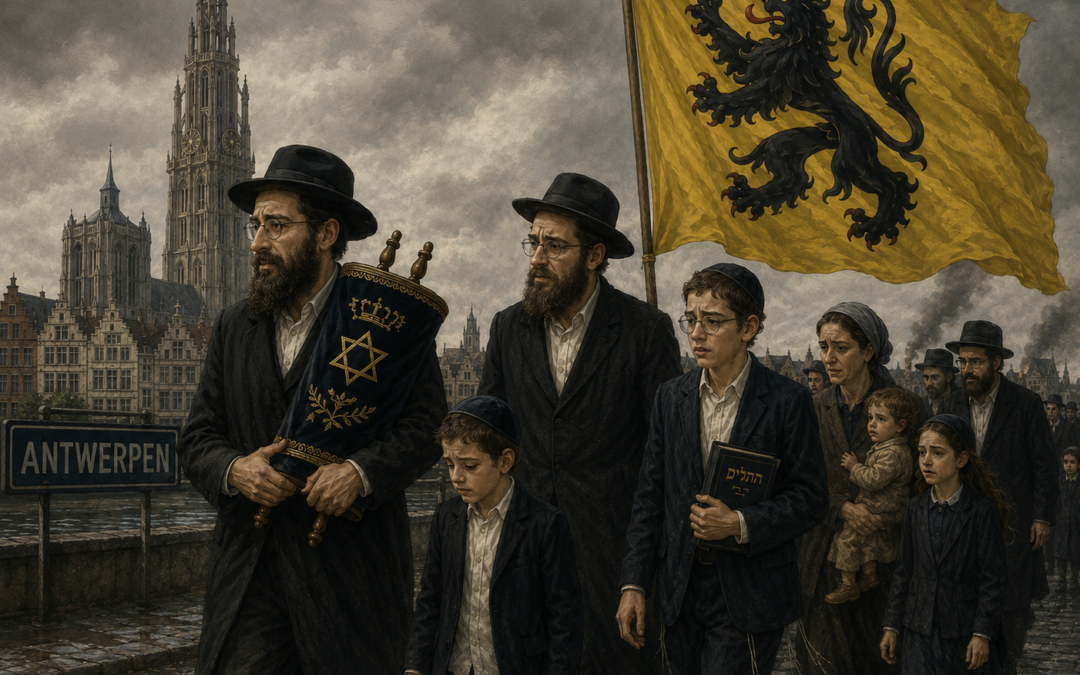
For eighteen months, Belgian authorities conducted an investigation involving wiretaps, house searches, financial inquiries, and extensive questioning. Such measures are typically associated with terrorism, organized crime, or threats to national security. Yet the focus of this investigation was not a criminal network, an extremist organization, or a danger to the Belgian state. It was a religious practice that has existed for thousands of years and lies at the heart of Jewish identity: the brit milah, the ritual circumcision through which a Jewish child enters the covenant and becomes part of the continuity of the Jewish people.
The Antwerp prosecutor’s office is seeking to bring two Jewish ritual circumcisers, known as mohels, before a criminal court in connection with circumcisions performed on at least ninety-eight infants. The courts will decide whether the legal allegations have merit, and every individual involved deserves the presumption of innocence. Yet regardless of the eventual outcome, the broader significance of this case extends far beyond a courtroom. For many Belgian Jews, it raises a far more profound question: what happens when a democratic state begins to treat the foundational practices of a religious minority as matters for criminal investigation?
This question cannot be separated from a broader reality. Over the past decade, many Jews in Belgium have watched as one pillar of Jewish religious life after another has come under increasing pressure. The prohibition of ritual slaughter fundamentally altered the ability of observant Jews to maintain a fully kosher lifestyle within the country. Now, ritual circumcision finds itself under legal scrutiny. Each measure may be defended individually on technical, legal, or ethical grounds. Yet communities do not experience these developments as isolated events. They experience them cumulatively.
The result is a growing perception that while Belgium continues to celebrate Jewish history, it is becoming less comfortable with Jewish continuity.
That distinction matters.
A society that proudly commemorates the Holocaust while simultaneously placing essential Jewish practices under increasing pressure risks sending a contradictory message. It honors Jewish memory while creating uncertainty about Jewish future. It celebrates the contributions Jews made to the nation while appearing less certain about the place Jews should occupy within its future.
For generations, Antwerp stood as one of the most important centers of Jewish life in Europe. Known internationally as the “Jerusalem of the North,” it was home to a thriving Jewish community whose influence extended far beyond the city’s boundaries. Synagogues, schools, kosher businesses, charitable institutions, scholars, entrepreneurs, and large families formed part of the city’s identity. During the height of the diamond industry, politicians proudly associated themselves with Antwerp’s Jewish community. Its success was viewed as a Belgian success. Its international reputation enhanced Belgium’s own standing in the world.
Few people at the time would have imagined that the future presence of this community would one day become an open question.
Yet today that question is increasingly being asked.
Not only by journalists or community leaders, but by ordinary Jewish families deciding where they want their children to grow up.
The reasons extend beyond any single legal case. They are rooted in a broader transformation taking place across Europe, one that has accelerated dramatically since October 7, 2023.
Any honest discussion must begin with what occurred on that day. October 7 was the murderous rampage of Hamas across Israel. Families were slaughtered in their homes. Children were murdered. Women were assaulted. Elderly civilians were executed. Young people attending a music festival were massacred. Hundreds of hostages were taken into Gaza.
For many Jews throughout Europe, the attack represented not only a national tragedy for Israel but a psychological turning point. It was a reminder that mass violence against Jews remains possible in the modern world. Yet what followed proved almost as disturbing.
Although condemnations were issued by political leaders across Europe, many Jews felt that the moral clarity surrounding the massacre quickly faded. Within weeks, public attention shifted almost entirely toward Israel’s military response. Discussions of the hostages became increasingly rare. The victims of October 7 gradually disappeared from public consciousness. The attack itself became a historical footnote while the subsequent conflict dominated headlines, political debates, university campuses, and social media.
This shift exposed a phenomenon that is becoming increasingly visible across Europe: societal antisemitism.
Unlike traditional antisemitism, societal antisemitism does not always manifest through explicit hatred of Jews. It often appears in more subtle forms. It emerges when Jewish suffering is treated as less urgent than the suffering of others. It appears when Jewish fears are questioned rather than acknowledged. It becomes visible when Jewish communities are expected to justify their concerns before they are granted legitimacy.
At its core, societal antisemitism is the normalization of double standards.
The dead Jew is mourned, but the living Jew is scrutinized.
The Holocaust is remembered, but contemporary Jewish insecurity is minimized.
Jewish identity is tolerated, provided it remains disconnected from Jewish collective concerns.
Israel may be criticized, as every democratic state should be open to criticism, yet criticism frequently crosses into a broader hostility that affects Jews who have no involvement whatsoever in Israeli policymaking.
This phenomenon does not originate from a single political ideology. That is precisely what makes it so powerful and so difficult to confront.
Elements of the far right continue to recycle traditional antisemitic myths regarding power, money, and influence. Segments of the far left increasingly interpret Jewish identity exclusively through the framework of colonialism and oppression. Parts of academia have adopted narratives that portray Israel as uniquely illegitimate while showing little interest in examining the ideology of Hamas. Significant portions of the media devote enormous attention to alleged Jewish wrongdoing while frequently overlooking threats directed against Jewish communities themselves.
At the same time, another development is reshaping the political landscape of Europe: the growing influence of political Islam.
This must be approached carefully and honestly.
Political Islam is not synonymous with Muslims. Europe’s Muslim citizens are individuals with diverse political views, beliefs, and backgrounds. They should never be collectively blamed for antisemitism. However, political Islam represents a distinct ideological project that seeks to transform religious identity into political influence and electoral power.
As Muslim populations have grown throughout Europe, political parties have increasingly viewed certain communities through an electoral lens. Demographic change in itself is neither unusual nor problematic. Democratic societies are built upon diversity. The concern arises when political leaders begin treating Jewish concerns as negotiable while treating anti-Israel sentiment as politically untouchable.
When that happens, Jewish security ceases to be a principle and becomes a calculation.
Many Belgian Jews increasingly believe that this calculation is already taking place.
The result is a climate in which hostility toward Israel often spills over into hostility toward Jews, while politicians, journalists, and public institutions struggle—or sometimes refuse—to distinguish between the two.
This is why the current debate surrounding ritual circumcision resonates so deeply within the Jewish community. It is not merely about legal definitions or medical qualifications. It is about trust. It is about whether Jews believe that Belgium continues to see them as a valued and permanent part of the national community.
The question facing Belgium today is therefore larger than the fate of two mohels.
It is whether a country that proudly commemorates Jewish history remains equally committed to protecting Jewish future.
How long will a community remain in a country where its core religious practices are increasingly challenged, where synagogues require permanent security, where Jewish children are advised to conceal visible signs of their identity, and where public sympathy often appears conditional?
How long can a city continue to call itself the Jerusalem of the North if the families who gave meaning to that title increasingly question whether their future lies elsewhere?
These questions should concern every Belgian, not only Jews.
A democracy is ultimately judged not by how comfortably the majority lives, but by whether minorities feel secure enough to remain themselves. Religious freedom is not tested by protecting popular traditions. It is tested by protecting traditions that may be unfamiliar, controversial, or misunderstood.
The future of Jewish life in Belgium will not be determined by one court case, one election, or one political controversy. It will be determined by whether Belgium chooses to remain a country where Jews are valued as living citizens rather than commemorated merely as historical victims.
The true challenge facing Belgium is therefore not legal but civilizational.
It must decide whether the “Jerusalem of the North” will remain a living reality or become a memory recalled only in speeches, museums, and commemorative ceremonies.
For the first time in generations, that question no longer feels theoretical.



Receive Breaking News
Sign up for our newsletter and stay up to date! Be the first to receive the latest news in your mailbox: