
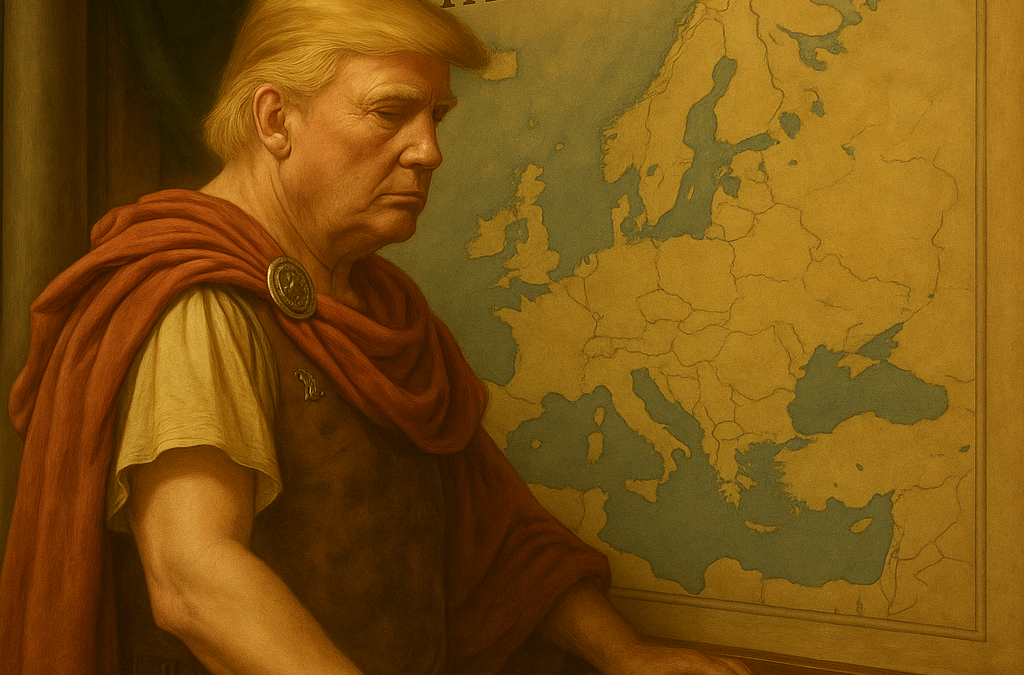
The United States has launched the Pax Silica Initiative (December 2025) as a strategic coalition to secure the “full stack” of the AI-era industrial base—critical minerals, energy inputs, advanced manufacturing, semiconductors, compute, AI infrastructure, and logistics.
Its branding invites an historical analogy: Pax Romana was not peace by consensus; it was stability delivered through Roman law, infrastructure, and—when required—force. Pax Americana similarly offered security and prosperity under a US-centered system of defense guarantees, dollar liquidity, and technology leadership. In that lineage, Pax Silica is best read as the industrial charter of a new order: Pax Trumpiana—a “peace” defined by supply-chain primacy, transactional alliance management, and control of strategic choke points.
The architecture: participants vs. signatories
Public reporting and partner-government releases indicate two concentric circles:
1) Summit participant countries (the “8”)
The inaugural Pax Silica summit brought together:
- United States
- Japan
- Republic of Korea (South Korea)
- Singapore
- Netherlands
- United Kingdom
- Israel
- Australia
and reporting also describes the United Arab Emirates (UAE) as present/associated in summit participation.
2) Declaration signatories (the “7”)
The Pax Silica Declaration was signed by:
- United States
- Australia
- Japan
- Republic of Korea
- United Kingdom
- Singapore
- Israel
Separate coverage notes that the Netherlands and the UAE participated but did not sign the declaration at launch.
This split matters: attendance signals alignment; signature implies commitments (or at least a willingness to be bound to a coordinated agenda on investment security, export controls, and supply-chain strategy).
Why Europe is (nearly) missing—and why the Netherlands is the exception
The EU’s near-absence is not a diplomatic oversight. It is the visible outcome of how power is distributed in the AI supply chain.
1) The Netherlands holds a true choke point (ASML).
In the semiconductor stack, very few assets function as global “gates.” ASML’s lithography systems (especially at the leading edge) are among them. In a coalition built around controlling the industrial prerequisites of AI, the Netherlands is included because it is structurally indispensable, not because it is “European.” This is why, from the EU27, the Dutch seat is the one Washington cannot ignore.
2) The US prefers sovereign, enforceable alignment over EU-level ambiguity.
Pax Silica is explicitly framed as an “economic security coalition”—the kind of arrangement that quickly runs into questions of export controls, outbound investment screening, and sensitive-technology protection.
Those instruments are easier to coordinate with states that can move decisively than with a bloc whose competencies are divided across Brussels, national capitals, and courts.
3) Europe’s posture is regulatory; Pax Silica is industrial.
The EU’s comparative advantage has been rule-making. Pax Silica is about the hardware reality beneath the rules: minerals, refining, energy, fabs, compute buildout, logistics corridors, and the private capital that stitches them together.
In that domain, Europe has world-class firms—but fewer levers that Washington perceives as both decisive and rapidly alignable.
4) The Netherlands may be “in the room,” but not necessarily “in the inner circle.”
The fact that the Netherlands attended yet reportedly did not sign at launch underscores the tension: Dutch strategic assets are European, but the coalition’s logic is American.
Europe’s presence, in other words, is conditional—based on utility and compliance, not on partnership parity.
From Pax Romana to Pax Trumpiana: what changed is the substrate of power
Rome’s system rested on legions and grain routes. Pax Americana rested on aircraft carriers, the dollar, and global institutions. Pax Trumpiana rests on silicon, compute, energy, and supply-chain coercion-resistance.
And that is the central point: Pax Silica is not primarily “about AI governance.” It is about who gets to build, scale, and secure the industrial base that makes frontier AI possible—and who must buy access on another power’s terms.
Europe’s strategic dilemma
Europe now faces an uncomfortable choice:
- Remain a “regulated province” of a US-centered AI-industrial order—benefiting from stability and access, while accepting dependency; or
- Convert sovereignty rhetoric into industrial sovereignty—through compute capacity, energy strategy, minerals/refining partnerships, and a coordinated semiconductor expansion that is not merely a subsidy program but a geopolitical posture.
Pax Silica’s membership pattern sends a blunt message: Europe is not treated as a strategic pole—except where a European country controls a choke point that the US cannot replicate or bypass quickly.


Receive Breaking News
Sign up for our newsletter and stay up to date! Be the first to receive the latest news in your mailbox: