
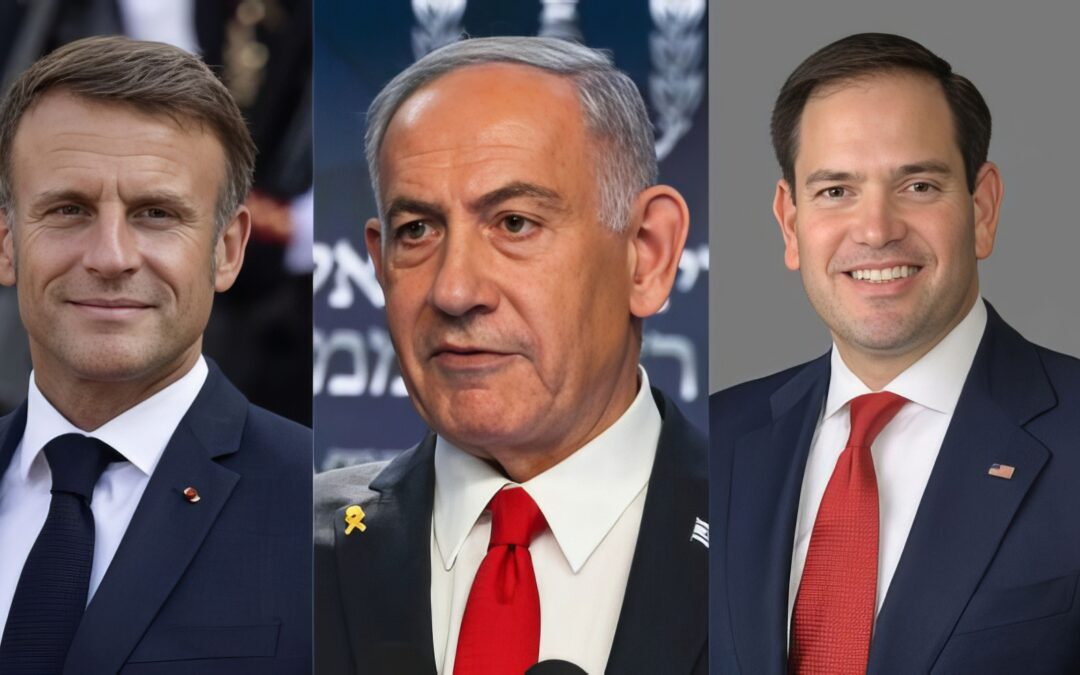
France’s President Emmanuel Macron has stunned the world by declaring that France will formally recognize the State of Palestine at the upcoming UN General Assembly – making it the first G7 nation to do so. The announcement “sets France apart from the United States and most of its close allies” and has already provoked furious reactions abroad. At home, Macron pitches this bold move as a historic push for Middle East peace and a display of France’s independent foreign policy stature. In reality, it appears to be a high-stakes opinion gamble by a politically weakened leader. Macron seems desperate to leverage shifting domestic dynamics – from France’s changing demographic makeup to anti-American undercurrents – in order to boost his flagging popularity and craft a legacy beyond his troubled presidency. But this bid for international acclaim through a dramatic Palestine gambit may badly backfire, imperiling France’s security and social cohesion. It risks emboldening extremists, accelerating the exodus of French Jews, and sending a dangerous signal that terrorism and intransigence are rewarded on the world stage. Macron’s decision, critics argue, is the short-term stunt of a leader playing roulette with France’s future, rather than the strategic statecraft of a master chess player.
A Changing France: Fewer Jews, More Muslims, and Diminished Influence
Over the past 30 years, the demographic landscape of France has shifted significantly, altering the domestic political calculus behind foreign policy stands like this one. France is home to both Europe’s largest Jewish and Muslim communities, but their trajectories have diverged sharply. The French Jewish population has been in steady decline, dropping from roughly half a million in the 1990s to around 440,000 today. Intermarriage and assimilation have shrunk the “core” Jewish population, even as the broader count of those with Jewish heritage is larger. More ominously, waves of anti-Semitic violence in recent decades have driven tens of thousands of French Jews to emigrate – many to Israel – especially after high-profile attacks in the 2010s. Each year saw more Jewish families, including business owners and professionals, packing their bags. With Jews now making up only about 0.6% of France’s population, their visible presence and influence in French society have waned. Once, prominent Jewish families (for example, the Rothschilds in finance) stood among France’s captains of industry and pillars of the Republic. Today, as their numbers shrink and security fears mount, the community’s economic and cultural clout is inevitably less pronounced. A former Prime Minister lamented that “without the Jews, France would not be France,” yet increasingly many French Jews feel that France with them has become untenable.
In stark contrast, France’s Muslim population has surged and grown more assertive in the public sphere. In the early 1990s, Muslims made up only a few percent of the French populace; by 2010 they were about 7.5% (around 4.7 million people) and climbing. Estimates today put France’s Muslim community at roughly 5 million or more – about 8% of the population – and demographers project further growth in the coming decades. One analysis found that in 2017 about one-eighth of France’s population was of Muslim origin (~8.4 million), and projections foresee up to 12–18% of the country being Muslim by 2050 if high immigration continues. This dramatic rise stems from decades of immigration (especially from North Africa and the Middle East), higher birth rates, and conversions. As a result, Muslims have become an increasingly potent electoral and social force in France – especially in urban centers and among left-wing and youth movements. Their concerns (including solidarity with Palestinians) are now mainstream political issues in a way that would have been unimaginable a generation ago. Meanwhile, the diminishing Jewish community – though still culturally vibrant – feels outnumbered and vulnerable. It has also lost some of its informal influence in elite circles simply by virtue of being fewer in number and less economically central than in past decades. This is not to perpetuate the trope of Jewish “power” (a notion 40% of French people agreed with in one survey), but rather to note a demographic reality: the voice of 3% of French citizens can more easily be ignored than that of, say, 10%. Jewish entrepreneurs and intellectuals remain prominent, but the community’s overall weight in French public life is lighter than before – a trend noted by observers of European Jewry’s decline.
These demographic shifts form the backdrop to Macron’s Palestine announcement. Domestically, support for the Palestinian cause runs high among French Muslims and the political left, while the dwindling Jewish population finds itself increasingly isolated in its concerns. Public opinion in France today is “primarily pro-Palestinian,” as even French officials acknowledge. Sympathy for the Palestinian narrative – and anger at Israel’s actions in Gaza and the West Bank – is common on the streets of Paris and Marseille. Large pro-Palestinian demonstrations have occurred in France, especially after flare-ups in the Middle East. Macron’s decision to recognize Palestine can be read as bowing to this shifting domestic wind. With fewer Jewish voters to offend and a growing pool of pro-Palestinian constituents to please, the calculus for French politicians has changed. The president may be hoping to tap into the “Palestine momentum” at home to bolster his own standing, portraying himself as the champion of a cause popular with many French citizens. Indeed, scenes of celebration have already been reported in some French immigrant neighborhoods after Macron’s pledge. Meanwhile, France’s Jews hear once again the familiar alarm bells – some are even talking about expediting their long-considered plans to leave the country for Israel or elsewhere, fearing they have “no future” in a France that is siding against the Jewish state.
Macron’s Domestic Weakness and Political Gambit
It is hard to separate Macron’s sudden lurch on the Palestinian question from his precarious political position at home. The timing is telling. Less than three years ago, Macron handily won re-election as president, but since then he has suffered a series of humiliating setbacks. In June 2022, shortly after his victory, French voters stripped Macron’s centrist party of its parliamentary majority, delivering what even his allies admitted was a “personal failure” for the president. For the first time in decades, a newly re-elected French leader failed to secure a working majority in the National Assembly. This left Macron a lame duck at home, forced to scrape together support on each piece of legislation or resort to controversial executive maneuvers. His bold plans for economic reform (e.g. pension changes) triggered massive street protests and nearly toppled his government. Confidence in his leadership eroded as France became politically gridlocked and polarized between surging extremes (the far-right of Marine Le Pen and the hard-left of Jean-Luc Mélenchon). Macron’s personal approval ratings sank, and he began to appear increasingly isolated and tone-deaf to public concerns (whether on the cost of living or crime).
Facing this domestic malaise and a restive populace, Macron has seemingly looked to foreign policy as a stage to project strength and divert attention from his troubles. But here too, his record has been checkered. Macron came into office vowing to reinvigorate French global leadership – styling himself as a visionary who would champion Europe, stand up to superpowers, and solve conflicts from Lebanon to Libya. In practice, many of his high-flying initiatives fizzled. Most notably, Macron’s attempts to mediate the war in Ukraine fell flat. In the lead-up to Russia’s 2022 invasion, Macron shuttled and phoned endlessly between Kyiv and Moscow, convinced he could talk Vladimir Putin down. Those efforts not only failed to prevent war; they also arguably undermined France’s credibility. Macron was caught flat-footed by the invasion he thought wouldn’t happen, and his continued phone calls with Putin during the war angered France’s Eastern European allies and even Ukraine itself. Far from the peacemaker, Macron ended up alienating both sides: Moscow resents Paris for joining EU sanctions and arming Ukraine, while Kyiv and its friends distrust Macron for being too eager to negotiate with the Kremlin. His grandiose pronouncements (such as calling NATO “brain-dead” shortly before war erupted) proved embarrassingly off-base. In sum, Macron’s foreign policy record has more flops than victories – from a failed intervention in Lebanon’s crisis to a deteriorating French influence in former African colonies.
It is against this backdrop of domestic fragility and foreign policy frustration that Macron’s dramatic pro-Palestine pivot must be understood. The president is grasping for a political lifeline, a way to recapture momentum and define his legacy on his own terms. Recognizing Palestinian statehood is a bold stroke that checks several boxes. Domestically, it appeals to progressive and Muslim voters who have been critical of Macron for being too centrist or too aligned with Israel. Internationally, it lets Macron cast himself as a visionary “man of peace” willing to break with Washington and take a moral stand – a legacy play for a leader who knows his time in the Élysée Palace is finite. Indeed, French commentators whisper that Macron is already contemplating life after the presidency. Term-limited and having lost his majority, he cannot run again in 2027, and his influence at home will only wane. What better way to pivot to a global role – perhaps at the EU or UN – than to burnish one’s credentials as a statesman who dared to do what others would not? There is a striking parallel to former German Chancellor Angela Merkel, who in 2015 opened Germany’s doors to a million Syrian refugees in a move widely praised abroad – and rumored to be partially motivated by her ambitions for a top UN job. At the time, even the tabloid Bild speculated that Merkel might try to succeed Ban Ki-moon as UN Secretary-General. Merkel never pursued that path in the end, but she did earn a reputation as a humanitarian leader (even winning a UN refugee agency prize later). Macron may have a similar calculation. By recognizing Palestine, he aligns himself with a cause that enjoys broad support in the Global South and among human rights advocates worldwide. If his domestic prospects are dimming, such a move could bolster his profile for an international post once he exits the French stage.
Of course, unlike Merkel’s refugee decision (which was at least framed as a humanitarian emergency response), Macron’s Palestine recognition is a more overtly political gambit. It pointedly distances France from the United States and Israel, France’s traditional close allies. This might win cheers in some quarters of French public opinion, where anti-American sentiment has simmered especially during the trade disputes of the Trump era. (Many in Europe feel that Donald Trump “won” the tariff battles, forcing Europe to back down, and thus being seen to snub Washington now plays well with a resentful public.) Macron, who early in his tenure tried to charm Trump, later turned into a vocal critic of U.S. unilateralism. Now, with Trump (and his allies) back in power in Washington, Macron’s defiance on Palestine can be read as partly an anti-Trump posture – a way to stand up to the Americans and score points at home for France’s “independence.” Being seen as “against the United States is popular now” in some French political circles, as protectionist U.S. policies have left a bitter taste in Europe. Macron likely knows that recognizing Palestine will irritate Trump personally, given Trump’s staunch pro-Israel stance. But that may be a feature, not a bug, in Macron’s domestic strategy: showing he won’t be cowed by Washington could curry favor with French nationalists and leftists alike, who rarely agree on anything except their dislike of perceived American dominance.
International Backlash: Allies Outraged and Enemies Emboldened
If Macron hoped for applause on the world stage, what he got instead was swift and scathing backlash from many of France’s allies. The United States “strongly rejects” Macron’s plan, declared U.S. Secretary of State Marco Rubio, calling it “reckless” and a gift to extremists. “This reckless decision only serves Hamas propaganda and sets back peace. It is a slap in the face to the victims of October 7th,” Rubio said in a post on X (formerly Twitter). Indeed, Washington had explicitly warned France and others not to take unilateral steps on Palestinian recognition – cautioning in a diplomatic cable that such moves could harm U.S. interests and trigger consequences. Macron has now openly defied those warnings. The result is a serious rift in the Western alliance: France has broken ranks with the US, UK, Germany, Canada, and others who have stood firmly behind Israel amid the ongoing war against Hamas. No other G7 or major Western power has recognized a Palestinian state, and Paris’s move blindsided many of them. Diplomats say Macron faced intense resistance from Britain, Canada, and others behind the scenes, but pushed ahead regardless. By setting France apart in this way, Macron has ensured that a once united Western front on the Israel-Gaza conflict now has a significant fracture. It could cause friction not just with Washington but even within the EU, where countries like Germany (with its historical commitment to Israel’s security) are unlikely to follow France’s lead. In other words, Macron has chosen a lonely path, one that diminishes France’s influence among its closest friends even as he seeks new admirers elsewhere.
This diplomatic bombshell also infuriated Israel, which views it as a staggering betrayal by one of its closest allies. Israeli Prime Minister Benjamin Netanyahu reacted with undisguised anger. “We strongly condemn Mr. Macron’s decision to recognize a Palestinian state… in the wake of the Oct. 7 massacre,” Netanyahu’s office announced, referencing the brutal Hamas terrorist attack that killed 1,200 Israelis on October 7, 2023. The Israeli leader blasted France’s move, saying it “rewards terror and risks creating another Iranian proxy” on Israel’s border. In a separate statement, Netanyahu warned that “a Palestinian state in these conditions would be a launch pad to annihilate Israel – not to live in peace beside it”. Such language is extraordinary between allies: the Israeli PM is effectively accusing France of appeasing jihadists and endangering Israel’s existence. Israel’s Defense Minister, Yoav Katz, was equally harsh, calling France’s recognition plan “a disgrace and a surrender to terrorism”. Jerusalem is livid, and it’s not just rhetoric – Israeli officials have hinted at tangible retaliation. According to diplomatic sources, Israel has privately warned France that it might “scale back intelligence sharing” or even complicate French initiatives in the Middle East as payback. One Israeli official described France’s recognition push as “a nuclear bomb for bilateral ties,” underscoring just how severely trust has been eroded. In essence, Macron’s move has shattered France’s relationship with Israel, perhaps irreparably for as long as the current Israeli government is in power.
It is worth noting that Palestinian leaders have naturally welcomed Macron’s announcement. Hussein al-Sheikh, a senior Palestinian Authority official, thanked France for its “commitment to international law and support for the Palestinian people’s right to self-determination”. Across the Arab and Muslim world, Macron’s decision has been celebrated as a long-overdue courageous stand. France’s clout in the Middle East, which had been waning, might see a short-term boost among publics there who view Palestine as a central cause. Macron himself defended his decision as true to France’s “historic commitment to a just and lasting peace in the Middle East”, emphasizing that he is merely keeping the two-state solution alive. But goodwill in Ramallah or Riyadh may come at the cost of grave dangers closer to home. By aligning France more openly with the Palestinian side, Macron is implicitly picking sides in a conflict that has already spilled over into Europe in the form of terrorism and communal tensions.
Roulette with Terrorism and Antisemitism: A Dangerous Trade-Off
While Macron basks in momentary praise from pro-Palestinian quarters, critics warn that the consequences of his decision could be bloody – both in the Middle East and on French soil. Israel’s leaders argue that recognizing a Palestinian state now (amid an ongoing war triggered by Hamas terror attacks) essentially rewards terrorism. The timing – coming just months after Hamas’s Oct 7 massacre of Israeli civilians – could not be worse, they say. It sends the message that mass violence pays: Hamas slaughters innocents and kidnaps hostages, and in response one of the world’s great powers grants the terrorists’ political wish (a unilateral advance toward statehood). The moral hazard is obvious. “Recognising a Palestinian state now would be equivalent to rewarding Hamas,” an Israeli official said bluntly. The U.S., likewise, fears Macron’s move “serves Hamas propaganda” – allowing the militant group to claim a victory over Western resolve. Indeed, Hamas and Islamist extremists globally are surely cheering France’s decision as vindication of their violent strategy. This emboldens terrorist organizations, potentially encouraging them to redouble their efforts, believing that Europe can be cowed or persuaded by bloodshed. If Hamas’s onslaught yields diplomatic gains, what lesson will Hezbollah, Islamic Jihad, or ISIS take? Macron may have hoped to revive a peace process, but in the eyes of many he has instead legitimized Hamas’s atrocities. That bodes ill for the security of Israelis, of course – but also, ultimately, for the security of Europeans. A newly energized jihadist narrative could easily manifest as renewed terror threats on French soil, a country that has already suffered greatly from Islamist terrorism in the past decade.
Meanwhile, France’s Jews are feeling more vulnerable than ever. Macron’s recognition of Palestine, coming amid an international wave of antisemitism after the Gaza war, risks pouring fuel on the fire of Jew-hatred. In France, anti-Jewish incidents have spiked whenever the Israeli-Palestinian conflict heats up. The Second Intifada in the early 2000s saw synagogues firebombed and Jewish schoolchildren attacked by French Muslims. After the 2012 Toulouse school massacre and the 2015 Hypercacher supermarket killings, thousands more French Jews decided to leave rather than live in fear. Even before the latest Gaza war, antisemitism in France had become “widespread and unleashed” – from vandalized Jewish cemeteries to slurs hurled at students, to Jewish philosophers being assaulted in broad daylight. Government data show an astonishing fact: though tiny in number, Jews consistently are the target of between one-third and one-half of all racist incidents in France. That was before October 7; since then, things have arguably gotten worse. Across Europe, pro-Palestinian rallies have sometimes devolved into antisemitic chants and attacks. French Jews have been advised to be discreet, synagogues have been guarded by soldiers, and many Jewish parents wonder if their children are safe wearing a yarmulke on the streets of Paris. Now, with Macron’s high-profile embrace of the Palestinian cause, French Jewish communities fear a green light has been given (however unintentionally) to the worst elements. If even the President of the Republic appears to side against Israel, what restrains the neighborhood bully from scrawling “Death to Jews” on a synagogue door, or worse? “It encourages Jews to leave France,” one communal leader said of the government’s stance, “because we see the writing on the wall.” Indeed, Israeli immigration officials are quietly bracing for another wave of French olim (Jewish immigrants), as families decide that France’s political climate has become too hostile. A prominent French Jewish commentator grimly noted that “France without its Jews would still be France – just a very different France”, conjuring images of empty synagogues turned into museums, as happened in other lands that lost their Jews. Macron’s move, in the eyes of many Jews, has hastened the arrival of that day.
Not only Jews are affected – France’s entire social fabric is put at risk by this kind of polarizing gesture. The Israeli-Palestinian conflict has long been imported onto the streets of Europe, with Jewish and Muslim communities bearing the brunt. When European leaders take sharply partisan stands on this issue, it often inflames tensions between those communities at home. Already, France has seen bitter recriminations between Jewish and Muslim citizens in the wake of Gaza events. The French hard-left (some of whom openly brand Israel as an apartheid or genocidal state) has been accused of stoking “political Islam” and indulging extremists – which in turn drives some disaffected youths towards radicalization. By siding openly with the Palestinian side, Macron has delighted the far-left factions (and perhaps neutralized some of their ire toward him), but at the cost of enraging many in the center and right who see this as capitulation to Islamist pressure and mob sentiment. France has prided itself on laïcité – a strict secularism that keeps foreign religious conflicts at bay – but Macron’s move arguably undermines that, injecting a foreign conflict squarely into domestic politics. Marine Le Pen’s far-right supporters, for instance, are already using this to paint Macron as “a whore of the Islamists” (echoing ugly rhetoric that had previously accused him of being “a whore of the Jews” during the Yellow Vest protests – a sign of how conspiracists will slot him into any anti-minority narrative as convenient). The point is that Macron’s one dramatic gesture could further tear apart an already divided society: Jew vs Muslim, left vs right, secularist vs religious. It is a move made in the name of peace, but which may sow turmoil at home.
Short-Term Applause, Long-Term Peril
Ultimately, President Macron’s recognition of a Palestinian state looks less like a carefully calculated step toward peace and more like a desperate bid for applause – a roll of the dice with potentially deadly consequences. Rather than deliberate grand strategy, Macron’s approach here resembles a gambler’s mentality: chase a flashy win to cover up past losses. As one critic put it, “Macron doesn’t play political chess… He plays casino roulette,” placing risky bets without fully thinking through the next moves or the fallout. And in this high-stakes game, it’s the French people who could end up playing Russian roulette with their safety and social harmony. You cannot achieve lasting political greatness by trying to distract from domestic failures with international grandstanding. Such short-sightedness will be paid for dearly by the population, if not immediately then in the years to come.
History will record Macron’s Palestine gambit as a dramatic turning point – either as a bold visionary stroke that jump-started a moribund peace process, or (far more likely) as a hubristic blunder that weakened France and worsened conflicts. By acting unilaterally, Macron undermines the coordinated leverage the West had in pushing for a negotiated two-state solution. He may find that other world leaders, sensing an opportunity or bowing to populist pressures, follow his lead – and that the collective effect is to legitimize Hamas’s terror tactics as a means of achieving political ends. If terrorism is seen to deliver diplomatic rewards, we can tragically expect more terrorism, not less, in the future. Europe could face blowback in its own backyard: jihadists inspired by Hamas might target European cities, or political Islamists emboldened by Western concessions could push harder against secular governments. The war against Islamist terror – which France knows too well from the Bataclan to Nice – will be that much harder to win when Western unity is fractured and extremists are gloating about victory.
For Emmanuel Macron, chasing a legacy on the international stage while his domestic agenda flounders is nothing new in French politics – many leaders have tried foreign policy adventures to paper over home woes. But rarely has the gap between short-term political theater and long-term national interest yawned as wide as it does in this case. Macron may win a few days of praise from certain quarters, and perhaps even a minor bump in polls from those happy to see France thumb its nose at the U.S. and Israel. Yet those fleeting “wins” are Pyrrhic. France’s strategic credibility has taken a hit, its alliances strained. The French economy will not be saved by this move; its security has likely been made shakier. Most importantly, Macron has set a precedent that short-term populism trumps principled consistency, a lesson not lost on friend and foe alike. Terrorists and anti-Western regimes will celebrate, while France’s allies will think twice before trusting Paris’s commitments.
There is an old saying that “in gambling, the many must lose in order that the few may win.” Here, Macron might hope to be the lone winner – the statesman who grabs headlines – while the many (the French public, Jews and Muslims caught in communal strife, Israelis and Palestinians yearning for real peace) all lose out. It is a cynical trade-off. Perhaps Macron truly believes he is jump-starting peace and that history will vindicate him. But even if one grants him good intentions, the execution – impulsive, uncoordinated, poorly thought-out – belies any claim of strategic genius. Macron has wagered France’s reputation and internal cohesion on a bet with very low odds of paying off.
In the final analysis, President Macron’s recognition of Palestine is a grand gesture long on symbolism and perilously short on foresight. It reflects a leader cornered by political and economic defeats, trying to compensate with strong stands as if they were wins. But international diplomacy is not a theater for vanity, and the costs of miscalculation are measured in lives and national destinies. France now faces the prospect of heightened terror alerts, increased emigration of a vital minority, and a further coarsening of its political discourse – all because its president decided to spin the wheel one more time. What France – and the world – needed was a cool-headed chess move, a thoughtful plan for peace. What it got was a roll of the dice. And when leaders play roulette with principle and security, it’s often the ordinary citizens who end up paying the price.
Macron’s legacy, far from the glory he seeks, may well be a cautionary tale: that short-term political gambits can have long-term consequences, and those consequences will be borne by generations to come. France, and Europe, will be dealing with the fallout of this decision for years – in ways perhaps none of Macron’s advisors truly predicted. In trying to deviate attention from his troubles with a dramatic foreign policy flourish, Macron might have triggered a chain of events that leaves everyone worse off. Greatness in leadership comes from patience, prudence, and principle – not from political stunts. By that measure, this episode is a profound failure of statecraft. It remains to be seen whether France can mitigate the damage, or whether Macron’s gamble will indeed “be paid dearly by his own population,” as critics warn. One thing is certain: the stakes have never been higher, and France now finds itself at the mercy of events Macron may no longer control.



Receive Breaking News
Sign up for our newsletter and stay up to date! Be the first to receive the latest news in your mailbox: