
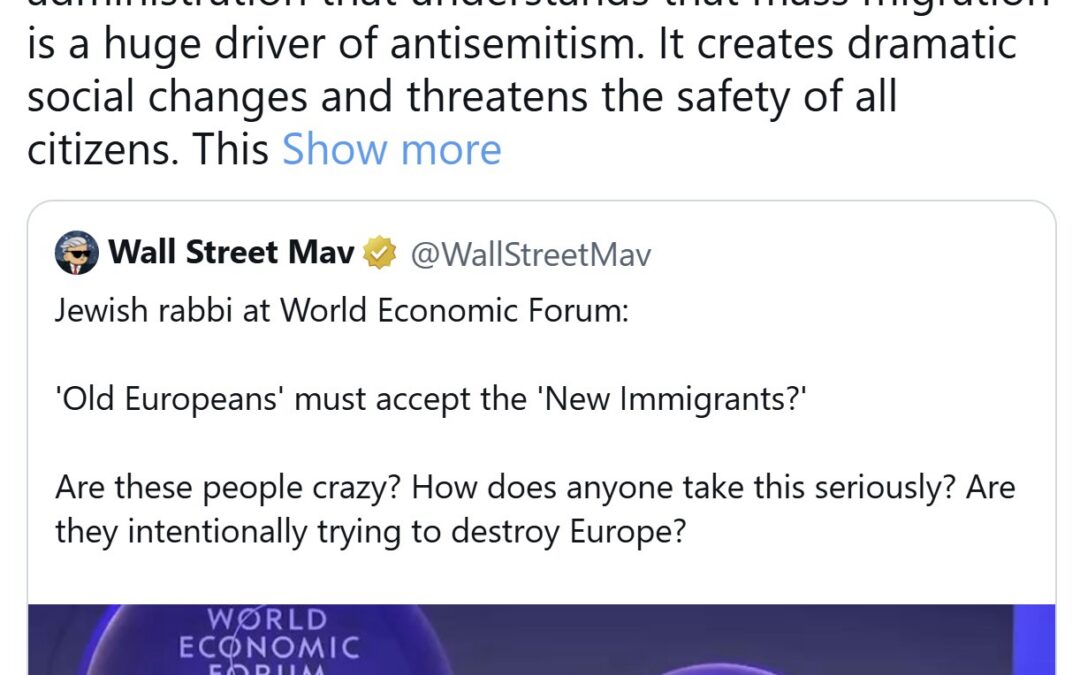
A public disagreement at the World Economic Forum in Davos briefly turned a strategic problem into a personal spat. But the substance matters far more than the optics. Ambassador Rabbi Yehuda Kaploun, the U.S. State Department’s Special Envoy to Monitor and Combat Antisemitism, castigated European Jewish leader Rabbi Pinchas Goldschmidt after Goldschmidt’s Davos remarks were interpreted—by some—as blaming “old Europe” for rising antisemitism. Goldschmidt issued a clarification, rejecting the quote attributed to him and stressing that antisemitism in Europe comes from multiple directions: the far right, the far left, and radical Islam.
The temptation—especially across the Atlantic—is to treat this as a familiar ideological argument: migration versus “European culture,” security versus values, right-wing versus left-wing. That framing is not only reductive; it is dangerous. Because the point European Jews live with every day is precisely that antisemitism is no longer a single-stream phenomenon. It is cumulative, mutually reinforcing, and increasingly normalized.
And that is why, underneath the Davos friction, both Kaploun and Goldschmidt are right—but not in the narrow way their dispute implied.
Who the two protagonists are—and why their dispute resonated
Ambassador Rabbi Yehuda Kaploun is the U.S. Special Envoy to Monitor and Combat Antisemitism, a State Department position tasked with leading U.S. diplomatic engagement on antisemitism worldwide. In the public exchange at issue, Kaploun argued that “mass migration” is a major driver of antisemitism and that the social changes tied to it threaten the safety of Jews and others. He framed the problem as one Western leaders must confront with clarity rather than euphemism.
Rabbi Pinchas Goldschmidt is President of the Conference of European Rabbis (CER), an institution representing rabbinic leadership across Europe and, in practice, one of the most direct conduits for what Jewish communities experience on the ground—security threats, school protection, shrinking public space for visible Jewish life, and the creeping normalization of anti-Jewish rhetoric. In his response to the controversy, Goldschmidt stressed that he was not blaming “old Europe” and that his message was about a multi-front threat: far-right, far-left, and radical Islamist antisemitism.
These roles matter. Kaploun speaks from the vantage point of statecraft and national security. Goldschmidt speaks from the daily operational reality of keeping Jewish communities functioning. They are not merely debating ideas; they are describing different parts of the same battlefield.
European Jews face a double dose—and it is getting worse
European Jews do not experience antisemitism as a partisan talking point. They experience it as a layered environment:
- A deep European inheritance of antisemitism—cultural tropes, conspiracy reflexes, historical scapegoating—never fully extinguished, only periodically suppressed.
- A newer accelerant: the importation of Middle Eastern conflict narratives, including antisemitic elements embedded in Islamist propaganda ecosystems, into European streets and online spaces—often in parallel with rapid demographic change and patchy integration.
That is the “double dose.” And it produces something uniquely corrosive: Jews are targeted not only as “the eternal European other,” but also as proxies for Israel in a conflict they did not start and cannot end—while being told that naming either dynamic is “divisive.”
Kaploun is correct that Europe cannot meaningfully address antisemitism if it refuses to talk about the role that poorly managed migration, integration failures, and the importation of extremist ideologies can play in intensifying anti-Jewish hatred.
Goldschmidt is correct that Europe cannot meaningfully address antisemitism if it pretends the continent’s own ideological currents—especially on the far right and far left—are not central drivers.
Where the real diagnosis begins is understanding how these streams now interact.
The uncomfortable evolution: Europe’s far-right antisemitism didn’t disappear—it changed clothes
A central mistake in today’s European debate is the assumption that antisemitism is neatly mapped onto one political camp. It is not. The more unsettling truth is that old far-right antisemitic tropes have become “salonfähig” by mutating into new, socially acceptable vocabularies, particularly in certain segments of the cultural and political left.
This is not a claim that “the left is antisemitic.” It is a claim about how antisemitism adapts. Europe’s most durable hatreds survive by laundering themselves through the moral language of the age.
What does that laundering look like?
- Classic antisemitic narratives of hidden power reappear as “anti-colonial” certainty: Jews (or “Zionists”) as uniquely illegitimate, uniquely malevolent, uniquely manipulative—an exception carved out from every other anti-racism instinct.
- Old conspiratorial thinking reappears as “systems analysis,” where any Jewish visibility in finance, media, academia, or politics is treated as proof of an omnipresent “lobby” or “network.”
- The ancient charge of collective guilt reappears as political morality: European Jews asked to answer for Israel as a condition of social acceptance, or threatened with exclusion if they refuse.
This is not “criticism of Israel.” Criticism of any government is legitimate. The problem begins when criticism becomes a permission structure: when it creates a moral loophole through which people feel entitled to recycle antisemitic stereotypes—now framed as righteous activism.
And once antisemitism is granted that moral cover, it becomes “respectable.” That is what salonfähig means in this context: not that antisemitism is openly applauded, but that it can be expressed without immediate social sanction—because it is packaged as progressive virtue.
The political accelerant: when electoral logic rewards denial
Here is where the user’s point is not only provocative; it is operationally important.
In parts of Europe, some politicians on the left have strong incentives to underplay, rationalize, or compartmentalize antisemitism that emerges from Islamist milieus, because confronting it risks alienating electoral constituencies and activist networks. At the same time, those same politicians may amplify rhetoric that aligns with “anti-imperialist” framing, which can—intentionally or not—provide rhetorical fuel to the most aggressive anti-Jewish narratives circulating in those milieus.
This is not primarily about ideology. It is about electoral calculus and the management of coalition politics:
- Downplay antisemitism in immigrant-origin communities by calling it “anger,” “trauma,” or “legitimate protest.”
- Treat Jewish anxiety as overreaction or political manipulation.
- Place Jews into the “privileged” category in a simplistic oppressor/oppressed worldview, making them ineligible for empathy.
- Redirect the moral spotlight away from antisemitic incidents to avoid intra-coalition conflict.
The result is a political environment in which Jews are asked, implicitly or explicitly, to accept diminished security and diminished dignity as the price of social cohesion.
And it is here that Kaploun’s point about migration becomes sharply relevant—not as a condemnation of immigrants, but as a critique of state failure: when integration is weak and radical networks are tolerated in the name of multicultural quiet, antisemitism finds new vectors. When politicians refuse to confront those vectors, the state’s monopoly on moral authority erodes.
The “woke” dilemma: a moral framework that can misclassify Jews
The modern “woke” environment—understood as a strong cultural emphasis on identity, power hierarchies, and victimhood status—can unintentionally enable antisemitism because it often struggles with Jewish identity.
Jews do not fit neatly into the framework:
- Jews are a minority with a long history of persecution, but are sometimes perceived as “white” or “successful,” and therefore coded as “powerful.”
- Antisemitism is not always experienced as a straightforward racialized hatred; it frequently operates through conspiracy and “anti-elite” rhetoric—making it harder for simplistic anti-racism toolkits to detect.
- Zionism becomes a proxy battlefield where nuance collapses into moral absolutism.
When that framework dominates institutions—universities, NGOs, parts of media, parts of cultural life—the risk is not only that antisemitism goes unchallenged. The risk is that antisemitism is reframed as justice, and Jews are recast as the obstacle to progress.
That is how old European antisemitism can migrate from the far right into new ideological homes—without losing its essential features.
Imported Islamist antisemitism: not “Islam,” but political Islam and radicalization ecosystems
To be analytically serious, terminology matters. The issue is not “Islam” or “Muslims.” The issue is political Islam and Islamist radicalization ecosystems that embed antisemitism in their worldview and propaganda: Jews as metaphysical enemies, conspiracy narratives about Jewish control, and a sacralization of conflict.
When large-scale migration is combined with:
- ghettoization and segregation,
- weak civic integration,
- transnational online propaganda,
- and foreign funding or influence networks,
then antisemitism can become normalized within certain peer environments, particularly among youth whose identity formation is shaped by grievance narratives.
This is the accelerant Kaploun is pointing to. If European governments cannot control borders, enforce integration expectations, and dismantle radical networks, Jewish communities will continue to bear a disproportionate share of the consequences.
The perfect storm: why the crisis feels “unliveable” to many communities
European Jewish communities are not confronting one threat. They are confronting a convergence:
- Economic insecurity that amplifies scapegoating politics and conspiracy thinking.
- Artificial intelligence and algorithmic media that scale hatred, misinformation, and intimidation at near-zero cost.
- A revival of “old European” antisemitism that becomes salonfähig through coded language and mainstream laundering.
- Mass migration and social transformation that, when poorly managed, increases polarization and facilitates extremist subcultures.
- Imported conflict narratives and political Islam that intensify anti-Jewish targeting and blur the line between “protest” and harassment.
When these forces combine, the outcome is predictable: more security costs, more fear, more emigration, fewer visible Jews, and a shrinking civic space for normal Jewish life. You do not need a formal expulsion to achieve de facto exclusion. You only need a sustained climate of intimidation and abandonment.
The asylum question: if Britain is discussed, what about everyone else?
That is why Robert Garson’s reported suggestion—raising the idea of asylum for British Jews—lands like a warning siren even if it never becomes policy.
Because the deeper question is not “Will the U.S. take British Jews?” The deeper question is: what does it mean for Europe’s democracies if Jewish citizens begin to contemplate exit as a rational safety strategy? And if such talk attaches to the UK—a country that sees itself as stable—then what does that imply for communities in France, Belgium, Germany, Sweden, and elsewhere, where the everyday experience for many has already shifted toward precaution and concealment?
In a healthy democracy, the asylum conversation would be unthinkable—not because Jews don’t deserve options, but because the state would be delivering normalcy as a baseline.
So who is right—Kaploun or Goldschmidt?
Both. And the error is to force a choice.
- Kaploun is right that migration at scale, if poorly controlled and paired with weak integration and tolerance of extremist ideology, can materially increase antisemitic risk.
- Goldschmidt is right that antisemitism is multi-front: far right, far left, and radical Islam—and that mis-framing it as a single-cause phenomenon only guarantees failure.
But here is the synthesis Davos inadvertently revealed:
Europe’s antisemitism problem is no longer additive; it is multiplicative. Old European antisemitism is being made socially acceptable in new ideological packaging, while imported Islamist antisemitism is being weaponized in the street—and too many politicians, including on the left, are treating Jewish safety as negotiable because confronting certain sources of hatred is electorally inconvenient.
That is not merely a Jewish crisis. It is a civil order crisis.
If Europe cannot protect the normal public life of Jews—without euphemism, without ideological filtering, without sacrificing truth for coalition management—it will not be protecting liberal democracy. It will be proving that liberal democracy has already begun to hollow out.



Receive Breaking News
Sign up for our newsletter and stay up to date! Be the first to receive the latest news in your mailbox: