
This is the central argument through which Europe’s political transformation should be understood. Before voters embrace radical answers, many have already concluded that something fundamental is wrong. Their financial security has weakened, their surroundings have changed, and the institutions meant to represent them appear unable—or unwilling—to respond.
Extreme narratives give those experiences an explanation. They identify a culprit, promise a remedy and turn private frustration into collective political action. Once established, they can intensify division. But treating them simply as the original source of discontent confuses the expression of a problem with its underlying causes.
The mistake of established parties is often to challenge the voter’s chosen remedy without taking the diagnosis seriously. Calling a proposed solution dangerous does not make the suffering that produced demand for it disappear.
People become receptive to radical answers when conventional answers repeatedly fail to improve their lives.
Europe’s illness has multiple causes: expensive energy, insecure employment, unaffordable housing, strained public services, difficult migration management, cultural confrontation and declining confidence in political leadership. These problems interact, but they are not identical. No single policy can resolve them all.
Yet politics rewards the promise of a single cure. One movement blames migration. Another blames capitalism. Another blames Brussels, cultural progressivism, excessive taxation or insufficient public spending. Each selects part of the problem and presents it as the explanation for the whole.
The individual voter does something similar. Someone struggling to pay an electricity bill may diagnose an energy-policy failure. A parent unable to secure a school place may see failed migration management or public underinvestment. A business owner facing rising costs may blame taxation and regulation. A person uncomfortable with institutional demands about language or identity may identify cultural coercion.
Their experiences differ, but their conclusions can converge: the existing political order is no longer protecting them.
This is the environment in which the sovereign state is regaining its appeal. It offers an apparently clear answer to a complex problem: bring decisions closer to the citizen, restore national control and make government answerable to its own population.
For decades, globalisation and European integration promised that greater interdependence would make everyone more prosperous. International trade expanded markets and reduced the cost of many goods. European cooperation increased mobility and commercial opportunity.
Those benefits were real. But the same system also created channels through which crises could travel.
A financial shock abroad can affect domestic credit. A distant war can raise household energy bills. Disrupted shipping can increase food prices. Dependence on foreign suppliers can leave local businesses vulnerable to decisions taken elsewhere.
Globalisation distributed opportunity, but it also distributed exposure.
For many people, the balance is now experienced through risk. The advantages of trade have become familiar and almost invisible. Its disruptions arrive suddenly and demand immediate sacrifices.
A household does not calculate the lifetime economic benefit of the single market when deciding whether it can afford heating. It compares this month’s bills with this month’s income. When that calculation deteriorates repeatedly, the political promise of integration loses credibility.
The conflicts in Ukraine and the Middle East have made this vulnerability especially visible. Europe’s dependence on imported energy connects military events outside the EU to the price of transport, food, manufacturing and domestic electricity.
Businesses facing higher costs must absorb losses, raise prices, postpone investment or reduce expenditure. Governments must respond to demands for assistance while financing defence and servicing public debt.
The result is an increasingly difficult relationship between national economic statistics and individual reality. An economy can grow while a substantial number of households feel that their prospects are shrinking.
People judge prosperity by what they can afford and what future they can imagine, not simply by what governments announce.
European integration has also linked migration responsibilities across countries. External borders, asylum rules and arrangements for sharing assistance mean that decisions in one part of Europe can affect another.
That cooperation can help governments manage pressures they could not easily handle alone. But where implementation fails, citizens may experience integration as a transfer of obligations without a corresponding increase in their ability to influence decisions.
Migration does not explain every housing shortage or overstretched public service. Planning failures, underinvestment and labour shortages also matter. Nevertheless, when migration interacts with those weaknesses, it can become the most visible explanation for a much broader failure.
Here again, a societal illness with multiple causes produces demand for a single cure. Closing borders becomes, for some, a proposed answer to problems that also require housing construction, public investment and institutional reform.
Dismissing those voters as irrational is politically ineffective. Their explanation may be incomplete, but the pressure they experience can be real.
The same mechanism operates in the culture war.
The identity politics commonly described by critics as “woke” can be experienced as a demand to accept new rules governing language, education, gender and national identity. Supporters may understand these changes as inclusion. Opponents may experience them as institutions prescribing beliefs and restricting legitimate disagreement.
The nationalist right turns that discomfort into a wider diagnosis: the governing establishment has become detached from the people whose lives it seeks to reshape.
When cultural unease coincides with financial insecurity, this explanation becomes more persuasive. Citizens can feel that they are being asked to accept both a lower standard of living and a diminished say over the values shaping their society.
The political reaction grows strongest when people believe they are losing economic security and personal autonomy at the same time.
Europe’s emphasis on military preparedness adds another layer.
Conflict gives political leaders visibility and authority. Summits, defence commitments and appeals to national resolve place them at the centre of events. A wartime atmosphere can also encourage the suggestion that questioning government policy means failing to recognise the seriousness of the moment.
The security threat is real. Russia’s war against Ukraine has particular significance for countries close to Russia, including Estonia, Finland and Poland. Their citizens have strong reasons to regard collective defence as a direct national interest.
But a genuine threat does not guarantee agreement about every response. Governments still need to explain the purpose, cost and limits of the sacrifices they request.
For many EU citizens, the fighting is on European soil but outside EU territory. The danger may feel indirect, while the economic consequences are immediate. They encounter the conflict through bills, taxes, spending decisions and anxiety about the future.
A citizen can oppose aggression while questioning whether a particular policy is effective or affordable. If political leaders refuse to recognise that distinction, they risk converting uncertainty into distrust.
The more politicians demand sacrifice without demonstrating its practical benefit, the greater the distance can become between their ambitions and their voters’ lives.
Citizens are capable of solidarity. But solidarity becomes harder to sustain when burdens appear unlimited, unfairly distributed or disconnected from an achievable objective.
The voter’s diagnosis then changes. The problem is no longer understood only as war, inflation or migration. It becomes a failure of representation: those exercising power seem to inhabit a different reality from those paying for their decisions.
Europe’s coming elections will test how widely that conclusion has spread.
Bulgaria holds its presidential election on October 25, 2026, with a possible second round on November 1.
Spain holds its parliamentary election on November 29, 2026.
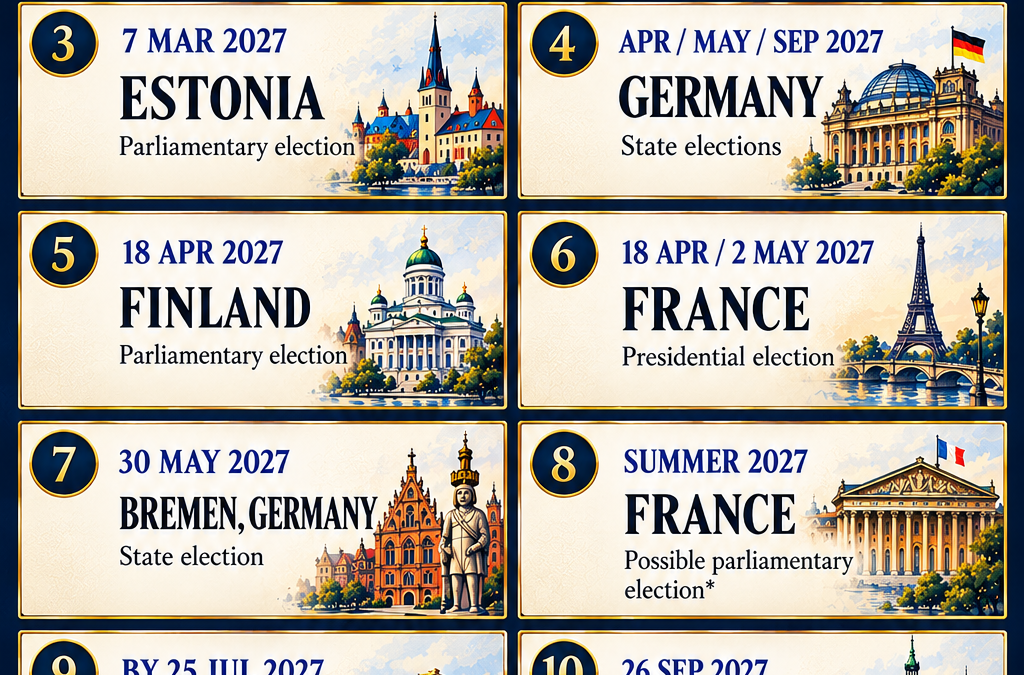
Estonia holds its parliamentary election on March 7, 2027.
Finland holds its parliamentary election on April 18, 2027.
France holds its presidential election on April 18 and May 2, 2027.
Germany holds state elections in Schleswig-Holstein and Saarland on April 18, 2027, North Rhine-Westphalia on April 25, Bremen on May 30, and Lower Saxony, or Niedersachsen, on September 26.
France could also hold parliamentary elections in summer 2027, following a dissolution. Without an early vote, its regular parliamentary election remains scheduled for 2029.
Greece is expected to hold parliamentary elections by July 25, 2027.
Poland and Slovakia are expected to hold parliamentary elections in autumn 2027.
Italy is expected to hold parliamentary elections by December 2027.
These elections will not all produce the same response. National circumstances matter. Proximity to Russia may strengthen demand for collective security. Economic performance, political credibility and coalition possibilities will shape each result.
Nevertheless, the common pressure is clear: governments will be judged on whether cooperation beyond national borders delivers protection within them.
Spain will test the possibility of a governing majority involving the conventional right and Vox. France will test whether the nationalist right can win the presidency. Italy will test the durability of Giorgia Meloni’s leadership, while Poland will test competing approaches to sovereignty and European cooperation. Germany’s state elections will influence federal authority even though they cannot directly remove the chancellor.
My forecast is that, by the end of 2027, Europe could be politically dominated by governments led by, dependent on, or increasingly shaped by the nationalist and far right.
That remains a forecast, not a certainty. Nor would it require an extreme-right government in every country. Established parties can adopt the priorities of their challengers. Coalition partners can turn limited electoral support into substantial policy influence.
The cumulative result could be a Europe that retains its institutions while changing its political purpose: more national discretion, more resistance to shared obligations and less willingness to transfer further authority to Brussels.
Across the Atlantic, the American midterm elections on November 3, 2026, will test the continuation of the counterreaction associated with President Trump.
The same diagnostic struggle is present. Different voters explain their dissatisfaction through economic inequality, migration, cultural coercion, institutional distrust or restrictions on personal freedom. Political movements compete to make one explanation dominant.
If Democrats move further into divisive cultural politics, they risk confirming the diagnosis of voters who believe that ideological demands have displaced concern for ordinary life. The deeper they descend into the culture war, the easier it becomes for opponents to present themselves as defenders of personal autonomy.
Republicans, however, must also demonstrate that their remedy works. Opposition to cultural progressivism does not itself lower prices or improve public services. A counterreaction can win an election and still fail to treat the conditions that brought it to power.
This is the central limitation of every single-cure political movement. National sovereignty can restore clearer responsibility, but it cannot by itself produce affordable housing, reliable energy or competent administration. Removing a constraint does not guarantee the wisdom of the decisions that follow.
The danger for established parties is to ignore the illness. The danger for their challengers is to mistake electoral victory for a cure.
Extreme narratives gain power when they make private suffering intelligible. They retain power only if they can turn that explanation into a better life.
Europe’s choice is therefore deeper than integration or sovereignty. It concerns whether political institutions can recognise the different causes of public dissatisfaction and respond with results that citizens can actually feel.
If they cannot, voters will continue searching for the one decisive remedy. And the sovereign state—visible, familiar and directly answerable at the ballot box—will increasingly be the remedy they choose.



Receive Breaking News
Sign up for our newsletter and stay up to date! Be the first to receive the latest news in your mailbox: