
That is the central lesson of the Mamdani moment. The meaning of Zohran Mamdani’s rise is not simply that a radical progressive could win in New York. The meaning is that he could do so in the city with the largest Jewish population in the United States, after October 7, after the explosion of anti-Israel activism, after Jewish students were intimidated on campuses, after hostage posters were torn down, after slogans that many Jews experience as eliminationist became fashionable in the streets, and after major Jewish organizations repeatedly warned that anti-Zionism was turning into open hostility toward Jewish communal life.
New York still has Jewish money, Jewish lawyers, Jewish philanthropists, Jewish schools, Jewish institutions, Jewish voters, Jewish cultural visibility, and Jewish access. What it no longer has is coherent Jewish political power.
That difference is everything.
The 2023 UJA-Federation Jewish Community Study found that New York City’s Jewish population stood at around 960,000, with about 412,000 more Jews in Westchester and Long Island. In demographic terms, Jewish New York remains enormous. But demography is not power. Wealth is not power. A gala dinner is not power. A photograph with a governor is not power. A meeting with a senator is not power. Power is the ability to shape candidate pipelines, punish political betrayal, organize voters, define civic language, protect young Jews, and make politicians understand that Jewish security is not a ceremonial matter but a political condition.
That is what has collapsed.
Mamdani’s election exposed the weakness of a Jewish establishment that mistook access for influence. Reuters reported after the election that roughly two-thirds of New York City’s Jewish vote went to Andrew Cuomo, while Mamdani nevertheless won the race and exposed a split between traditional Democratic Jewish voters and younger progressive currents. The point is not only that many Jews opposed him. The point is that their opposition was not enough. A community can be large, anxious, and active, yet still politically ineffective if it is divided, reactive, and institutionally outdated.
For decades, American Jewish leadership relied on elite brokerage. That model worked in a specific historical environment: postwar sympathy, Holocaust memory, bipartisan support for Israel, strong Jewish participation in Democratic politics, and the old New York machine. Jewish leaders could call mayors, governors, senators, university presidents, editors, donors, and police commissioners. They had access, and access looked like power.
But the new political generation is not governed by the old rules. It is governed by turnout, digital mobilization, ideological purity, street pressure, resentment politics, and the ability to connect local grievances to global narratives. The radical left learned to connect rent, race, policing, capitalism, Gaza, colonialism, and Zionism into one emotional structure. Jewish institutions answered with statements, panels, legal letters, and fundraising appeals. One side built a movement. The other preserved a network.
This is why New York matters for the rest of America.
If anti-Zionist politics can win in New York, it can win anywhere inside the Democratic urban machine. Progressive candidates in Boston, Chicago, Los Angeles, Philadelphia, Detroit, Minneapolis, Seattle, San Francisco, and Washington will read the lesson carefully. They will conclude that Jewish donors can be bypassed, Jewish organizations can be denounced, Jewish voters can be split, and support for Israel is no longer a necessary credential for advancement inside progressive politics.
The result will not be an overnight abandonment of Jews by the Democratic Party. It will be something more subtle and more dangerous. Jewish concerns will be recoded as donor anxiety. Zionism will be treated as a form of privilege. Support for Israel will become a liability in primaries. Anti-Jewish intimidation will be acknowledged only when it comes from the far right, while anti-Jewish hostility from the left will be explained away as “solidarity,” “decolonization,” or “youth activism.”
That is how political marginalization begins. Not with formal exclusion, but with a new permission structure.
Nor should Jews believe that the right automatically offers a complete refuge. Some Republicans will defend Israel sincerely. Some will court Jewish voters seriously. But the conspiratorial right has its own ancient poison: “globalist” fantasies, replacement theories, financier myths, and suspicion of liberal Jewish influence. American Jews are therefore facing pressure from both sides: a radical left that increasingly treats Zionism as original sin, and a radical right that periodically rediscovers the oldest conspiracy theories in Western politics.
The statistics confirm that this is not hysteria. ADL reported that 2025 was the third-highest year for antisemitic incidents in the United States since it began tracking them in 1979, and also recorded a historic high in physical antisemitic assaults. That means American Jewish life is not merely uncomfortable; it is entering a period in which political hostility, cultural hostility, and physical insecurity are reinforcing one another.
Europe should be even more alarmed.
European Jewish communities have long depended indirectly on American Jewish political weight. The World Jewish Congress presents itself as representing Jewish communities and organizations in 100 countries around the world, while the European Jewish Congress says it was created to give a unified voice to Jewish communities across Europe. Formally, representation exists. Structurally, organizations exist. Diplomatically, meetings are held. But for many European Jews, the lived reality is different: representation often feels distant, elite, reactive, and insufficiently democratic.
This is not a call to destroy existing organizations. It is a call to admit that their existence is no longer enough.
The European Jewish Congress may speak in Brussels. The World Jewish Congress may speak internationally. National Jewish bodies may speak to their governments. The American Jewish Joint Distribution Committee has a historic humanitarian role and helped support the establishment of the European Council of Jewish Communities in 1968. The ECJC today describes itself as a non-political and non-denominational platform for strengthening Jewish life across Europe. These are useful functions. But they do not solve the central problem: European Jews lack a democratic, politically forceful, transnational representative body able to defend Jewish interests in a time of accelerating danger.
This gap has become intolerable.
The EU Fundamental Rights Agency’s latest major survey found that 96% of Jewish respondents had encountered antisemitism in the year before the survey. The survey was conducted before October 7, and the agency also collected evidence from Jewish umbrella organizations afterward, when many communities reported dramatic increases in antisemitic incidents. Europe is not merely witnessing isolated hatred. It is witnessing the normalization of anti-Jewish pressure in streets, universities, unions, cultural institutions, municipalities, media spaces, and political parties.
The danger is no longer limited to neo-Nazi vandalism or old Catholic antisemitism or Islamist violence. It is now legal, cultural, academic, electoral, and diplomatic. It appears in campaigns against Jewish religious practices. It appears in municipal boycotts. It appears in harassment of Jewish students. It appears in the demonization of Israel. It appears in the expectation that local Jews must answer for every decision of the Israeli government. It appears in the quiet transformation of Jewish visibility into Jewish vulnerability.
Since the Shoah, European Jewish life has been built on a promise: never again would Jews be left undefended in the face of political hatred. That promise is now being tested. Too many institutions still behave as if antisemitism is a problem to be commemorated, not a power structure to be confronted.
The post-2015 migration crisis made the situation worse, not because all immigrants are hostile to Jews, and not because immigration itself is the enemy. That would be false and unjust. Many immigrants came to Europe to work, to live peacefully, to educate their children, and to escape violence. But Europe’s political class underestimated the ideological dimension of integration. Angela Merkel’s “Wir schaffen das” was presented as a moral and historical challenge that Germany could overcome; in 2015 and 2016, around 1.1 million people applied for asylum in Germany. The failure was not compassion. The failure was the assumption that material welfare would automatically produce loyalty to liberal democracy.
A destructive mentality entered the Western bloodstream: not the will to live as well as people lived in the West, but the will to make the West morally ashamed of itself, politically weaker, and culturally more submissive. This mentality is not limited to immigrants. It exists also among native-born radicals, academic activists, anti-capitalist ideologues, and political Islamists. But migration without serious integration gave it new social terrain.
The old immigrant dream was aspiration: to build, to study, to work, to rise, to join, to contribute. The new destructive politics is accusation: the West is guilty, wealth is theft, success is oppression, Israel is colonial, Jews are privileged, and equality means taking from those who are envied rather than building anything better.
That mentality destroys both the American dream and the European welfare state. The American dream depends on aspiration. The European welfare state depends on solidarity. Both collapse when resentment replaces responsibility. And when societies become resentful, Jews are always in danger. Jews are accused of having too much, influencing too much, defending themselves too much, remembering too much, succeeding too much, and caring about Israel too much.
This is where political Islamism and extreme-left ideology find common cause.
Not Islam as a religion. Not Muslims as people. The threat is political Islamism as a power project, allied with an extreme left that has replaced economic justice with civilizational revenge. One side brings religious absolutism and anti-Zionist obsession. The other brings anti-capitalist resentment and academic vocabulary. Together, they turn Israel into the master symbol of evil and Jews into the local representatives of that evil.
This alliance does not need to control the world to endanger Jews. It only needs to dominate activist spaces, universities, unions, city councils, media narratives, cultural institutions, and party primaries. New York shows how such a coalition can move from street language into electoral power.
That is why the diminished political weight of American Judaism is not only an American crisis. It is a diaspora crisis.
If Jewish influence can weaken in New York, then Jews in Paris, Brussels, Antwerp, Berlin, Malmö, Amsterdam, London, Budapest, Warsaw, Kyiv, and the Baltic states cannot assume that old structures will protect them. If Jewish institutions in America cannot make Jewish vulnerability politically decisive in the city most associated with Jewish life outside Israel, then European Jewish communities must stop waiting for rescue from American prestige.
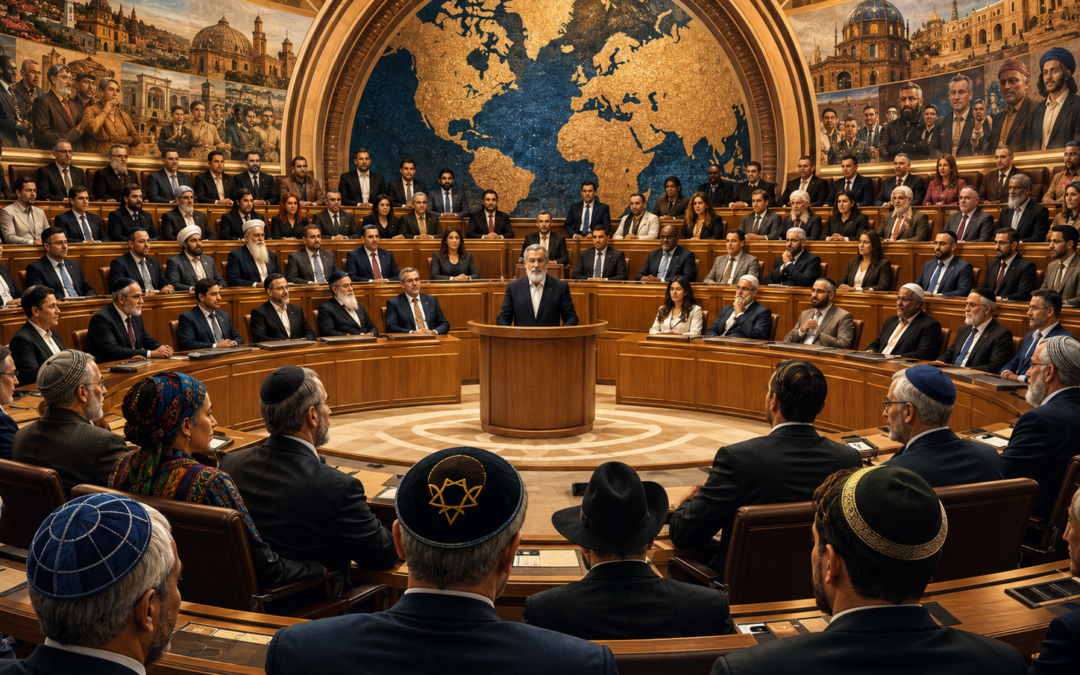
The answer is the creation of a new Diaspora Jewish Forum.
This body must not be another elite organization claiming superiority over existing Jewish institutions. It must not be built as a rival vanity project. It must not become a club of donors, presidents, and professional representatives speaking over the heads of ordinary Jews. Its legitimacy must come from democratic representation.
The new forum should include the United States, Western Europe, Eastern Europe, the Balkans, the Baltics, Ukraine, Britain, and other diaspora communities willing to participate. It should include religious Jews and secular Jews, Orthodox, Conservative, Reform, traditional, cultural, Zionist, and non-institutional Jews. It should include students, young professionals, rabbis, community leaders, security experts, legal advocates, educators, and political strategists. Women and young Jews must not be decorative. They must hold power.
Its mandate must be political.
It should map threats. It should train candidates. It should prepare Jewish communities to intervene in local politics. It should defend religious freedom. It should coordinate legal action against antisemitic discrimination. It should monitor far-left and far-right parties. It should expose Islamist political entryism where it appears. It should challenge municipal boycotts. It should defend Jewish students. It should build media capacity. It should create rapid-response teams. It should coordinate lobbying in Washington, Brussels, London, Paris, Berlin, and national capitals across Europe.
Most importantly, it should measure success by outcomes, not ceremonies.
How many hostile laws were blocked?
How many Jewish students were protected?
How many candidates were trained?
How many politicians understood that attacking Jews carries a cost?
How many communities regained confidence?
How many alliances were built before the crisis came?
The relationship with the United States remains essential. American Jewish life still has unmatched resources, legal protections, philanthropic capacity, intellectual infrastructure, and political reach. But the relationship with Israel is even more essential. Israel is not an accessory to Jewish identity. It is not a diplomatic inconvenience. It is not a symbol to be hidden so that diaspora Jews may be tolerated. Israel is the final refuge built into modern Jewish history.
The Jewish Agency explains that eligibility for Aliyah is determined by Israel’s Law of Return, which allows Jews and their families to immigrate to Israel. That fact must shape all diaspora strategy. Jews should fight for strong, proud, safe lives in every country where they live. But they must never again build a political strategy that treats Israel as optional.
The new Diaspora Jewish Forum should therefore be unapologetically connected to Israel while remaining democratic enough to allow disagreement over Israeli governments and policies. Criticism of Israeli policy must remain possible. But denial of Jewish peoplehood, demonization of Jewish sovereignty, and the transformation of diaspora Jews into hostages of Middle Eastern politics must be treated as red lines.
The old diaspora model was built on memory, access, philanthropy, and elite reassurance. That model is no longer sufficient. The new model must be built on representation, discipline, political literacy, and organized pressure.
Jewish communities do not need more applause in rooms where everyone already agrees. They need leverage in rooms where decisions are made by people who do not care unless forced to care.
New York is the warning. Europe is the emergency. Israel is the refuge. The diaspora is the front line.
The Jewish world must stop confusing proximity with power and nostalgia with strategy. The bill has arrived. The answer is not despair. The answer is construction: democratic, transatlantic, Israel-connected, politically serious Jewish representation before it is too late.



Receive Breaking News
Sign up for our newsletter and stay up to date! Be the first to receive the latest news in your mailbox: