
There are dates that belong to the calendar, and dates that belong to memory. The seventh of October has become, irrevocably, the latter.
For Israel, for Jewish communities throughout the world, and for all people of good will who remember the victims of Hamas’s terrorist attacks of 7 October 2023, this day carries an absence that time cannot fill. Behind its two simple numbers lie names, faces, interrupted lives. There are families for whom remembrance is no annual observance, but the permanent condition of their days.
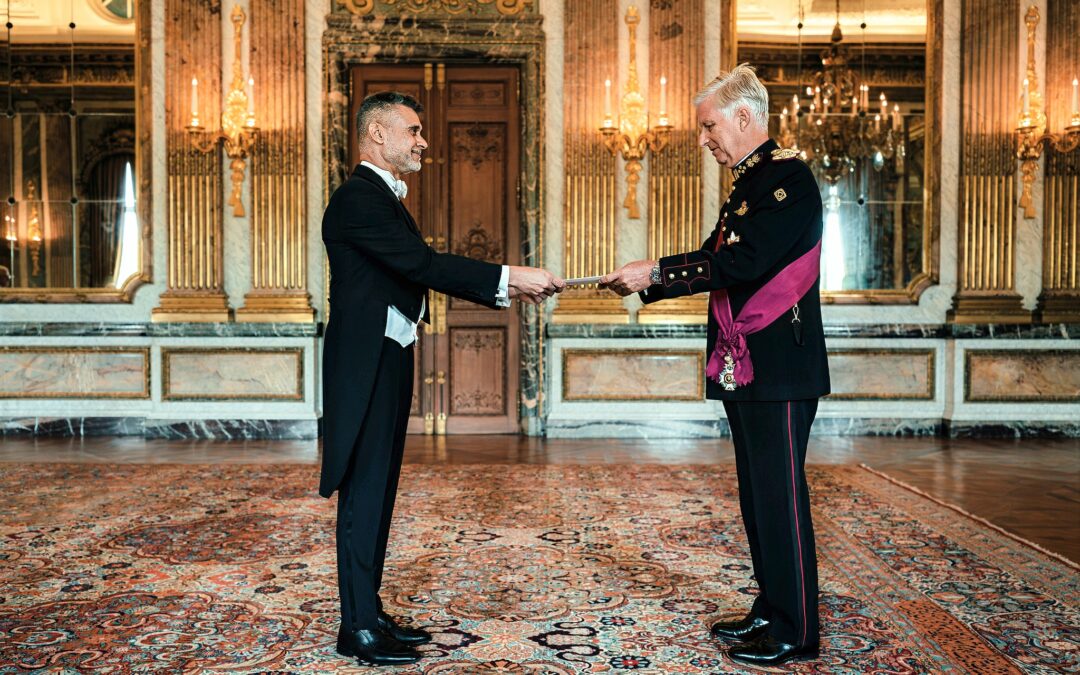
It was on this date that David Saranga, Israel’s ambassador to Belgium, presented his credentials to His Majesty King Philippe of the Belgians.
The Royal Palace’s press service informed us that presentations of credentials are arranged long in advance, according to the arrival of each ambassador in Belgium. The date assigned to the Israeli ambassador was therefore a coincidence, rather than a deliberate commemorative choice.
That explanation should be recorded faithfully. Yet it cannot exhaust the meaning of the occasion.
It is extraordinary that a date so deeply inscribed in contemporary Jewish consciousness could pass through the machinery of diplomatic scheduling without its significance apparently prompting reconsideration. A calendar can be organised months ahead; grief does not become less recognisable through advance planning. One might have expected the meeting of this ambassador and this anniversary to give pause.
Nevertheless, a coincidence can acquire a significance greater than the intention that produced it. History sometimes enters a room without having been invited.
On the third anniversary of the day Hamas sought to terrorise Israel through murder and abduction, Israel’s representative stood before the Belgian sovereign. On a day associated with the violent assault upon Jewish life, the diplomatic life of the Jewish state continued, formally and visibly, at the heart of Europe.
There is something profoundly moving in that continuity.
The presentation of credentials is a restrained ceremony. Its language is formal; its gestures are governed by custom. Yet beneath those conventions lies a substantial human achievement: nations maintaining a relationship through words, representatives and institutions. An ambassador arrives carrying the authority to speak for his country and the responsibility to listen to another.
On this particular day, those familiar gestures bore an additional weight. The letters could not answer the anguish of the bereaved. No royal audience could restore a murdered child or return a family to the life it had known before that morning. But the ceremony offered an image of a country continuing to speak, to engage, to claim its place among nations while carrying its dead in memory.
Belgium gives that image a particular resonance. Brussels is a centre of European political life. Antwerp is home to a Jewish community whose presence is woven visibly into the city’s streets and daily rhythms. Jewish life here has a public face: a child walking to school, a family preparing for Shabbat, a synagogue door opening onto an ordinary pavement.
That visibility is precious. It also places a responsibility upon the society around it. The freedom to live openly as a Jew must remain an ordinary freedom, requiring neither concealment nor exceptional courage.
For those communities, the arrival of a new Israeli ambassador has a meaning beyond diplomatic administration. It offers a point of contact with a country bound to their histories, their families and their sense of belonging. On 7 October, that connection inevitably touches a wound.
The anniversary also asks something of Europe’s moral language. Political disagreement does not relieve anyone of the duty to recognise an atrocity. Criticism of Israel must never become permission to threaten Jews, excuse their murder or demand that they answer collectively for the actions of a government. Whatever political vocabulary is used, the victims of Hamas deserve to be remembered as human beings, without qualifications attached to their mourning.
We need not attribute an unspoken message to the King, nor invent a commemorative intention that the Palace has expressly disclaimed. The symbolism exists in the conjunction itself: the ambassador, the sovereign, the date.
Perhaps this is what makes the occasion so affecting. Its significance was not composed in advance. It emerged from the encounter between an official calendar and a people’s memory.
On 7 October, David Saranga presented his credentials to the King of the Belgians. The ceremony belonged to diplomacy. The day belonged to the dead, to the survivors, and to everyone still trying to find words adequate to what happened.
For a moment, they occupied the same room.
And within that meeting was a quiet promise of continuity: remembrance carried forward by a living country, speaking in its own name.



Receive Breaking News
Sign up for our newsletter and stay up to date! Be the first to receive the latest news in your mailbox: