

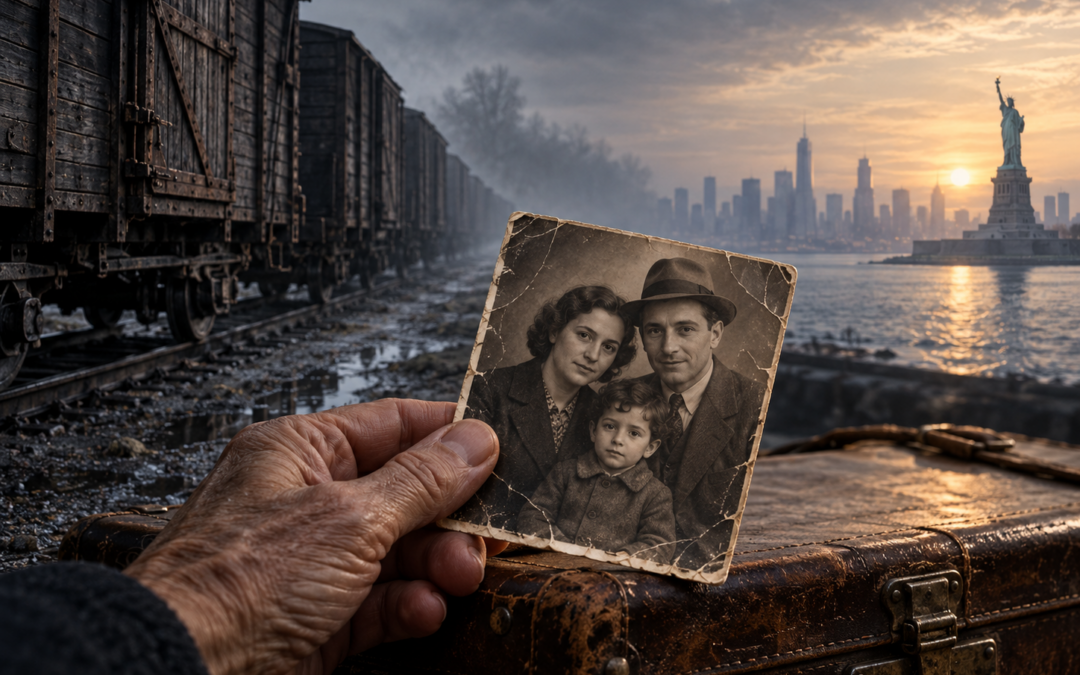
The Royal Society of Jewish Welfare founded the Nico Gunzburg Foundation with a specific purpose: to pursue accountability for the Belgian Railways’ role in wartime deportations and to seek the restitution of Nazi-looted art. The Foundation identifies this initiative as the starting point of its sustained campaign to make the railway company answer for its responsibility. It is now taking that campaign further, tracing American relatives and heirs of deportees and bringing the demand for justice before a wider international audience.
The campaign began with direct meetings and discussions with the Belgian Railways, SNCB/NMBS. The railway company subsequently referred the matter to the Belgian government, a move the Foundation regarded as an attempt to shift responsibility away from itself. The issue then entered a government and parliamentary process that ultimately led to the historical investigation conducted by CegeSoma. The Foundation insists that its original demand was for accountability and redress, not an indefinite succession of institutional referrals.
The formal chronology is documented. On 4 April 2019, the Chamber of Representatives approved a resolution calling for an investigation into SNCB’s role in the deportations. In January 2022, the Minister of Mobility and the President of the Senate commissioned CegeSoma to carry out the research. Historian Nico Wouters presented the report to the Senate on 8 December 2023. For the Foundation, the investigation supplied evidence that now requires action.
The central fact must be stated plainly: the Belgian Railways received payments for deportation transports. SNCB acknowledges this on its own website. The CegeSoma report describes a tariff system with a base rate of four pfennigs per person per kilometre, reduced by half for groups of 400 or more, applied to the special trains carrying Jews from Belgium, France and the Netherlands. Human beings being sent towards imprisonment and murder were counted, transported and charged for.
Financial records put the payments from the Mitteleuropäisches Reisebüro’s Brussels and Berlin offices at 50,713,457 Belgian francs during the occupation: more than 50 million francs. Using early-1940 purchasing power as the benchmark, that represents around €50 million in today’s money. These payments covered transports that included deportation trains. The scale of the money reinforces the Foundation’s demand for a serious reckoning. Financial redress must address the harm suffered by victims; it cannot be reduced to the reimbursement of railway receipts.
The surviving records do not permit every payment to be matched to an individual convoy. That limitation does not erase the acknowledged fact that payments were made. Nor does the existence of German occupation make the railway’s participation disappear. The Foundation’s case concerns the responsibility of an institution that helped carry out deportations and was remunerated for those services. The historical context must be examined fully; it must not become a permanent excuse for avoiding the consequences.
At the heart of the Foundation’s judicial campaign lies a clear principle: established wrongdoing must have consequences. Acknowledgement cannot be treated as the completion of justice while the question of redress remains unanswered. A report, an exhibition or a commemorative ceremony may contribute to remembrance. None, in the Foundation’s view, settles the claims of victims and their families. The purpose of its action is to obtain a judicial determination of responsibility and the remedies that should follow.
The Foundation regards its legal case as very strong. Its confidence rests on the documented operation of the transports, the evidence of payment and the suffering of identifiable victims. The action seeks to connect that record to enforceable legal responsibility. Historical findings do not themselves constitute a court judgment, and the defendants remain entitled to raise legal defences. But political reluctance to address compensation is no answer to the evidence. The Foundation intends to have that evidence tested in court.
Delay is itself central to the confrontation. The Foundation alleges that successive referrals and prolonged procedures amounted to a strategy of running down the clock until the few remaining survivors would no longer be alive to demand justice in person. This is the Foundation’s accusation about institutional conduct and motive, not a finding made by a court. Its urgency is nevertheless undeniable: survivors do not have the time available to ministries, committees and public companies.
For an elderly survivor, another postponement can mean losing the last opportunity to see responsibility acknowledged with tangible consequences. The Foundation refuses to accept a process in which institutions can repeatedly defer a decision while the people to whom they must answer disappear. The death of survivors must not be allowed to bring the demand for accountability to an end. Their families and lawful successors remain part of that demand.
The Foundation also condemns what it regards as anti-Jewish attitudes within a number of Belgian political parties. Its position is that neither political hostility nor electoral calculation should influence the treatment of Holocaust victims’ claims. The strength of a legal case must be assessed through evidence and law. A family’s right to seek justice cannot depend on whether its claim is politically convenient, or whether defending Jewish interests is fashionable in the politics of the moment.
The criticism extends to parts of the Jewish institutional establishment. The Nico Gunzburg Foundation received clear messages that some Jewish organisations with close government ties or public funding have opposed its efforts to protect their own institutional standing. It challenges that opposition openly: access to ministers and financial support must never take precedence over the interests of survivors and their families.
Such opposition has strengthened the Foundation’s determination. The Belgian government’s unwillingness to enter substantive negotiations with the Nico Gunzburg Foundation has driven the dispute into the courts and brought it to international attention. Direct dialogue between the parties could have eased tensions and opened the way to a negotiated solution. In the Foundation’s view, entrenched political resistance, fuelled in part by anti-Jewish sentiment among certain political forces, continues to obstruct that path. Reports of the Belgian proceedings in July 2026 described earlier discussions that had failed to produce an agreement and the Foundation’s readiness to pause proceedings if meaningful compensation talks resumed. Its position remains direct: the government and the railway can negotiate seriously, or face a campaign that continues through litigation and international scrutiny.
The American initiative gives that escalation a concrete purpose. The Foundation is actively tracing relatives and potential heirs in the United States whose parents, grandparents or other family members were deported from Belgium. Families that rebuilt their lives abroad must not be excluded from the search for redress because they now live beyond Belgium’s borders. The inquiry is extending the circle of people able to contribute evidence and have their legal position assessed.
The work begins with the transport lists held by Kazerne Dossin. Names, dates of birth, addresses and convoy numbers are being compared with Arolsen Archives records and files held by the Belgian State Archives, including its Archives Service for War Victims. Each identity is being checked carefully: a registration card alone does not establish deportation, and spelling changes must not lead to mistaken matches. The aim is to assemble documented individual histories that can support a serious legal assessment.
The Foundation is then following those histories into American records. The United States Holocaust Memorial Museum’s databases and International Tracing Service archive can help connect wartime persecution with post-war displacement. The Joint Distribution Committee’s emigration records provide further leads. Passenger manifests, naturalisation files and relevant court records are being used to identify migration routes, relatives and destinations in the United States. The search includes families who left Europe before the war as well as those who emigrated after liberation.
From there, genealogical research is establishing the links between generations. Census records, obituaries and family trees provide starting points; civil certificates and probate records supply evidence needed to assess family relationships and succession. The Foundation is distinguishing relatives who can contribute testimony from heirs or estate representatives who may be entitled to pursue particular claims. It is preserving documentary references and resolving discrepancies so that public appeals lead to credible files.
The Foundation is also preparing outreach through American Jewish communities, remembrance organisations and genealogical networks, with the families of Roma victims included in the research. Where cases meet the relevant criteria, specialist archival services and Red Cross tracing channels can assist. Families are being invited to contribute photographs, correspondence and other records, with private information handled discreetly. No family needs to possess a complete history before coming forward.
The international strategy requires legal precision. Finding an American heir does not automatically establish jurisdiction in a US court; sovereign immunity and other procedural requirements must be examined. The Foundation is assessing those questions while building evidence that may also support the Belgian proceedings and negotiations. The American search strengthens the reach of the campaign without prejudging which court or process can provide a remedy.
The Foundation’s demand is that Belgium confront the consequences of the history its own institutions have documented. The Royal Society of Jewish Welfare created the Nico Gunzburg Foundation to pursue that responsibility. It will not be satisfied by acknowledgement followed by further postponement. The Belgian Railways were paid for their part in the deportations. The victims and their families are entitled to demand that the question of responsibility be brought to a legal conclusion.



Receive Breaking News
Sign up for our newsletter and stay up to date! Be the first to receive the latest news in your mailbox: