
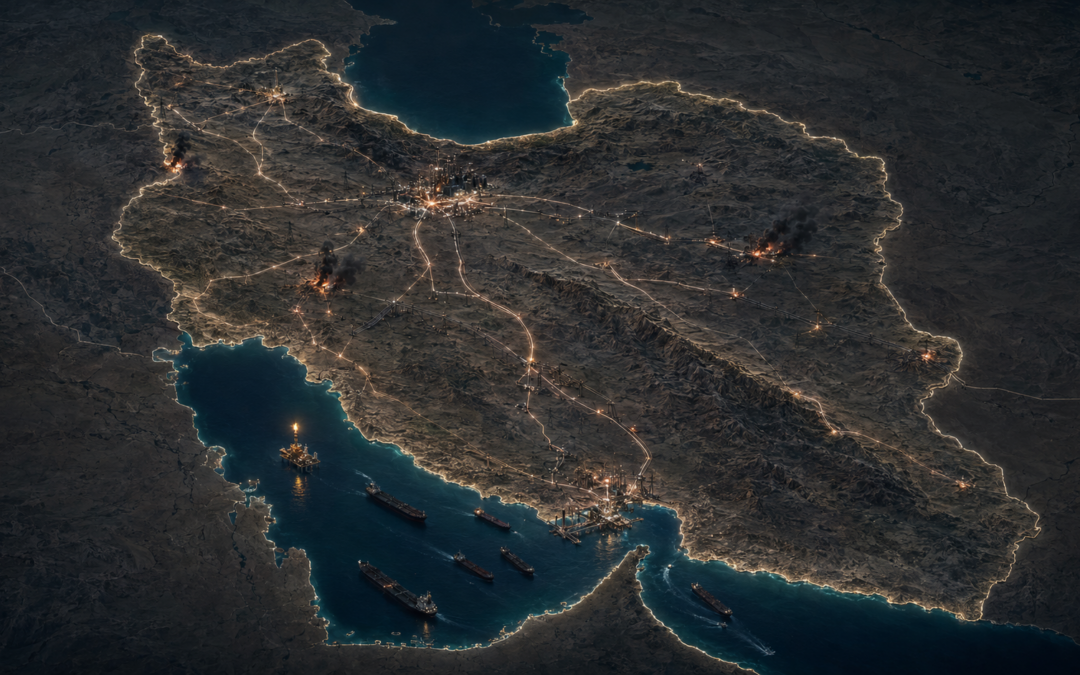
The Iran war has entered a broader and potentially decisive phase. What is new is not that Iranian leaders or economic assets have never been targeted, but the scale and systematic character of American pressure on Iran’s transportation arteries, military logistics, communications networks, ports and export flows.
The first phase of the campaign concentrated primarily on command centers, air defenses, missile and drone launch sites, naval capabilities and facilities belonging to the Islamic Revolutionary Guard Corps. Those targets remain important. On 19 July, United States Central Command said its latest strikes had hit Iranian command centers, communications networks, air-defense and coastal-surveillance sites, maritime capabilities, and missile and drone positions. Its publicly stated objective remains the degradation of Iran’s ability to threaten American forces and commercial shipping—not regime change.
Yet the operational pattern is clearly expanding. Recent attacks have included bridges leading toward Bandar Abbas, road and railway connections, a railway station, an airport and what CENTCOM described as “military logistics infrastructure.” A surveillance tower inside Chabahar port was also destroyed because Washington said it was being used by the Revolutionary Guard to monitor commercial vessels. Iranian authorities have additionally reported attacks on power infrastructure, although not every reported site has been independently confirmed by the United States.
This does not prove that Washington has formally adopted regime collapse as its war aim. Bridges, communications systems and port facilities can have direct military functions, particularly when they supply a naval base or support attacks on shipping. Nevertheless, strategy must be assessed not only through official declarations but also through the cumulative effects of target selection.
Destroying a missile launcher removes a weapon. Severing the roads, power, communications and financial flows supporting that launcher attacks the system capable of replacing and operating it.
The center of gravity is therefore moving from Iran’s individual military assets toward the wider machinery that allows the state to sustain military power. Transportation corridors connect production facilities with ports and military bases. Electricity supports communications, industry and administration. Ports provide access to supplies and export revenue. Oil income finances the security establishment, state salaries and Iran’s regional networks.
The practical effect—and increasingly plausible strategic purpose—is to raise the cost of governing until the regime must choose between financing the war, maintaining its coercive apparatus and preserving basic public services.
Washington’s renewed naval blockade reinforces this interpretation. The United States is not merely attacking Iranian forces; it is restricting traffic entering and leaving Iranian ports and intercepting vessels attempting to reach them. This places direct pressure on the commercial and fiscal foundations of the state, even where oil-production facilities themselves have not been destroyed.
Iran, meanwhile, is responding by widening the battlefield. Its attacks and threats against American forces and regional partners—including Qatar, Bahrain, Kuwait and Jordan—are intended to internationalize the cost of the war. Tehran cannot match American conventional air power. It can, however, threaten military bases, energy facilities, desalination plants and commercial shipping in the hope that Gulf governments, energy markets and international businesses will pressure Washington to stop.
This horizontal escalation is not necessarily evidence of imminent collapse. Iran continues to demonstrate coordinated military command and an ability to inflict damage. But it also reflects a narrowing range of strategic options. Unable to secure superiority over Iran itself, the regime is attempting to make the economic and political price of continuing the campaign unacceptable across the entire region.
The most consequential escalation threshold remains Kharg Island. The island handles approximately 90 percent of Iran’s oil exports and is therefore the Islamic Republic’s principal fiscal choke point. American forces previously struck more than 90 military targets on Kharg while deliberately preserving its oil infrastructure. A direct attack on the export terminal—or an attempt to seize the island—would represent a fundamentally different level of escalation.
Kharg is Iran’s fiscal choke point, but the Strait of Hormuz is the global energy choke point. The strait normally carries approximately one-fifth of global oil trade. On 19 July, only four vessels were recorded crossing it, down from eight the previous day. Brent crude consequently moved above $90 per barrel as markets began pricing the possibility of prolonged disruption. Inventories are already at their tightest level in five years.
A sustained interruption of Kharg’s operations, combined with continued restrictions in Hormuz, would transform the conflict from a regional war into a global energy, inflation and commercial-shipping crisis.
From an intelligence-assessment perspective, the structural risk of systemic failure inside Iran is now exceptionally high. War damage, disrupted transportation, declining export income, inflation, industrial shutdowns and pressure on state finances are gradually weakening Tehran’s administrative capacity. At the same time, the regime is using wartime conditions to intensify political repression, arrests and executions. An accelerated internal crackdown is visible.
State weakness, however, is not synonymous with regime collapse. Authoritarian systems can survive extraordinary economic hardship if their coercive institutions remain united, adequately supplied and convinced that their own survival depends upon preservation of the regime.
The decisive indicators will therefore not be the number of bridges or military facilities destroyed. They will be nationwide civil mobilization, visible fragmentation among political elites, declining loyalty within the Revolutionary Guard and Basij, security units refusing orders, failure to pay the coercive apparatus, loss of control over provinces and the emergence of a credible political alternative.
Those conditions have not yet fully converged. The Revolutionary Guard remains cohesive and may even strengthen its authority as civilian institutions weaken. An external attack can also generate nationalism and temporarily unite parts of the population around the state, even among citizens who previously opposed the Islamic Republic.
Before reaching a breaking point, Tehran will probably intensify repression, tighten communications, militarize major cities and prioritize the financing of its security institutions over civilian needs. It may simultaneously seek a limited diplomatic arrangement with Washington to obtain economic relief and buy time without abandoning its ideological foundations.
The long-term trajectory nevertheless points toward growing systemic instability. If military pressure, fiscal exhaustion, infrastructure disruption, nationwide public mobilization and fragmentation within the security establishment eventually converge, the Islamic Republic could enter its final phase.
Collapse would not necessarily begin with the dramatic fall of Tehran or the immediate disappearance of the regime. It could begin much earlier, when the government can no longer move fuel, pay institutions, maintain electricity, coordinate its provinces or enforce decisions beyond the centers still controlled by the Revolutionary Guard.
At that stage, the Islamic Republic might continue to possess weapons, offices and formal institutions. It might still appear intact from the outside. Yet in strategic terms, it would already have ceased to function as a viable governing system.
The war’s center of gravity is therefore moving from the missile launcher toward the machinery of the state. Whether Washington intends this pressure to produce negotiations, behavioral change or eventual regime failure remains uncertain. But the campaign is increasingly testing not merely Iran’s ability to fight—it is testing the Islamic Republic’s ability to survive.



Receive Breaking News
Sign up for our newsletter and stay up to date! Be the first to receive the latest news in your mailbox: