
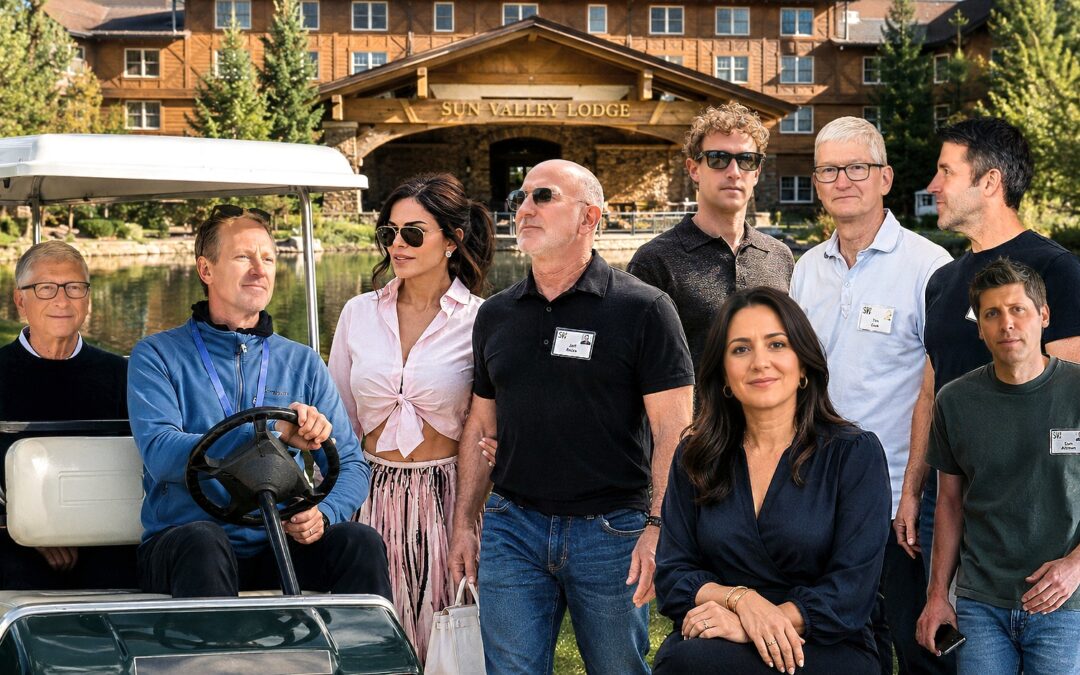
In the mountains of Idaho, the people who control artificial intelligence, global media, entertainment and vast pools of capital are confronting a question that may define the next economic era: who will produce the electricity needed to power the intelligence economy?
Every July, a small resort town in Idaho briefly becomes one of the most important centres of power in the world.
The Allen & Company Sun Valley Conference is routinely described as a “summer camp for billionaires,” but that description understates its significance. Summer camps are places of recreation. Sun Valley is a place where industries are reorganised, alliances are formed and the future direction of capital is quietly discussed.
Since 1983, the boutique investment bank Allen & Company has invited a carefully selected group of technology founders, media proprietors, financiers, political figures and entertainment executives to spend several days together at the Sun Valley Resort. The formal presentations are private. The discussions are off the record. Families may accompany the guests, while golf, hiking, lunches and evening receptions create an atmosphere in which conversations can move naturally from personal acquaintance to strategic cooperation.
That informality is precisely what makes Sun Valley powerful.
Davos is public, institutional and increasingly theatrical. Political leaders arrive with prepared speeches, companies rent branded pavilions and almost every conversation is designed to be reported. Sun Valley operates according to the opposite principle. Its influence comes from discretion. The name badges may be visible, but the substance remains behind closed doors.
It is Davos without the bureaucracy—and with considerably more concentrated private power.
The most consequential guest list in business
The 2026 gathering brings together an extraordinary concentration of economic influence.
Among the most prestigious attendees are Jeff Bezos, Mark Zuckerberg, Bill Gates, Apple chief executive Tim Cook, incoming Apple leader John Ternus, Alphabet chief executive Sundar Pichai, OpenAI chief executive Sam Altman, Anthropic chief executive Dario Amodei, Palantir chief executive Alex Karp and LinkedIn co-founder Reid Hoffman.
The media and entertainment establishment is equally well represented. The guest list includes figures associated with Disney, Netflix, Amazon, YouTube, Warner Bros. Discovery, Paramount, Comcast and the Murdoch media empire. David Ellison, Bob Iger, Josh D’Amaro, David Zaslav, Ted Sarandos, Greg Peters, Rupert Murdoch and other senior industry figures place almost the entire commanding structure of American media within walking distance of one another.
This is more than a gathering of wealthy individuals. It is a temporary parliament of private economic power.
The people at Sun Valley do not merely own companies. They control operating systems, cloud infrastructure, artificial-intelligence models, advertising markets, film studios, streaming platforms, newspapers, social networks and the investment capital required to connect all of them.
AI has turned an energy question into an economic question
The central subject in Sun Valley this year is likely to be artificial intelligence. But the real strategic question is no longer simply who has the best model, the most talented engineers or the largest collection of data.
The decisive question is now: who has the electricity?
Artificial intelligence is often presented as an immaterial technology—a world of algorithms, software and virtual assistants. In reality, AI is becoming one of the most physically demanding industries ever created. Every advanced model depends upon enormous data centres filled with specialised chips that require uninterrupted power, sophisticated cooling and direct access to reliable electrical grids.
The International Energy Agency expects American data-centre electricity consumption to increase by approximately 240 terawatt-hours by 2030, more than doubling from its 2024 level. Goldman Sachs has estimated that American data-centre power demand could rise from roughly 31 gigawatts in 2025 to 66 gigawatts in 2027.
The bottleneck is becoming visible. American utilities are struggling to secure transformers and other essential grid equipment, with some lead times extending beyond three years. Data-centre power requirements could reach approximately 110 gigawatts by 2030.
This changes the nature of the technology industry.
For two decades, the dominant companies were those that controlled information. In the coming decade, they may be those that can combine information with energy. The successful AI corporation will increasingly need to think like an electricity utility, an infrastructure developer and perhaps even a nuclear-energy company.
Sun Valley therefore sits at the intersection of two economies. The first is the digital economy created by Silicon Valley. The second is the heavy industrial economy needed to keep the digital economy alive.
The future of AI may depend as much upon turbines, reactors, transformers, gas pipelines, transmission lines and power-purchase agreements as upon software engineering. The technology leaders attending Sun Valley understand that the race for artificial intelligence is becoming a race for generating capacity.
America’s advantage is that these worlds can meet in the same place. The founder of an AI laboratory, the chairman of a media group, the owner of a cloud platform and the financier of a new power project can discuss their interests during the same afternoon.
That capacity for rapid coordination is one of the least understood sources of American economic strength.
A lodge designed for discreet power
The setting is not incidental.
Sun Valley Lodge opened in December 1936 as the centrepiece of what became America’s first destination ski resort. Built on the former Brass Ranch, it developed an early association with Hollywood, business and political society. Ernest Hemingway worked on For Whom the Bell Tolls there, while guests over the decades included figures such as Clark Gable, Lucille Ball and Frank Sinatra.
The Lodge combines mountain informality with carefully controlled luxury. It offers a 20,000-square-foot spa, a glass-enclosed outdoor pool, restaurants, lounges, event spaces, fitness facilities and suites designed to allow guests to remain within the resort’s protected social environment.
There are spacious Lodge Suites with granite entrances, wool carpets, large baths, walk-in showers and, in some cases, fireplaces separating the bedroom and sitting areas. Terrace Suites add private outdoor spaces and mountain views. Celebrity Suites commemorate figures such as Hemingway, Marilyn Monroe, Clint Eastwood and resort founder Averell Harriman, with separate parlours, fireplaces and private living areas.
The luxury is significant, but it is not ostentatious in the manner of Monaco or Dubai. Sun Valley’s aesthetic is deliberately restrained: stone, timber, mountains, discreet service and casual clothing.
A chief executive may appear in a polo shirt. A billionaire may walk to lunch rather than enter through a security convoy. Yet behind that studied simplicity are individuals whose decisions can move stock markets, redirect billions of dollars and determine which technologies reach hundreds of millions of people.
The casual clothing is not the absence of power. It is the confidence of power that no longer needs to advertise itself.
Why the presence of the media matters
The exceptional representation of media and entertainment companies this year deserves particular attention.
AI may be transforming production, but media still shapes legitimacy. Technology can generate information at unprecedented speed, yet human societies remain governed by stories: which developments are celebrated, which are feared, which conflicts are understood and which political positions are placed outside respectable debate.
The presence of virtually every major American media and entertainment organisation demonstrates that public opinion is not secondary to economic power. It is part of economic power.
The distinction between technology and media is also disappearing. Amazon owns a film studio and a streaming service. Apple produces television and film. YouTube is simultaneously a technology platform, broadcaster and cultural institution. Meta distributes news and political speech to billions. Netflix is not simply an entertainment company; it is one of the world’s most influential exporters of narratives and social values.
AI will accelerate this convergence. It will change how films are produced, how advertising is personalised, how newsrooms operate and how individuals discover information. It will also make the struggle over credibility far more intense.
This is why one attendee is especially interesting: Bari Weiss.
Bari Weiss and the revolt against ideological journalism
Weiss’s presence is important not because she controls a company comparable in scale to Amazon or Meta, but because she represents an intellectual tendency that much of the Western media tried to suppress and is now being forced to reconsider.
She is broadly associated with a politically centrist or centre-left tradition, but she rejects the ideological orthodoxies that transformed parts of progressive journalism. She is strongly pro-Israel, critical of identity-driven politics and resistant to the idea that journalism should serve as an instrument of ideological mobilisation.
In 2020, Weiss resigned from The New York Times after three years at the newspaper. Her resignation letter was not a conventional departure announcement. It was an indictment of a newsroom culture she believed had become intolerant of intellectual disagreement.
She argued that the newspaper had allowed social-media pressure and internal ideological conformity to influence editorial judgement. She described an environment in which colleagues who departed from fashionable positions could face hostility and public disparagement, while editors failed to defend genuine viewpoint diversity.
The most significant point in her letter was not personal. It was institutional.
A newspaper that sees itself as defending democracy cannot perform that function when it treats ideological disagreement as moral contamination. Journalism loses its authority when reporters begin with a political conclusion and then select facts that support it. It becomes especially dangerous when the profession claims neutrality while practising activism.
Weiss represented a refusal to accept that transformation.
Her subsequent success suggests that a large public exists between populist rage on the right and ideological conformity on the left. That public is politically homeless but intellectually substantial. It wants journalism that is liberal in the classical sense: open to argument, suspicious of concentrated authority, willing to challenge its own tribe and capable of defending Israel without apologising for doing so.
She is therefore a symbol of what is missing from much of today’s populist, woke-inspired left-wing journalism: intellectual courage, curiosity about opposing arguments and the willingness to risk professional status by dissenting from one’s own political environment.
Her presence at Sun Valley signals that media power is being recalibrated. The people who control American entertainment and information understand that public confidence in legacy journalism has weakened. They are searching for voices capable of reaching audiences that neither trust ideological progressivism nor want to surrender public debate to the most aggressive elements of the populist right.
Weiss occupies that space.
What Europe does not have
Europe has no comparable media figure with the same combination of access, independence, intellectual visibility and willingness to confront the ideological habits of her own political milieu.
European journalism contains excellent individual reporters. But its institutional culture is often narrower than it acknowledges. Public broadcasters and major newspapers frequently operate within a limited consensus on identity, immigration, Israel, the Middle East and the boundaries of acceptable political language.
Those who challenge that consensus are too easily categorised as right-wing, reactionary or socially unacceptable. The result is not healthier democracy. It is an intellectual vacuum.
When mainstream institutions refuse to accommodate heterodox but democratic voices, the audience does not disappear. It migrates toward more radical platforms. The exclusion of moderate dissent therefore strengthens the extremes it was supposedly intended to contain.
Europe needs a figure capable of speaking from within the liberal tradition while criticising the ideological deterioration of liberal institutions. It needs someone who can defend minority rights without converting every social disagreement into an identity conflict; someone who can oppose antisemitism without treating Israel as an embarrassment; and someone prepared to say that intellectual diversity is not an optional luxury but a condition of democratic survival.
Bari Weiss is not important because everyone must agree with her. She is important because she demonstrates that disagreement itself can become a viable media institution.
The true architecture of American supremacy
Sun Valley reveals something deeper about the United States.
America’s military strength is visible: aircraft carriers, overseas bases, nuclear weapons and defence budgets. Its economic strength is less theatrical but ultimately more pervasive.
It lies in the ability to assemble capital, technology, media, energy and entrepreneurial ambition within a single ecosystem.
At Sun Valley, the leaders building artificial intelligence can meet the investors financing infrastructure. The executives controlling global entertainment can meet those controlling distribution platforms. Media proprietors can speak with political strategists. Former officials can interact with corporate founders. Deals do not require years of intergovernmental negotiations. They can begin during a walk, a private dinner or a conversation beside a fireplace.
Europe can organise conferences. America organises power.
The European model remains fragmented among national governments, regulatory authorities, public broadcasters, energy policies and slow-moving institutions. The American model is more fluid. It allows ambitious individuals, private capital and technological institutions to converge rapidly around a new economic opportunity.
This does not make the American system morally perfect. Nor does it guarantee that the decisions made by concentrated elites will always serve the public interest. But it does explain why the United States repeatedly converts technological revolutions into economic dominance faster than its competitors.
The Sun Valley Lodge is therefore more than an exclusive hotel. For several days each year, it becomes a physical representation of the American operating system.
Inside its suites, lounges and meeting rooms are the people who control computation, capital, electricity demand, information and imagination. They are discussing not merely the next generation of companies, but the infrastructure of the next economic order.
Aircraft carriers demonstrate America’s capacity to project force.
Sun Valley demonstrates something even more powerful: America’s capacity to project the future.
And in the twenty-first century, that may be the greater form of superpower.



Receive Breaking News
Sign up for our newsletter and stay up to date! Be the first to receive the latest news in your mailbox: