
Starship Opens the Door to Space’s Industrial Age—and America Leaves Europe Far Behind
The dream is to reach the Moon and Mars. The nearer revolution is to turn Earth’s orbit into an industrial neighbourhood. As America builds the machinery for that transformation, Europe risks becoming a customer in an economy it should be helping to shape.
The most important cargo aboard a rocket does not always appear on its manifest. Sometimes, alongside the satellites and scientific instruments, it carries an idea capable of rearranging the world below.
Starship carries such an idea: that space need no longer be a destination reserved for exceptional expeditions, but somewhere business can operate routinely.
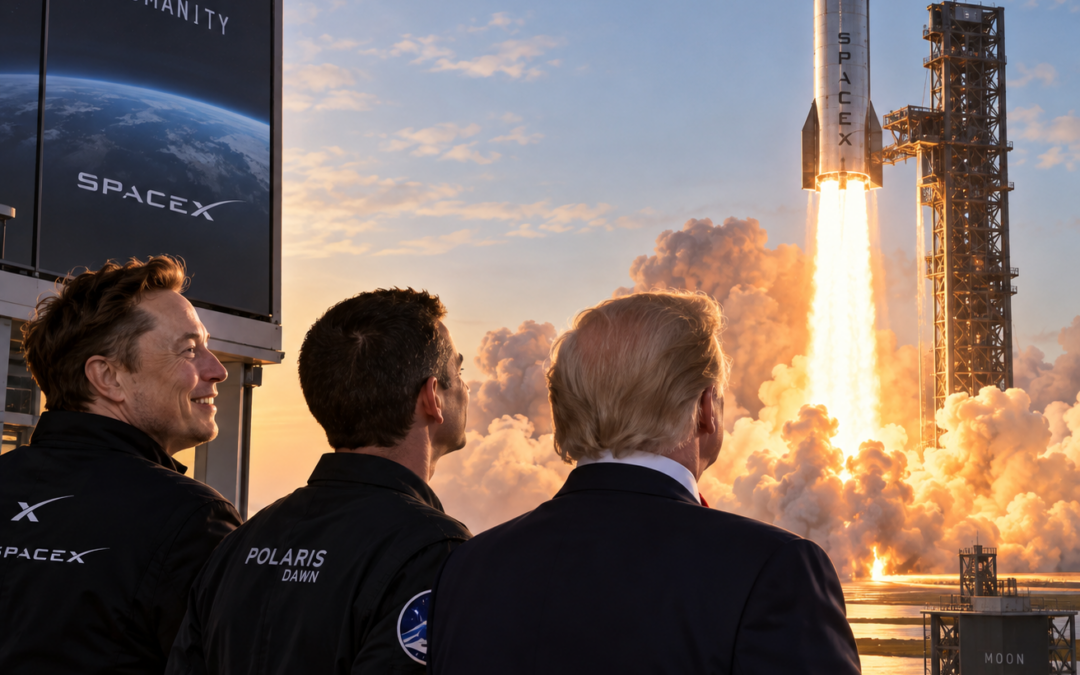
On 28 September 2026, SpaceX’s fourteenth Starship test flight reached Earth orbit and released 26 next-generation Starlink satellites. An engine problem shortened the mission, which ended with an ocean splashdown. This was an important breakthrough, but not a flawless performance, and certainly not yet the demonstration of a spacecraft returning home to be promptly refuelled and flown again. The distinction matters. A milestone is not a mature transport system.
Nevertheless, to watch this machine and see only another rocket is to misunderstand the ambition. The question is no longer simply whether humanity can reach space. It is whether reaching space can become sufficiently affordable, frequent and predictable to support an entirely different scale of economic activity.
That is where the industrial age begins: when an extraordinary journey becomes an ordinary service.
Beyond the romance of Mars
Space exploration possesses an irresistible vocabulary. Lunar settlements, Martian horizons, humanity among the planets: these are images large enough to lift the imagination out of its daily confinement. But a transport business cannot live indefinitely on the grandeur of its destinations. It needs cargo, customers and repeat journeys.
Starship is designed to carry more than 100 metric tonnes to orbit in a fully reusable configuration. That combination—substantial carrying capacity and the intended recovery of both stages—is central to its promise. Its purpose is not merely to make a larger delivery, but eventually to make large deliveries again and again without manufacturing an entirely new vehicle for each departure.
Imagine a shipping company obliged to destroy its vessel after every Atlantic crossing. Its captains might be brilliant, its navigation impeccable, its passengers grateful to arrive. Yet its economics would remain punishing. Reusability seeks to change the rocket from an object consumed by the journey into an asset earning its keep across many journeys.
The decisive achievement, therefore, will not be another spectacular ascent. It will be an uneventful return, followed by inspection, refuelling and another departure at a cost that makes commercial sense.
There is still a formidable distance between that ambition and its reliable execution. Recovering a vehicle is not the same as recovering it cheaply. Reusing it is not the same as turning it around quickly. The economic calculation must include maintenance, replacement parts, launch infrastructure, reliability and the number of paying—or otherwise economically useful—missions that can actually be flown.
Yet even the prospect changes how a business might think. When transport becomes less restrictive, designers can consider larger structures, heavier equipment and projects that would previously have been ruled out before the first drawing was complete. A cheaper route does more than reduce the cost of existing commerce. It can make different commerce possible.
Starship’s first orbital satellite deployment offered a glimpse of that relationship. Its cargo was not a collection of symbolic objects dispatched to demonstrate national prestige, but a new generation of communications satellites intended to expand an operating network. The larger Starlink V3 satellites are designed around capabilities beyond those of their predecessors, with Starship providing the means of deploying them at scale.
The Moon provides the romance. Satellite deployment provides more immediate work.
Here lies the strength of the industrial logic. A company developing a high-capacity launcher while also building the network that can fill it is addressing both sides of a difficult equation. It is not merely constructing a railway and hoping that someone eventually needs a train. It is developing the transport system alongside a substantial reason to use it.
SpaceX’s proposed Starmind system extends that ambition into orbital artificial-intelligence computing, presenting solar-powered satellites as a prospective platform for processing data. This remains a proposition to be demonstrated commercially at scale, not an established replacement for terrestrial data centres. But it reveals the direction of travel: orbit is being imagined not only as a place from which to communicate, but as a place in which to perform economically valuable work.
None of this requires believing that factories will soon spread across the Moon. Industrialisation can begin more modestly, through the repeated delivery, operation and replacement of useful machinery. Before there can be an economy of distant settlements, there must be an economy of dependable transport.
Europe’s uncomfortable comparison
For Europe, the unsettling feature of Starship is not its size. It is the industrial model its developers are trying to establish.
Europe still possesses real launch capability. On 12 February 2026, the four-booster Ariane 6 successfully carried 32 satellites for Amazon’s communications constellation into low Earth orbit. That configuration can carry approximately 21.6 tonnes to low Earth orbit. It is a substantial engineering achievement and an important instrument of independent European access to space. Europe is not merely standing outside the launch gate.
But access and competitive leadership are different things.
Ariane 6 remains an expendable launcher. Starship is being developed around full reusability and a much larger intended payload. Comparing their ultimate operating costs today would be premature: Starship has not yet established the routine service on which its economic promise depends. Nevertheless, their contrasting designs expose the strategic problem. Europe is operating a new launcher within the economics of expendability while its American competitor is attempting to escape those economics altogether.
Europe is also pursuing reusable technology. Its Themis demonstrator, powered by the Prometheus engine, is intended to develop rocket recovery and reuse capabilities. But an ESA update published on 30 July 2026 described a wet dress rehearsal preparing the programme for its first flight. Set beside Starship’s orbital deployment of satellites in September, that provides a sobering illustration of the distance between the respective programmes.
This is not a verdict on the intelligence of European engineers, nor on every branch of European space activity. It is a warning about the pace at which engineering is being converted into industrial capability.
An industry cannot close that distance through declarations of ambition alone. It needs hardware that flies, customers that return, investment that survives setbacks and institutions that distinguish an informative failure from an unforgivable embarrassment.
The danger for Europe is to congratulate itself on remaining in the race while the nature of the race changes.
One competition concerns the ability to launch a satellite. Another concerns the ability to place large quantities of infrastructure in orbit repeatedly, at a price and frequency that allow new markets to develop. Success in the first does not guarantee a meaningful position in the second.
The price of becoming a customer
Europe need not imagine a deliberate American refusal to carry European cargo to understand the risk.
Even an accessible foreign launch service leaves its customers dependent on somebody else’s capacity, schedule and commercial decisions. And a reduction in an operator’s underlying costs does not automatically become an equivalent reduction in the price charged to outsiders. Technological advantage can be passed on to customers, retained as profit or used to accelerate the operator’s own expansion.
The strategic issue is therefore larger than the price of a launch. It concerns who determines the terms on which the next generation of space businesses can operate.
A European company might develop an exceptional satellite, sensor or computing system and still find that its route to market depends on infrastructure controlled elsewhere. There is nothing inherently wrong with international cooperation. But cooperation becomes a less comfortable arrangement when one side supplies the indispensable means of participation.
Sovereignty, in this context, is not a flag painted on a rocket. It is the practical ability to act without having to accept whatever conditions another provider sets.
The European response should consequently be more ambitious than defending the economics of yesterday’s launcher. Independent access remains worth preserving, but independence must be capable of evolving. It cannot become a ceremonial justification for permanent technological distance.
Europe needs to reward demonstrated progress, provide credible demand for useful services and give promising programmes the capital and testing opportunities required to become operating businesses. Safety must remain a requirement; administrative comfort must not become a substitute for it. The choice is not simply between government and private enterprise. It is between arrangements that help machinery reach the launch pad and arrangements that remain satisfied with agreeing that machinery is desirable.
Nor should Europe confuse participation with leadership. Supplying excellent components to a foreign-led industrial system can be valuable. It is not the same as owning the transport infrastructure, setting its development timetable or capturing the opportunities that grow around it.
Starship has not yet fulfilled its largest promises. Rapid, economical reuse still has to be proven. The industrial future suggested by its design will require much more than one successful orbital mission.
But Europe would make a serious mistake by treating those remaining difficulties as reassurance.
The significance of Starship is not that every ambition attached to it must come true. It is that a machine intended to change the scale of activity in space is being built, tested and put to work. Its uncertainties are increasingly the uncertainties of execution.
For Europe, the question is whether it will help create that new industrial world—or merely negotiate better terms for entering it.
The next space age may be remembered less for the first person to step onto a distant planet than for the moment when carrying machinery above this one ceased to be an exceptional undertaking.
America is trying to make that moment arrive.
Europe must decide whether it intends to build the ships or book the passage.



Receive Breaking News
Sign up for our newsletter and stay up to date! Be the first to receive the latest news in your mailbox: