
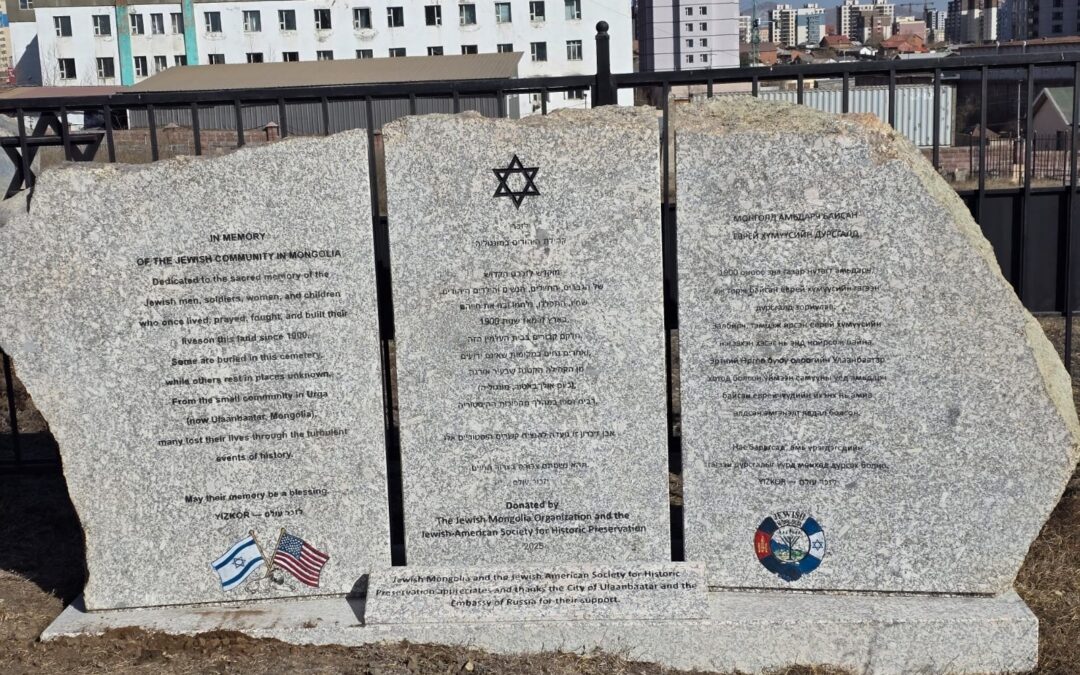
A memorial erected in Ulaanbaatar in 2026 honours Mongolia’s Jewish past. Its dedication brings renewed attention to the community devastated in 1921 by the forces of Baron Roman von Ungern-Sternberg, and to the fate of survivors such as Baron Israel-Eli Zanzer, who escaped the massacre only to perish later in the Holocaust.
Jewish life in Mongolia began long before that catastrophe. Merchants established trading connections in the nineteenth century, and Russian Jewish refugees later arrived seeking safety from the violence of the Russian Civil War. For those families, Mongolia offered the possibility of rebuilding their lives far from the persecution they had fled.
In 1921, that refuge became a place of terror. Ungern-Sternberg, an anti-Bolshevik warlord committed to restoring monarchy, treated Jewish identity as evidence of allegiance to his political enemies and held responsible for the Russian revolution. His forces murdered Jews regardless of age or political activity. The massacre destroyed the lives of people whose supposed offence was their birth, extending the violence of the Russian Civil War into a community that had sought protection beyond Russia’s borders.
Among the few reported survivors was Baron Zanzer. Chabad.org identifies him as Israel-Eli Zanzer, a Jewish figure whose role in Mongolia’s gold mining enterprise and connections within local society had earned him a noble title from the Bogd Khan. His Mongolian name honoured Zanabazar, the revered Buddhist spiritual leader. His position reflected a degree of acceptance that makes the community’s subsequent persecution especially striking.
According to Jerry Klinger’s account in The Times of Israel, Baron Zanzer used his connections and a bribe to escape Ungern-Sternberg’s reach. He fled to Lutsk, then in Poland, where he would later die in the Holocaust. Survival in Mongolia had offered him a reprieve, but no lasting safety.
Baron Zanzer’s fate gives this history a deeply personal dimension. A life that crossed cultures and earned recognition in Mongolia was eventually extinguished in Europe. His story connects two distinct episodes of antisemitic murder, separated by geography and two decades. Remembering him requires following that life beyond the moment of escape, when survival might otherwise appear to bring the story to an end.
The new memorial grew out of the work of Yair Jacob Porat, an Israeli businessman living in Mongolia, and the Jewish American Society for Historic Preservation, led by Klinger. Porat sought out forgotten Jewish graves in Ulaanbaatar’s Russian Orthodox cemetery. The society supported fencing around identified burial sites and the creation of a memorial, which was erected by the Jewish Mongolia Organization and the society.
With inscriptions in English, Hebrew and Mongolian, the monument commemorates the Jewish people who lived and built their lives in the country. Its dedication includes those buried in the cemetery and those whose resting places are unknown. The wording is broad: it honours the community without explicitly naming Ungern-Sternberg or the Holocaust. The historical accounts surrounding the memorial supply those essential connections.
That breadth leaves room to remember both the victims murdered in Mongolia and those, like Baron Zanzer, whose journeys continued towards another catastrophe. Their histories belong together in any account of the lost community. The place where a person died cannot, by itself, tell us where that person belonged, what they contributed or how often they had already been forced to begin again.
More than a century after the massacre, the memorial gives visitors a place to pause and learn about people whose lives have received little public attention. Naming Baron Zanzer helps restore an individual to that history, alongside the men, women and children whose names remain to be recovered. Their remembrance deserves the same care as the preservation of the stone itself.



Receive Breaking News
Sign up for our newsletter and stay up to date! Be the first to receive the latest news in your mailbox: