
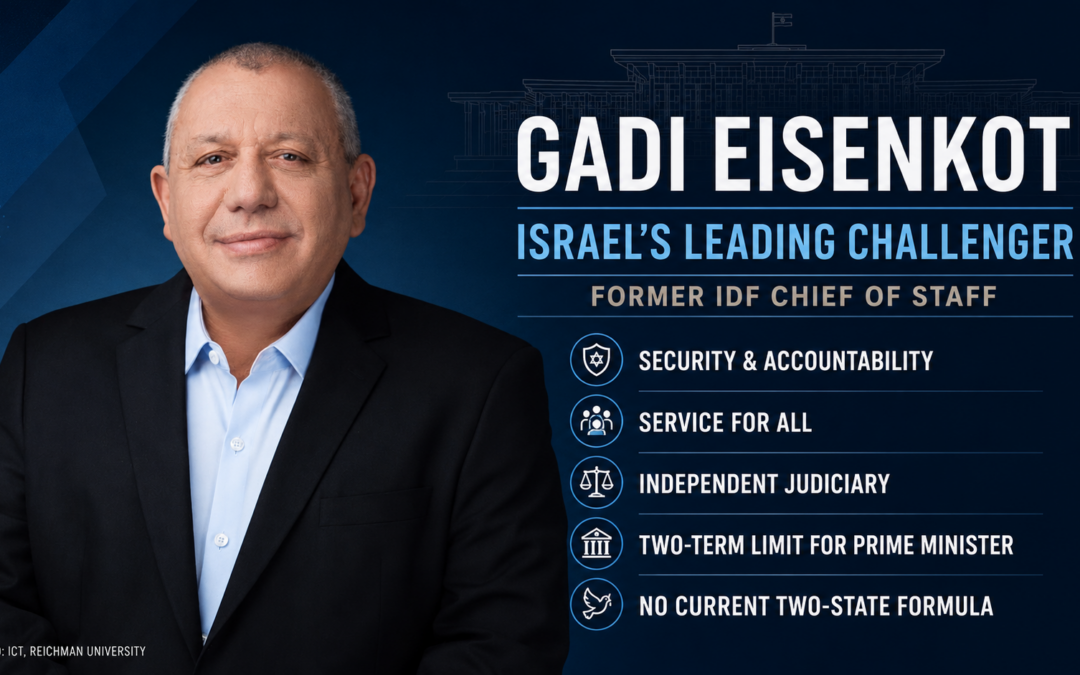
Israel’s October 27 election is no longer shaping up as a straightforward contest between Benjamin Netanyahu and a familiar opposition. A newly established party, Yashar — Hebrew for straightforward, upright or honest — has shaken up the political landscape. Its leader, Gadi Eisenkot, a former chief of staff of the Israel Defense Forces, has transformed his record as a military commander and his reputation for personal integrity into the most serious challenge Netanyahu currently faces.
According to the latest poll by the public broadcaster Kan, published on July 19, Yashar would win 22 Knesset seats, compared with 21 for Likud and 15 for Together, the alliance led by Naftali Bennett and joined by Yair Lapid. Other recent polls have also placed Yashar first, although Likud continues to lead in some surveys. A one-seat advantage is well within the usual margin of error. Moreover, in the same Kan poll, Netanyahu held a narrow lead over Eisenkot when respondents were asked who was most suitable to serve as prime minister. Eisenkot is therefore not the undisputed frontrunner. He is, however, the campaign’s most prominent new challenger — and the candidate every other party must now take into account.
His rise reflects more than dissatisfaction with Netanyahu. Eisenkot offers a clear political contrast: less performance, more orderly government; less ideological theater, more institutional discipline. He speaks like a commander rather than a natural campaigner. That can make him appear restrained and reassuring, but his style can also conceal how hard-line some of his security positions actually are.
A military career built on controlled force
Eisenkot was born in Tiberias in 1960 to a family of Moroccan Jewish origin and grew up in Eilat. He joined the Golani Brigade in 1978. During his 41 years in uniform, he rose from infantryman to commander of the Judea and Samaria Division, head of the Operations Directorate, commander of the Northern Command and deputy chief of staff. From February 2015 until January 2019, he served as the IDF’s 21st chief of staff.
His record cannot easily be placed in a single category. During the wave of stabbing attacks that began in 2015, he opposed broad collective punishment in the West Bank and defended strict rules of engagement. He argued that soldiers should use only the force required by the threat and should not allow themselves to be guided by public anger. That position placed him in direct conflict with parts of the political right.
The most consequential controversy was the Elor Azaria case. In March 2016, Azaria shot and killed Abdel Fattah al-Sharif, a Palestinian attacker who was lying wounded and incapacitated on the ground in Hebron. Eisenkot publicly defended the army’s ethical code and the military justice process. He rejected attempts to portray Azaria as a hero. Azaria was convicted of manslaughter in January 2017 and sentenced to 18 months in prison. Eisenkot later reduced the sentence by four months — an indication that his position combined institutional firmness with a measure of clemency.
Eisenkot is nevertheless far from a military moderate. He is closely associated with the Dahiyeh doctrine, which envisages the use of overwhelming force against areas and infrastructure used by Hezbollah in a future war. As chief of staff, he also institutionalized and expanded the so-called Campaign Between Wars: overt and covert intelligence-led operations intended to slow the military buildup of Iran and Hezbollah, delay a larger war and improve Israel’s position should such a war nevertheless erupt. Operation Northern Shield, which exposed and neutralized Hezbollah’s cross-border tunnels without immediately triggering a wider conflict, was a prime example of that approach.
The common thread is not moderation. It is the controlled use of force by the state, within the law and for a clearly defined strategic purpose. Eisenkot can support severe military action while simultaneously opposing indiscipline, revenge and political interference in operational decisions. That combination is essential to understanding both the general and the politician.
From the war cabinet to a party of his own
Eisenkot entered politics in 2022 and joined the newly formed National Unity slate led by Benny Gantz and Gideon Sa’ar. In the Knesset, he focused primarily on foreign affairs, defense doctrine, intelligence and the development of the armed forces. Following the Hamas attack of October 7, 2023, he became a minister without portfolio in the emergency government and served as an observer in the war cabinet.
In June 2024, Eisenkot left the government together with Gantz. He accused Netanyahu of substituting tactical military successes for a coherent strategy. In June 2025, Eisenkot announced his departure from National Unity and resigned his Knesset seat. He argued that the party had failed to implement the transparent, democratic renewal expected of a potential governing party. This included a genuinely open and competitive process for selecting the party leadership and its candidates. He established Yashar in September 2025.
Yashar’s leadership team is intended to project both administrative competence and political breadth. It includes former Shin Bet director Yoram Cohen, former Religious Services Minister Matan Kahana, former Science Minister Orit Farkash-Hacohen and former Finance Ministry Budget Division chief Shaul Meridor. Women currently constitute a majority of the ten-member team presented by the party. This is not yet the party’s final ranked electoral slate, which will be submitted later in the campaign.
The authority — and burden — of personal loss
Eisenkot’s political position cannot be separated from the losses his family suffered during the war in Gaza. His 25-year-old son, Master Sgt. Gal Meir Eisenkot, was killed in Jabalia on December 7, 2023, during an operation connected to the recovery of hostages’ bodies. A nephew, Sgt. Maor Cohen Eisenkot, was killed the following day. Another nephew, Capt. Yogev Pazy, was killed in November 2024.
Nearly two years after Gal’s death, Eisenkot accused the government of prolonging the war because of political hesitation and ideological considerations, including plans for renewed Israeli settlement in Gaza that conflicted with the officially declared war objectives. His grief gives his criticism unusual moral weight in a country where families have endured years of reserve duty, bereavement and uncertainty over the hostages. It does not place his decisions beyond criticism, but it makes it difficult to portray him as someone unfamiliar with the human cost of the policies he advocates.
What Yashar proposes
Yashar’s ten-point program begins with accountability. The party promises an independent state commission of inquiry into the Hamas-led attack of October 7, the decade preceding it and the conduct of the war. It calls for a new national security doctrine based on planning, initiative, better-protected borders and an expansion of the circle of regional peace agreements, rather than what it describes as improvised crisis management.
Its most consequential domestic proposal is “service for all.” Under the detailed plan, the IDF would determine first who should be called up for military service. Those not selected would be required to perform national or civilian service. The plan would apply to both ultra-Orthodox and Arab citizens of Israel, with only a limited exemption for a small number of outstanding full-time Torah students. Eisenkot says he would prefer another election to forming a government that preserved broad exemptions from service.
The same social-contract logic is reflected in Yashar’s proposals for education and the economy. The party would make full public funding conditional on a common core curriculum that includes Hebrew, English, mathematics, science, civics, democratic education and modern technological skills. Economically, it promises to reduce market concentration, increase competition, adopt international standards, invest in transportation, healthcare and education, and direct more public support and services toward citizens who work and serve.
Institutionally, the party opposes what it considers another unilateral assault on the judiciary. It promises an independent court system, a free press, respect for minority rights and human rights, and a Basic Law on Legislation intended to establish broadly accepted rules between the Knesset and the courts. Yashar also proposes limiting prime ministers to two terms, abolishing unnecessary ministries and rebuilding a professional civil service.
On the relationship between religion and state, Yashar advocates an inclusive and respectful expression of Judaism and greater autonomy for municipalities and communities to reflect their local character, provided that the rights of others are protected. LGBTQ+ rights do not constitute a separate pillar of the party’s ten-point program. Eisenkot nevertheless endorsed a package of proposals known as the “Sagi Laws,” including recognition of civil marriage, a ban on conversion therapy, legal recognition of families and statutory protections against discrimination.
The Palestinian question: separation without a defined end state
The largest gap in Eisenkot’s platform concerns the Palestinians. Yashar says Israel must preserve a durable Jewish majority and expand the circle of peace, but its published ten-point program contains no developed framework for Gaza, the Palestinian Authority or the West Bank.
In a June 6 interview with Channel 12, Eisenkot said he had never supported the formula of “two states for two peoples.” He argued that slogans calling for immediate peace underestimate the religious, national and social depth of the conflict. This does not necessarily mean that he permanently rejects every possible form of Palestinian statehood; he has not presented a developed final model. His statements suggest that he does not currently consider final-status negotiations realistic and believes that other arrangements must be explored.
At the same time, he describes himself as a strong supporter of Jewish settlement in Judea and Samaria — the biblical term widely used in Israel for the West Bank — provided that such settlement is lawful and serves Israel’s national interest. He also warns that unrestricted settlement expansion, annexation or a situation in which roughly equal Jewish and Palestinian populations live intermingled between the Jordan River and the Mediterranean Sea would endanger Israel’s future as both a Jewish and democratic state. His position is therefore neither the traditional two-state program nor the one-state vision of the far right. It is a security-centered approach that seeks to preserve separation and strategic freedom of action while postponing a final political settlement.
Eisenkot has also described violence by extremist Jewish militias against Palestinians and Israeli soldiers as terrorism and a threat to state authority. That position follows directly from his belief that only the state may legitimately exercise force. The absence of a clearer Palestinian strategy nevertheless remains a vulnerability. A candidate for prime minister will eventually have to explain not only what cannot happen, but also what political order he intends to build after the war.
Can he form a coalition?
Eisenkot approaches coalition politics through three conditions rather than a list of parties he excludes in advance. He says he can work with any party that accepts Israel as a Jewish and democratic state, endorses the values of the Declaration of Independence and supports military service — or, for those not selected, compulsory national or civilian service — for ultra-Orthodox and Arab citizens of Israel.
This creates conditional openings but provides no guaranteed partners. Ra’am, led by Mansour Abbas, is not categorically excluded, but there is no agreement between the two parties. The ultra-Orthodox Shas party could theoretically participate if it accepted Eisenkot’s service principle, although that would conflict with its current policy. The positions of Hadash-Ta’al and Balad are difficult to reconcile with Eisenkot’s definition of a Jewish state. The far-right parties, for their part, would struggle to reconcile their positions with the equality principles contained in the Declaration of Independence.
Regarding Netanyahu, Eisenkot says that anyone who held a senior political position or military command on October 7, 2023, is unfit to continue leading the country. He has repeatedly promised to replace Netanyahu and accuses him of subordinating national security to personal and political interests. Even under repeated questioning, however, Eisenkot has stopped short of making an absolute promise that he would never serve in a government with Netanyahu. He therefore retains some room for maneuver within Israel’s unpredictable parliamentary system.
The coalition arithmetic remains his greatest obstacle. In the July 19 Kan poll, the opposition bloc excluding the Arab parties received 55 seats, six short of the 61 required for a majority, while Netanyahu’s bloc received 51. Eisenkot says he is seeking at least 63 seats for a broad Zionist, state-oriented coalition involving Bennett, Lapid, Avigdor Lieberman, Yair Golan and other opposition figures. Whether those parties can cooperate after a campaign in which several leaders are competing for the premiership remains far from certain.
The election is becoming a choice between two models of leadership
Eisenkot’s emergence is changing the structure of the election campaign. The contest is no longer solely a judgment on Netanyahu or a conventional division between left and right. It is increasingly becoming a choice between two models of security leadership: Netanyahu’s highly personalized politics of maintaining power, managing political alliances and taking strategic risks, and Eisenkot’s promise of institutional discipline, equal service obligations and government that is accountable for its decisions.
The former general’s strengths are clear. He possesses credibility on security matters, a compelling personal story, a reputation for seriousness and the ability to attract voters who do not identify with the left. His weaknesses are equally evident. He has limited political and administrative experience in executive positions, his domestic program remains more of a governing framework than a fully costed plan, and he continues to be deliberately vague about the political future of the Palestinians. Above all, he has not yet demonstrated that he can convert first place in the polls into the support of at least 61 Knesset members for a government.
Polls conducted more than three months before election day are snapshots, not results. Netanyahu has repeatedly recovered from positions that appeared politically hopeless. Nevertheless, Eisenkot is now the challenger who appears most capable of reshaping the campaign. His central argument is that Israeli security cannot be separated from competent government, equal civic obligations and limits on political power. The election will determine whether Israelis regard that as a credible national alternative — or merely another centrist promise unable to survive the realities of coalition politics.



Ontvang het laatste nieuws
Abonneer je op onze nieuwsbrief en blijf op de hoogte! Ontvang als eerste het laatste nieuws in je inbox: