
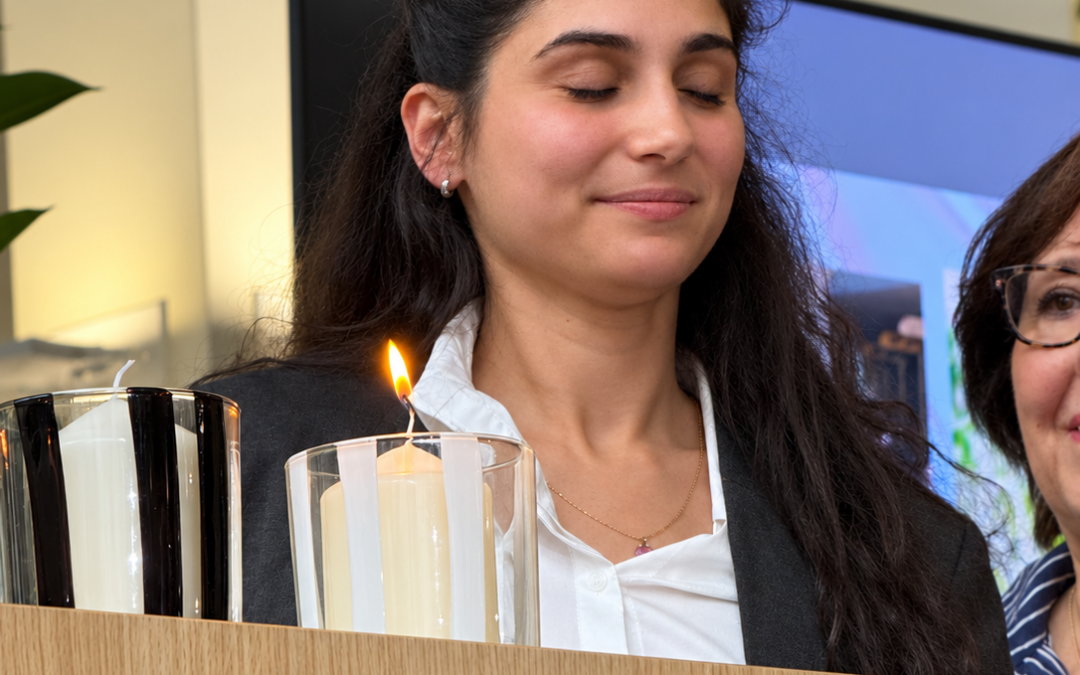
On 6 October 2026, the Jewish community gathered in Antwerp to commemorate the terrorist attacks of 7 October 2023. Under the title “Israel Lives”, the evening centred on remembrance, solidarity and resilience. Three years after the murders and abductions, the grief remains profound. Yet the conviction endures that terror must not break Jewish life.
Organised by the Jewish Information and Documentation Centre and Hart voor Israël, the commemoration brought together testimonies, speeches and music. Raz Shifer, a survivor of the attack on the Nova music festival, gave remembrance a human face. Behind every victim lies a life; behind every name, a family changed forever.
The musical contributions of Barry Mehler, Aaron Wajnberg and his klezmer band made room for sorrow, hope and the determination to live. Darya Safai’s participation also expressed political solidarity. But it was above all Georges-Louis Bouchez’s presence and exceptional speech that gave the evening particular significance.
The MR leader was there at a moment when presence matters. For a community that has increasingly felt alone in recent years, this means far more than a polite gesture. It means that its grief is recognised and that it can count on political support, even when that support does not automatically attract applause.
Bouchez has built trust within the Jewish community by visibly continuing to stand alongside it. The warm recognition he received from the organisers reflected that bond. His appearance in Antwerp made clear that he now fills a political void extending beyond a single party.
In the past, the VLD maintained close ties with the Jewish community. That historic relationship rested on liberal principles, individual freedom and the protection of minorities. Today, there is a painful impression that the party has traded its former loyalty for accommodation with a climate of anti-Jewish hysteria. For those who remember that earlier bond, it feels as though the party has sold its political soul.
Bouchez is also assuming a role that the Jewish community long associated with the N-VA: that of an ally whose lasting support it believed it could count on. Darya Safai’s presence demonstrates that there are people within that party who continue to uphold this solidarity visibly. Precisely for that reason, the distance shown by other political leaders stands out all the more.
Alongside those who attended, two absences were particularly noticeable: the Prime Minister and the Mayor of Antwerp.
In the “Jerusalem of the North”, the Mayor’s absence carries particular weight. The Jewish community is part of Antwerp’s historic and living fabric. Its grief concerns the city as well. Commemorating the terror of 7 October therefore also involves the responsibility towards Jewish residents: their safety, their dignity and their place in society.
The Prime Minister’s absence likewise left an empty place. Without knowing their reasons, no conclusions can be drawn about their personal motives. But the public signal remains. On an evening when presence means so much, absence is inevitably noticed.
That distance had already been felt before the commemoration. This year, neither the Mayor of Antwerp nor the Prime Minister submitted a Jewish New Year message to our magazine, Centrale. Following the Flemish Minister-President’s refusal last year, their greetings were absent this year too.
In 2025, Matthias Diependaele’s office initially cited sensitivities surrounding the conflict in the Middle East as the reason for declining to provide a Rosh Hashanah message. The Minister-President subsequently explained that his decision arose from a general principle of not supporting religious activities in his official capacity.
Nevertheless, that initial reference to the Middle East remains painful. A New Year greeting to Jewish fellow citizens is a simple gesture of recognition and belonging. It expresses no judgement on the policies of the Israeli government. When even such a greeting becomes politically sensitive, it creates the impression that Belgian Jews are being judged through the lens of a foreign conflict for which they, as a community, bear no responsibility.
The absence of this year’s New Year messages, followed by the absence from the commemoration, reinforces an uncomfortable feeling: the once seemingly unquestionable bond with certain politicians appears to have become dependent on the popularity the Jewish community enjoys at any given moment.
How enduring is a bond that gives way as soon as the public mood changes?
Political loyalty acquires meaning when it is tested. When support attracts criticism, when debate hardens and when silence seems easier, it becomes clear who is truly prepared to continue standing alongside a community. Recognition of Jewish citizens must not depend on opinion polls, street protests or electoral calculations.
That is why Georges-Louis Bouchez’s appearance deserves particular attention. His presence and speech gave visible expression to something many people feel is missing today: a political ally who demonstrates his solidarity personally. A community remembers who stood beside it when it needed support. It also remembers which promises failed to produce any visible response at that moment.
“Israel Lives” was, first and foremost, dedicated to the victims, the survivors and their families. Their remembrance must remain central. But the evening also held up a mirror to Belgian politics. Commemoration requires a willingness to stand by those who face fear and exclusion today.
In Antwerp, Georges-Louis Bouchez gave that solidarity a face. The empty places made clear why it matters.



Receive Breaking News
Sign up for our newsletter and stay up to date! Be the first to receive the latest news in your mailbox: