
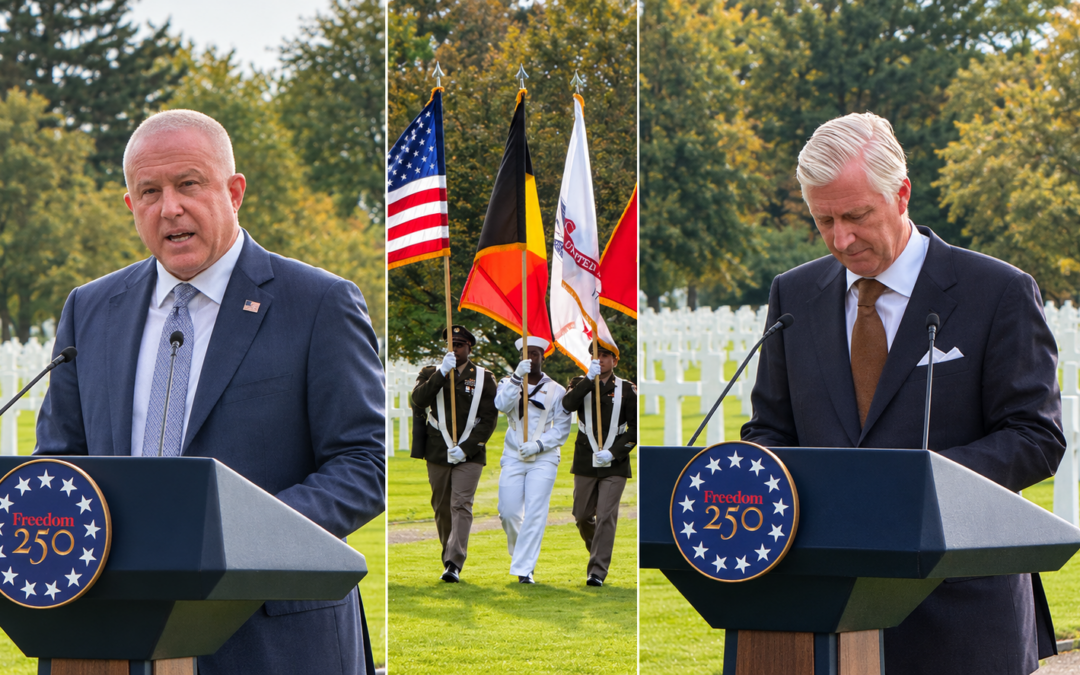
At Henri-Chapelle, the white headstones stand in ordered ranks, like an army held forever at attention. Beneath them lie 7,987 American servicemen who never returned home. The quiet of this Belgian hillside holds the lives they surrendered, the families who waited for them and the freedom their sacrifice helped restore. Here, Europe’s debt to the United States is written in stone.
On 2 October 2026, Ambassador Bill White brought that debt into the living present. The ceremony organised by the United States Embassy, in the presence of His Majesty King Philippe, gathered Belgium’s leaders, three American veterans of the Second World War and hundreds of children around a shared act of remembrance. In the year marking 250 years of American independence, the occasion gave particular meaning to the ideals for which these men had crossed the Atlantic.
White deserves warm recognition for the care and conviction he brought to the event. His speech moved easily from the dignity of the setting to the individual lives that give it meaning. He thanked his embassy team and the American Battle Monuments Commission staff who maintain the cemetery with such devotion. Their daily work honours a promise that distance and the passage of time will never diminish America’s care for its fallen.
The ambassador’s gratitude was unmistakably personal. Addressing the veterans, he said: “We owe you our eternal love, gratitude, and respect.” In a place where every grave marks a life cut short, those words carried the weight of an enduring obligation.
Frank Stellar, Truman Christian and Russell Sattazahn had returned to the continent where they served as young men more than eight decades earlier. Their presence allowed the gathering to encounter history through the people who had lived it. The battles remembered in books had once been their days and nights, their fear, their courage and their losses.
Stellar’s return held a deeply intimate purpose: to visit the grave of his brother-in-law, Private First Class Edwin Earl Stewart. Christian had served as a machine gunner during the Battle of the Bulge, fighting around St. Vith. Sattazahn, a soldier of the 1st Infantry Division, had suffered devastating wounds and lost his right hand in an explosion in Germany. White’s gentle request that visitors shake his left hand revealed the attentiveness that made this tribute so moving. It recognised the man with warmth while honouring the sacrifice he still carries.
The remembrance also embraced the Tester brothers, Glen, Robert and James, who lie side by side at Henri-Chapelle. War took them in different places; their mother wished them reunited in death. Before those three graves, the scale of a world conflict becomes the grief of a single family. Europe lives with freedoms for which American households paid a price beyond calculation.
King Philippe gave solemn expression to Belgium’s gratitude. He recalled the courage of men who fought far from home and the responsibility to keep their memory alive. His reflections on reconciliation and European cooperation connected their sacrifice to the peace that followed. The possibility of rebuilding Europe, and eventually bringing former enemies into a common political project, rested on the liberation to which these Americans contributed so decisively.
Their graves remain eternal proof of how much Europe owes its freedom to the United States. Alongside the courage of other Allied forces and resistance movements, American sacrifice helped break Nazi domination and reopen the possibility of democratic life. At Henri-Chapelle, that contribution has thousands of names. Gratitude begins with remembering each one.
One of White’s most thoughtful gestures was to ask the approximately 250 children present to stand. He addressed them as the future, inviting them to understand why the veterans and the fallen mattered to their own lives. For those children, freedom acquired a human face. Men who had once been scarcely older than they were had travelled across an ocean and risked everything so that later generations could grow up in liberty.
Bringing those generations together was a considerable diplomatic achievement. White gave the children a memory they could carry with them, and the veterans the assurance that their service still speaks to the young. The ceremony showed how an ambassador can strengthen relations between countries through direct human understanding.
The presence of the King, the Prime Minister, the defence leadership and political figures including Georges-Louis Bouchez offered a powerful public affirmation of the American relationship. Their gathering can be read as an acknowledgement of its lasting importance. With war again threatening European security, the alliance carries an urgency that every grave at Henri-Chapelle helps us understand.
That relationship also deserves confidence because of the future it makes possible. The United States remains a driving force in innovation. Its artificial intelligence companies and research institutions are helping reshape how we work, discover and learn. Its space capabilities, through NASA and American industry, continue to expand the possibilities of exploration. Cooperation with this creative power offers Europe opportunities that reach well beyond the immediate demands of defence.
The children honoured by White will inherit that world. They will need the freedom to think independently and the knowledge to put new technologies to humane use. A strong partnership between Europe and America can help them do both. The alliance has a task in protecting the peace in which discovery becomes possible, and in ensuring that discovery improves the lives of the next generation.
Ambassador White’s achievement at Henri-Chapelle was to make the bond between our countries tangible. It could be seen in a veteran returning to a relative’s grave, in a king paying tribute and in children standing among those who had secured their freedom. Across the ordered rows, thousands of young Americans remain forever far from home. The future we build together should be worthy of them.



Receive Breaking News
Sign up for our newsletter and stay up to date! Be the first to receive the latest news in your mailbox: