
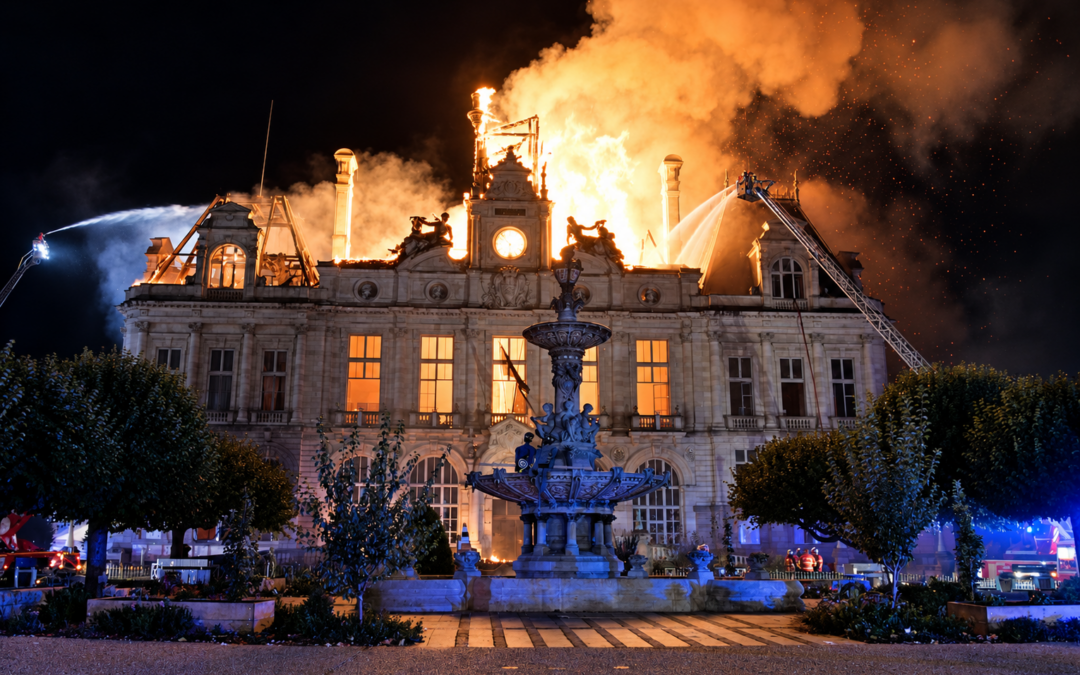
A town hall belongs to generations. Its stones outlive mayors, governments and the passions of an afternoon. Within its walls, people marry, register births and conduct the ordinary business through which a population becomes a political community. To burn it is to attack the continuity of that community: its memory, its institutions and its confidence in tomorrow.
On 17 October, France witnessed that continuity go up in flames. Limoges’s historic town hall burned during nationwide unrest. Its collapsing spire became an image of a country struggling to preserve what previous generations had entrusted to it. Across France, attacks on public buildings, confrontations with police and the looting of shops overshadowed demonstrations about living costs and public services.
France is burning. Is Europe looking at an isolated catastrophe, or a reflection of its own approaching future?
As elections approach, the relationship between political ambition and public disorder deserves scrutiny. Revolutionary movements have always understood that anger can create opportunities unavailable through ordinary persuasion. A population convinced that everything is intolerable becomes receptive to those promising to overturn everything.
For La France Insoumise, a revolutionary atmosphere could favour its presidential ambitions. Economic dissatisfaction and cultural conflict can become mutually reinforcing: one supplies the grievance, the other supplies the enemy.
Every political movement can be judged by whether it draws an unmistakable boundary between protest and intimidation. The moral test comes precisely when those breaking the law speak the language of one’s own cause.
Angry people do not always stop to ask whether they are right. Anger offers its own permission. In a crowd, doubt can feel like disloyalty; restraint can look like weakness. The individual conscience risks disappearing beneath the collective certainty that destruction has become a form of justice.
There are genuine hardships behind the anger. Families struggle to meet expenses. Young people fear that education will no longer deliver opportunity. Public institutions too often answer suffering with procedure.
But a grievance does not become more legitimate because someone sets fire to a building in its name. A stolen handbag contains no answer to educational inequality. A looted luxury shop offers no programme for economic renewal. The destruction of public property impoverishes the very public on whose behalf the destruction is supposedly committed.
US Vice President JD Vance wrote on X:
Western liberals imported the third world into France and other countries in the name of diversity and compassion. They ignored fundamental questions of assimilation and compatibility. They were told it would lead to this and they didn’t listen.
I pray that France, a beautiful country of amazing people, will stop this madness before more of its landmarks burn.
And I hope Americans are paying attention. This is the future congressional Democrats seek for your country.
His warning places the events in France within a wider argument about the future of Western societies. The questions he raises about assimilation and social cohesion cannot be wished away by those uncomfortable with discussing them.
A country cannot sustain itself through geography alone. Sharing a territory requires a framework of obligations: respect for the law, acceptance of civic responsibility and recognition that political disagreement does not authorise the destruction of a common home.
Immigration policy cannot be separated from that framework. When governments encourage arrivals without ensuring the conditions for successful integration, they leave future generations to manage the consequences. Cultural separation, economic frustration and institutional weakness can accumulate until every confrontation carries the weight of grievances far larger than its immediate cause.
The responsibility of government is to confront those failures before extremists turn them into instruments of mobilisation.
The warning already extends beyond France. Brussels has witnessed clashes between protesters and police. Albania has experienced violent demonstrations amid anger over education, living conditions and corruption. Their national circumstances differ, but the recurring images are troublingly familiar: burning property, damaged institutions and streets in which force threatens to replace democratic argument.
When political motivations drive attacks on law and order, voters have a responsibility to examine the consequences of the movements seeking their support. That responsibility applies in Europe and in the United States.
What will these movements build? What will they protect? Which principles will survive when respecting them becomes politically inconvenient?
The combination of revolutionary demands and antisemitism is especially destructive. Antisemitism turns social frustration into collective accusation. It offers a target in place of an explanation and hostility in place of a solution. When political actors tolerate it as a means of exciting a crowd, they corrode the foundations of equal citizenship.
Europe cannot claim unity while permitting Jewish citizens to become bargaining chips in its ideological conflicts. A civilisation that excuses the intimidation of one community weakens the security of every community.
The consequences reach beyond domestic politics. European cooperation depends on the confidence of sovereign nations and their citizens. If that cooperation becomes associated with lost control, cultural estrangement and governments unable to maintain order, its legitimacy will erode.
Countries will reconsider their commitments. Electorates will demand a different settlement. Parties promising to restore sovereignty will gain strength wherever established institutions appear resigned to their own impotence.
The counterreaction is already visible in French politics, where Marine Le Pen has made the violence an indictment of her opponents. Those who believe disorder will advance the revolutionary left should consider how readily fear can strengthen its adversaries.
A crowd may march towards one political destination and carry a country towards another.
France, of all nations, should recognise this danger.
The French Revolution remains an inexhaustible source of political imagery. Its language promises liberation; its history demands considerably more caution. Those who celebrate the overthrow of an order often pay less attention to what happens after the overthrow, when rival factions compete to define virtue and disagreement becomes evidence of treason.
The revolutionaries themselves were not spared. Danton and Robespierre each encountered the machinery of death that revolutionary government had made an instrument of authority. The revolution did not respect the distinction between those who initiated it and those it subsequently condemned.
Everyone recognises 14 July 1789. Far fewer can explain where the Revolution ended. France’s political settlement continued through empires, monarchies and successive republics.
France now lives under its Fifth Republic. The numbering itself should discourage any romantic belief that upheaval reliably produces stability.
Those invoking 1789 should read beyond the storming of the Bastille.
Today, failed integration and cultural estrangement risk supplying fresh fuel to that old revolutionary fire. Economic dissatisfaction gives it force. Political ambition gives it direction. Antisemitism gives it a poisonous outlet. Institutional hesitation gives it room to spread.
The choice facing France and Europe is whether to recover the authority and cohesion necessary to govern themselves, or allow their countries to be consumed by conflicts they no longer dare to confront.
Sovereignty means the capacity to make democratic decisions and enforce them. It means protecting citizens, maintaining public order and requiring those who share a country to accept responsibility for its future. Without that capacity, constitutional promises become words recited over a retreat.
Limoges’s town hall can be rebuilt. Restoring the conviction that a common inheritance deserves protection will take more than masonry.
Fire promises a beginning. By morning, the debts remain, the grievances remain, and the public owns one building less.
A generation that mistakes destruction for emancipation may discover too late that it has burned the institutions through which its freedom could have endured.



Receive Breaking News
Sign up for our newsletter and stay up to date! Be the first to receive the latest news in your mailbox: