
The forthcoming French presidential election is about much more than choosing Emmanuel Macron’s successor. It concerns Europe’s future, the resilience of democracy and the survival of the continent’s largest Jewish community.
France is experiencing political paralysis. A weakened presidency, a divided parliament and a society in which public discontent repeatedly erupts onto the streets form the backdrop to a struggle for power whose consequences will reach far beyond French borders.
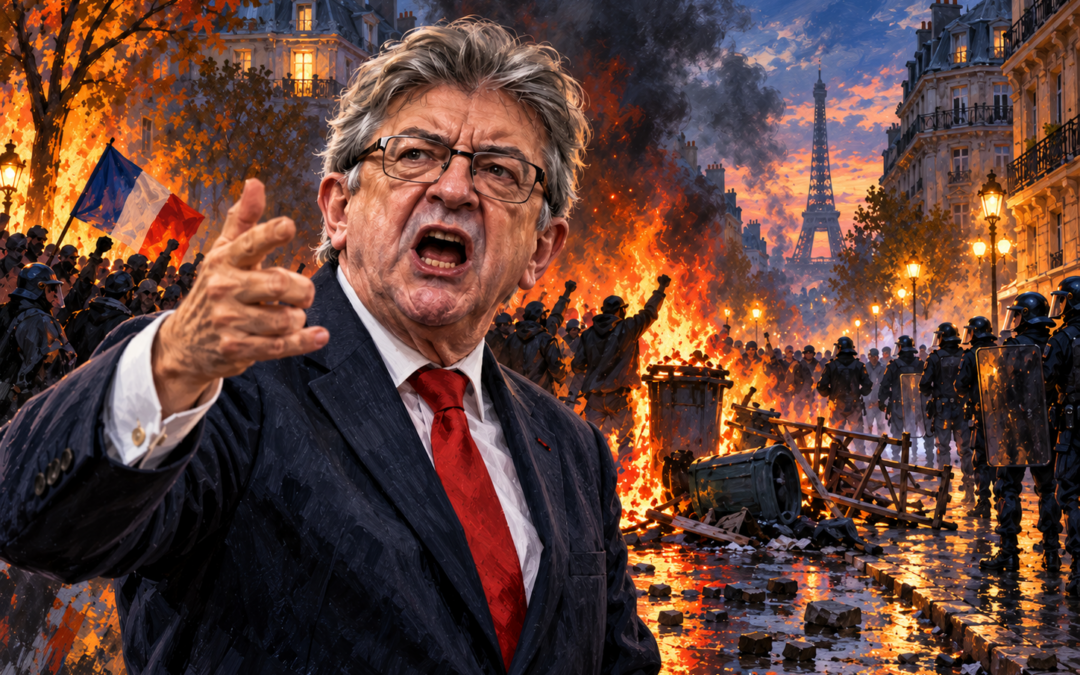
Burning rubbish bins, barricades and tear gas show how school pupils’ genuine concerns disappear behind a political confrontation. It begins with complaints about dilapidated buildings, insufficient space and absent teachers. Then come blockades, destruction and violence. Black blocs appear, other groups join in, and the original demand for better education becomes absorbed into a struggle against the government.
La France insoumise seeks to turn that discontent into political advantage. Pupils’ concerns disappear behind a mob, while physical destruction becomes a means of undermining the established order. The streets are expected to impose what the institutions do not immediately deliver.
Jean-Luc Mélenchon wants to ride that discontent into the presidency. The “new French” are supposed to bring him to power: young people from the banlieues and voters from immigrant backgrounds on whom he pins his revolutionary hopes. Muslim immigration occupies an important place within that strategy.
This goes beyond reaching out to new voters. Mélenchon sets his “new France” against the old France. The traditional working class gives way to a new political vanguard. The social struggle consequently acquires an identity-based character: people’s origins become a means of deciding who represents the future and who belongs to the past.
My central comparison is therefore deliberately stark: Mélenchon combines antisemitism and socialist promises in a new National Socialism, in which the national element is replaced by imported political Islam, which becomes the new nationalism. The parallel I draw with Hitler’s National Socialism concerns the mobilisation of social frustration, the formation of a chosen community and the use of antisemitism as a binding force. Within that ideological comparison, what changes is the identity used to legitimise the pursuit of power.
This is a comparison of political mechanisms, not an equation of historical regimes or their crimes. Hitler’s genocidal dictatorship retains its historical specificity. But that history must not prevent us from recognising mechanisms of exclusion when they reappear under another banner.
In this critique, political Islamism becomes the new nationalism: an ideological allegiance that risks being placed above a shared French civic identity. Liberty, equality and fraternity become subordinate to the electoral usefulness of group identity and religious-political mobilisation.
This criticism is directed at Mélenchon’s strategy for gaining power and at political Islamism as an ideology. Muslims and immigrants do not constitute a homogeneous bloc. Their diversity is precisely what is overlooked when a politician attempts to organise them into a single revolutionary electorate.
The “new French” are supposed to bring Mélenchon to power. He wants to reach the presidency on their shoulders. The question is what price France will pay if its shared republican ideals give way to a politics that organises confrontation between population groups.
This is precisely why the reluctance of part of the French Jewish community could become a historic mistake. Continuing to view the former Front National and La France insoumise in the same way, solely through yesterday’s political categories, risks obscuring the shifting nature of the danger today.
That question took concrete form when France’s Chief Rabbi, Haïm Korsia, recently stated on French television that he would cast a blank ballot in a second-round contest between Mélenchon and Marine Le Pen. He does not wish to give either party his vote.
I consider that choice a historic mistake. The right to vote is among the essential achievements of Jewish emancipation. It affirms that Jews are full citizens, with the same right as every other citizen to help determine their country’s future.
Legally, casting a blank ballot is also a democratic choice. Politically, however, in such a decisive confrontation, it means declining to use one’s vote to influence the outcome between the two candidates. When a community’s security and future are at stake, that reluctance becomes a decision with serious consequences.
An election rarely offers a choice between perfection and danger. Often, voters must choose between imperfect alternatives on the basis of their practical consequences. Placing both options on the same footing can erase the very distinction that will prove decisive for the future.
The Front National’s past must not be erased. But Jean-Marie Le Pen’s expulsion from the party led by his daughter cannot be dismissed as meaningless either. Marine Le Pen thereby drew a visible line against part of her father’s political legacy.
A party must be judged on its past and its present conduct. A left-wing identity does not confer exemption from scrutiny over antisemitism. Right-wing origins do not make every subsequent change impossible by definition.
In a confrontation with Mélenchon’s project, I see Marine Le Pen and Jordan Bardella as the political counterweight most likely to prevail, and potentially the decisive opportunity to put the security and future of France’s Jewish community back at the centre of political debate. Automatically equating the two camps offers that community no political way forward.
Meanwhile, Europe’s largest Jewish community lives under sustained pressure. Quiet emigration is increasing. Families leave without grand declarations because they seek a future for their children in which Jewish life requires less fear and fewer precautions.
A community does not have to disappear in a single dramatic moment. It can diminish slowly, family by family. Every departure motivated by security concerns raises the same question: why could France not convince these citizens that their future could also be built at home?
That question concerns all of Europe. A continent that fails to provide adequate protection for its Jewish citizens loses part of its history and undermines its democratic promise.
Belgium faces the same challenge. A political culture that sets the streets against the institutions does not stop at the French border. In Wallonia too, physical destruction risks being presented as part of a justified struggle against the established order. Social concerns give nobody the right to legitimise destruction and intimidation.
PVDA and PTB, the two language versions of the same party’s name, must also be judged on how they mobilise public indignation. Where opposition to Israel turns into suspicion of Jewish citizens, antisemitism becomes a banner in the struggle for power, however progressive the surrounding language may sound.
The warning also applies to the mobilisation of the “new Belgians”. Their participation in democracy is unquestionable. The danger arises when parties address them as a separate political bloc and use foreign conflicts to deepen domestic divisions.
In Flanders, Vlaams Belang cannot content itself with general statements against antisemitism either. The party must demonstrate a visible and unequivocal break with every antisemitic current within its own political environment. Marine Le Pen drew a concrete line by expelling her father. The same clarity can be demanded of a party that claims to defend our society.
As long as that clarity is lacking, the question remains whether the party still hopes to benefit from latent antisemitism among part of the Flemish population. Only consistent conduct can dispel that suspicion.
The N-VA, the party of power, cannot distance itself from this reality by retreating into silence either. Where antisemitism and political Islamism are used as springboards to power, a governing party must visibly defend democratic boundaries. Silence leaves the political field to others.
Fortunately, Wallonia still has the MR and Georges-Louis Bouchez. His outspoken defence of Jewish citizens recalls liberalism’s original purpose: protecting individual freedom against collective suspicion, religious coercion and political intimidation.
His stance makes clear that old forms of hatred do not become harmless when they adopt new political clothing. Where political Islamism undermines equal citizenship and freedom of conscience, it must be opposed. Where antisemitism hides behind progressive language, it must be named.
A possible move by Bouchez into Flemish politics could herald a liberal revival. Flemish liberals have allowed their raison d’être to fade too far. Liberalism must once again become a conviction people dare to defend: protecting freedom, the rule of law and individual dignity, even when doing so is politically uncomfortable.
The French presidential election will show how far Europe is prepared to defend those principles. When social promises become intertwined with antisemitic images of the enemy, when political Islam claims the place of a shared civic identity, and when violence becomes an argument, the democratic order itself is at stake.
France chooses a president. Europe will live with the consequences.



Receive Breaking News
Sign up for our newsletter and stay up to date! Be the first to receive the latest news in your mailbox: