
On the eve of the third anniversary of Hamas’s October 7 attacks on Israeli citizens, The New York Times has published an opinion article entitled “How AIPAC Failed — and How It Can Recover.” I read it three times, yet could not find a convincing answer to the second half of the title.
What I found instead was an argument that, in my reading, would require AIPAC to retreat from its support for Israel—the very raison d’être of the organisation. An organisation cannot recover by abandoning the purpose for which it exists.
The timing is striking. The same newspaper had just described the violence aboard a Flydubai aircraft bound for Israel as an “altercation.” According to reported accounts, one pilot stabbed the captain and apparently attempted to crash the aircraft before passengers and crew intervened. The apparent objective was mass murder through a 9/11-style hijacking. Calling such an attack an “altercation” diminishes its gravity and the terror experienced by those aboard.
The question of language is not incidental. Words shape public understanding. When an apparent attempt to bring down an aircraft carrying Israeli passengers is reduced to an “altercation,” readers are given a description that fails to convey the scale of the reported attack.
This is the political and media environment in which AIPAC is now expected to explain its supposed failure.
The familiar accusation is that AIPAC abandoned the Democrats and moved towards the Republicans. In my view, the more consequential development is that substantial parts of the Democratic Party have moved away from Israel, while becoming increasingly tolerant of antisemitism within their own political movement.
Nancy Pelosi once described American cooperation with Israel as a commitment so fundamental that it would survive even the destruction of the Capitol. Yet in July, she joined more than a hundred Democratic colleagues in supporting an amendment to eliminate the proposed military assistance to Israel. The amendment failed, but the reversal carried a clear political message: what was once presented as an enduring commitment had become negotiable.
In September, California Governor Gavin Newsom told PBS that condemnation of Benjamin Netanyahu’s conduct was “almost universal” within the Democratic Party. Although he also affirmed support for a secure Israel and condemned Hamas’s terrorism, his remarks illustrated how profoundly the party’s political atmosphere has changed.
Criticism of an Israeli government is legitimate. The danger arises when hostility towards Israel becomes a condition of political acceptance, when Jewish citizens are held responsible for Israeli policy, and when support for the Jewish state is treated as evidence of suspect loyalties.
My concern is that tolerance of such rhetoric is becoming embedded in parts of the party’s political identity. AIPAC did not create this transformation, and changing its lobbying methods alone will not reverse it.
AIPAC must continually assess its strategy. But the central problem reaches beyond endorsements, campaign spending or communications. It concerns the erosion of a political consensus that sustained the American-Israeli relationship for decades.
It also concerns competition from powers whose resources and methods extend far beyond electoral lobbying.
Qatar has invested billions in relationships with American universities and educational institutions. The U.S. Department of Education identified Qatar as the largest foreign source of reportable university gifts and contracts in the 2025 disclosures, accounting for more than $1.1 billion that year alone. Research organisations such as the Institute for the Study of Global Antisemitism and Policy have argued that extensive Qatari funding creates channels for ideological influence and anti-Israel bias.
Funding alone does not prove that a university follows a donor’s political instructions. Nevertheless, the scale and duration of these relationships demand scrutiny. Their significance lies in the ability to shape the institutions in which future journalists, policymakers, diplomats and political leaders are educated.
AIPAC seeks to influence political decisions. Qatar’s broader strategy illustrates how influence can be cultivated long before those decisions reach Congress.
The challenge cannot be answered simply by increasing campaign contributions. Electoral spending may help secure a victory, but it cannot by itself restore public trust, counter an entrenched narrative or build lasting institutional legitimacy.
For decades, organised Jewish participation, financial contributions and close political relationships helped ensure that Jewish concerns received attention. Those instruments remain valuable. Yet the assumption that they will always provide sufficient protection is becoming harder to sustain.
Demographic change adds another dimension. Pew Research Center’s September 2026 estimate places the American Muslim population at approximately 5.5 million. Its earlier projections anticipated more than eight million by 2050, surpassing the population identifying as Jewish by religion.
Neither Muslims nor Jews form a uniform political bloc, and Muslim citizens must not be confused with the interests of Qatar or any other state. But changing demographics inevitably alter electoral calculations. Jewish communities cannot base their long-term security on an expectation that their numbers or financial contributions will always secure political attention.
The same challenge exists in Europe and around the world. A dispersed minority needs representation capable of surviving changes in governments, populations and political fashion.
The future of the Jewish diaspora therefore depends on political weight beyond numbers—and beyond finances.
It must become a diplomatic force.
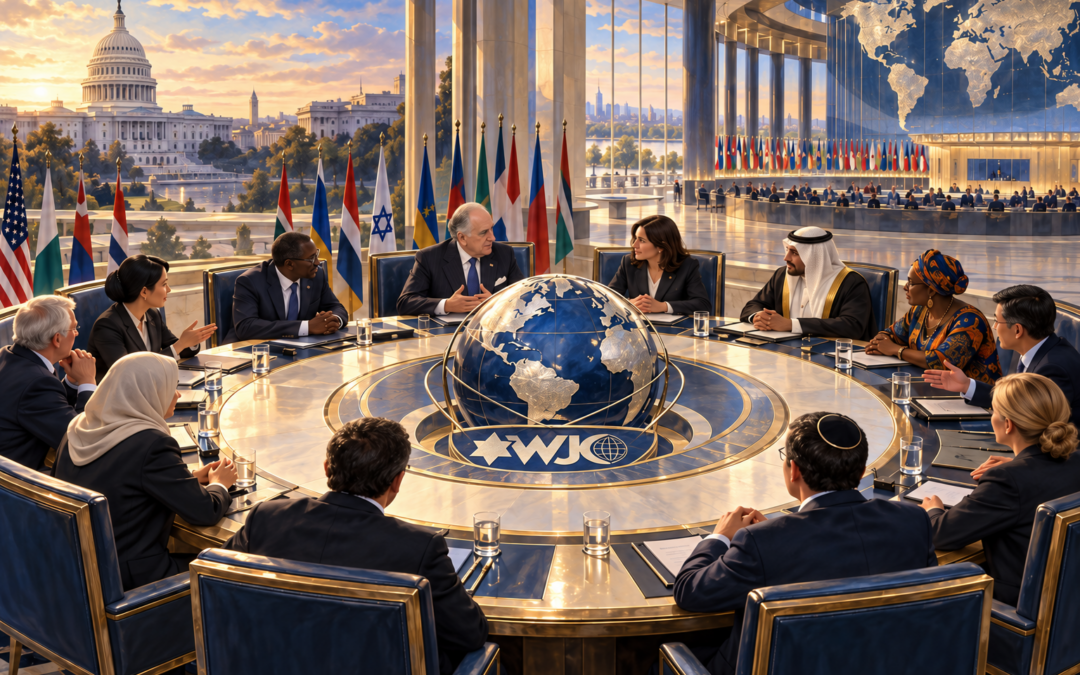
This is where the World Jewish Congress has a responsibility that no American lobbying organisation can fulfil. AIPAC’s mission concerns the relationship between the United States and Israel. The WJC’s mandate encompasses Jewish communities across more than 100 countries, each facing distinct political conditions and vulnerabilities.
In my view, only the World Jewish Congress possesses the global representative foundation needed to build a coherent diplomatic voice for the Jewish diaspora.
That foundation must now become a more powerful instrument of international representation. The WJC should maintain permanent relationships with governments, secure sustained access to decision-makers and establish continuity that survives elections and changes of leadership.
Its work must encompass physical security, religious freedom, education, cultural preservation and protection against discrimination. It must also defend the legitimacy of Jewish participation in public life and the right of Jewish communities to maintain their relationship with Israel.
Such a diplomatic role requires authority drawn from the communities it represents. It must accommodate their diversity while identifying the interests that unite them. Its strength should come from credibility, institutional standing, expertise and relationships built over time.
Jewish concerns must receive consideration throughout the year, including when no election is approaching and no campaign contribution is being discussed.
AIPAC remains essential. Its mission should be strengthened, and its strategy adapted to the changing American political landscape. But the difficulties it faces reveal why electoral lobbying alone cannot secure the future of Jewish communities.
Three years after October 7, remembrance carries an obligation to prepare. Expressions of solidarity are insufficient without institutions capable of turning them into lasting protection.
The next chapter of Jewish influence must reach beyond the electoral cycle and acquire enduring diplomatic weight.
The World Jewish Congress must lead it.



Receive Breaking News
Sign up for our newsletter and stay up to date! Be the first to receive the latest news in your mailbox: