
Ronald Reagan once told an anecdote about three men standing before the gates of Heaven. There was room for only one of them, Saint Peter explained, and the place would go to the man who had practised the oldest profession in the world.
The first man was a surgeon.
“My profession is the oldest,” he said. “God took a rib from Adam in order to create Eve. That was a surgical operation.”
The second man was an engineer.
“Impossible,” he replied. “Before Adam and Eve, there was only chaos. Someone had to build the world out of it. That was the work of an engineer.”
Then the third man stepped forward.
In Reagan’s version, he was an economist. But our age requires one small amendment: the third man is a politician.
The surgeon and the engineer look at him in disbelief.
The politician shrugs.
“And where,” he asks, “do you think the chaos came from?”
The joke is old. The diagnosis is eternal.
The professional politician has no real ideology. He has an inventory. Today he sells solidarity, tomorrow security, the day after tomorrow indignation. His convictions last exactly as long as the opinion poll that makes them profitable.
He does not necessarily solve problems. He mines them.
Chaos, for him, is not a catastrophe. It is raw material. Division is not a failure. It is a constituency. Fear, envy and resentment are not social diseases to be cured, but emotions to be harvested.
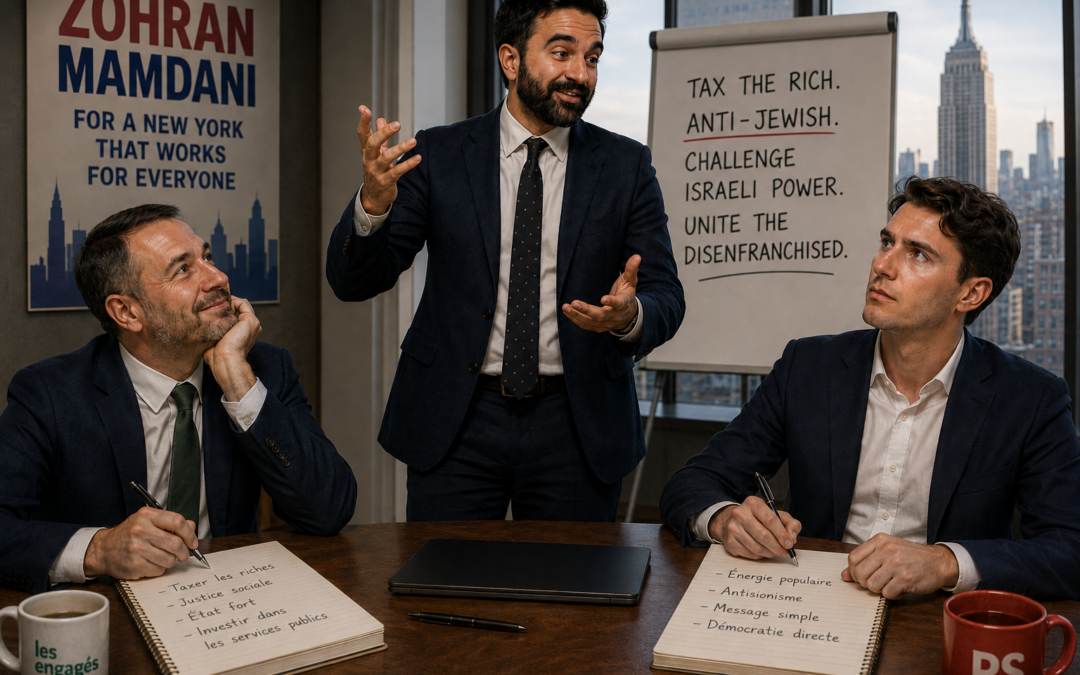
New York has now written the manual. Zohran Mamdani has given it a cover.
Envy with a Free Bus Ticket
Those who claim that Mamdani won merely because he promised free buses, free childcare and rent freezes have seen only the packaging. These promises were clever, simple and cinematic. They could be explained in one sentence and sold in a thirty-second video.
But every free ride has a hidden ticket office. Every free service has a bill. And in Mamdani’s story, it was already clear who would be made to pay it: someone else.
His success rested on two ancient political pillars. The first was envy. The second was the electoral normalisation of antisemitic sentiment under the banner of anti-Israel activism.
Mamdani openly declared that billionaires should not exist. His campaign linked its social promises to higher taxes on millionaires and corporations. The message was not merely that poorer New Yorkers deserved help. The deeper message was that wealth itself had become suspect.
There lies the difference between social policy and the politics of envy.
Social policy asks how people may be lifted up. The politics of envy asks who must be dragged down.
Social policy seeks to reduce poverty. The politics of envy seeks to make prosperity morally suspicious.
The entrepreneur is no longer presented as someone who accumulated capital, took risks, paid employees and perhaps made mistakes along the way. He is reduced to the caricature of someone who has “too much.” How that wealth was created no longer matters. Its existence becomes proof of guilt.
Envy is jealousy that has been handed a ballot paper.
That was Mamdani’s first political fuel. He did not promise voters a society in which more people could build wealth. He promised them a society in which the wealthy would be handed the bill. It is an irresistible formula, because the politician offers benefits to those who may vote for them, while sending the invoice to a minority that does not support him anyway.
Antisemitism in Humanitarian Packaging
The second pillar was darker.
Criticism of Israel is not automatically antisemitism. Nor is criticism of Benjamin Netanyahu. A government, including the Israeli government, may be judged harshly. Military conduct may be examined. Palestinian suffering must not be denied or minimised.
But Mamdani did not stop at criticism of a government.
He supports the BDS movement. He refused to recognise Israel specifically as a Jewish state, preferring instead to say that Israel may exist only as a state with equal rights for all. He initially refused to condemn the slogan “globalise the intifada.” Only under political pressure did he promise not to use the words himself and to discourage others from doing so. Earlier, he had linked the brutality of the New York police directly to Israel, claiming that when the NYPD’s boot is on someone’s neck, that boot has been laced by the Israeli army.
These are not accidental slips. They form a pattern.
The Jewish state is not treated as one state among many, with borders, governments, crimes, enemies and historical traumas. It is treated as the metaphysical source of injustice, as though even police violence in New York can only be understood by dragging Israel into the frame.
That is the characteristic movement of modern antisemitism. It rarely says openly anymore: “I hate Jews.” It prefers to speak of the one Jewish state that alone must be denied national legitimacy. It speaks of hidden influence, dark money and power operating behind the visible world. It gives old prejudices a new vocabulary and then calls it human rights activism.
In June 2026, Mamdani went further still. He described AIPAC, the pro-Israel lobby organisation, and the forces he claimed were protecting the existing order as “monsters.” He spoke of millions in dark money, of power, of attempts to set people against one another. Even some of his progressive Jewish allies condemned the choice of words as part of a disturbing pattern.
One does not need to look into Mamdani’s soul in order to judge his language. Politics is not measured by secret intentions, but by public signals.
A politician who, in the city with the largest Jewish community outside Israel, first relativises the word intifada, rejects the Jewish character of Israel, makes the Israeli army responsible for American police violence and then depicts a pro-Israel organisation as a monster fed by dark money knows exactly which audience he is serving.
The fact that he also declares his opposition to antisemitism does not erase those choices. A politician may solemnly defend fire safety on Monday and hand out matches on Tuesday.
The Political Chemistry of the Thirties
The comparison with Nazism must be made with care. Mamdani is not Hitler, and New York is not Germany in 1933. A direct equivalence would be historically lazy and intellectually dishonest.
But that does not mean the mechanism should be ignored.
The poisonous political chemistry consists of two ingredients: economic resentment and a Jewish enemy image. One group is told that its hardship is caused by the wealth of another. Then it is taught that behind wealth, media, lobbies and political power, the same suspicious influence is always lurking.
During the Great Depression, the Nazis gained support by presenting Jews as the source of political, social, economic and moral decay. They transformed frustration into accusation, and accusation into a worldview.
Not the same movement. Not the same crime. But a historically recognisable method.
When citizens are taught that social problems do not arise from complex institutions, bad laws, human weakness and clashing interests, but from a morally rotten class and a suspect minority, the same track is always being laid. The final station may differ. The direction remains dangerous.
Mamdani set the train in motion, and the Democratic Party is watching the ticket sales.
In June 2026, three candidates backed by him won Democratic primaries for the United States House of Representatives. Two sitting members of Congress were defeated. What was still presented in 2025 as a surprising local victory is now developing into a political school: promise tangible benefits, demonise economic opponents and present anti-Israel radicalism as moral purity.
Success is more contagious than conviction.
Les Engagés Discover Envy
Belgian politicians have been watching closely.
Anti-Israel agitation has by now become so ordinary here that Jewish citizens are again and again forced to answer for a government they did not elect and a war over which they have no authority. The boundary between criticism of Israel and the suspicion cast upon Jews is crossed constantly, after which people feign outrage when the word antisemitism is used.
But that source alone does not produce unlimited votes. And so Mamdani’s other fuel is now being deployed: envy.
Les Engagés seek to overtake the Socialists and even the PTB on the left with proposals that are economically harmful but electorally vivid. They propose an annual contribution on what they call “large financial fortunes.” Real estate would be excluded, and the first 500,000 euros in financial assets would be exempt. Technically, therefore, only the amount above 500,000 euros would be taxed. Politically, however, the message is unmistakable: from half a million euros onward, the citizen enters the category of “large fortune.”
That amount is significant. But it is not oligarchic wealth.
It may be the proceeds from the sale of a small business. It may be the pension reserve of someone who saved and invested for forty years. It may be the capital of a self-employed person who does not enjoy a generous civil-service pension. It may be the money with which someone intends to finance future care, support children or secure old age.
For Les Engagés, however, it is enough to redefine that citizen politically. He is no longer prudent, independent or forward-looking. He now belongs to the “large fortunes.”
The PS places its definition of the “ultra-rich” at 1.25 million euros, in addition to the family home and professional assets. The PTB begins its millionaire tax only at a net worth of five million euros. The tax bases differ, but the semantic race is unmistakable: Les Engagés are lowering the political threshold of wealth even further than parties that openly call themselves socialist or Marxist.
That is not centrism. That is electoral price-cutting.
They do not seek to defeat the PTB by explaining why its economic prescriptions are wrong. They seek to defeat it by declaring an even larger group of citizens to be rich fiscal sinners.
California Taxes Mountains; Belgium Taxes Hills
The comparison with California makes the Belgian impoverishment of the word “rich” almost comic.
In California, voters are expected to decide on a one-time levy of five percent on individuals with wealth exceeding one billion dollars. Even in one of America’s most progressive states, the target is explicitly billionaires. The proposal is also one-time.
In Belgium, by contrast, the debate concerns an annual contribution beginning above 500,000 euros in financial assets.
California points to a mountain and calls it a mountain.
Belgium points to a hill and announces that even there the sherpas must pay.
The difference is more than arithmetic. It reveals two opposing ambitions. California is debating how much may be taken from people who possess more than a billion. Belgium is debating how low the definition of wealth can be pushed before the middle class realises that it is next.
They do not want to make Belgium richer. They want to drag the concept of wealth so far downward that ever more citizens rise above it and can therefore be fiscally plucked.
A country does not become prosperous by calling its savers rich. Nor does it become just by making its successful citizens suspect.
Equality in impoverishment remains impoverishment.
The Tax That Selects Its Own Electorate
Of course, not everyone affected by such a tax will immediately leave. People have families, homes, companies, employees and social ties.
But not everyone needs to leave.
A tax base is not hollowed out by a total exodus. It is enough for the most mobile entrepreneurs, investors and wealthy individuals to go first. A country does not have to empty itself in order to become poorer. It is sufficient that precisely those who can rebuild capital, companies and jobs elsewhere decide to do so.
There is also a perverse electoral logic hidden here.
The people who are taxed leave or withdraw their investments. The people who support the tax remain. At the next election, the share of opponents is smaller and the share of beneficiaries larger.
The tax slowly destroys its own opposition.
When the revenue then disappoints, the politicians will not conclude that the tax was wrong. They will say that the rich have fled and that therefore a new group must now pay its “fair share.”
Today the threshold is 500,000 euros.
Tomorrow it will be 400,000.
Then 250,000.
The large fortune becomes a modest fortune. The modest fortune becomes savings. Savings become a sign of privilege. And each time, we will be told that only a small, exceptionally favoured minority is affected.
Until the minority has become the majority.
Poverty as an Instrument of Power
Poorer citizens are easier to govern than independent citizens. Not because they are less intelligent or less worthy, but because economic dependence narrows political freedom.
Those who depend increasingly on the state for housing, transport, childcare, income and healthcare find it harder to oppose that same state.
Prosperity disperses power.
Poverty concentrates it.
An independent citizen can refuse, leave, invest, support a newspaper, finance an association or start a political movement. A dependent citizen must first wonder whether his benefit, permit, subsidy or social housing will be endangered.
The politician who claims to fight poverty does not always have an interest in its disappearance. Poverty is also a client base. Dependence is also electoral loyalty. The state throws out the lifebuoy after first allowing the water to rise.
After entrepreneurs and capital have left, the fiscal threshold can be lowered again and again. In the end, only politicians remain above the line — not necessarily because they are the richest, but because they themselves decide where the line is drawn.
America Remains an Example
The United States remains an example for Europe. But not every example is meant to be followed.
Some examples are monuments.
Others are warning signs.
Mamdani shows how elections can be won by combining social promises with economic envy and anti-Israel radicalism that makes antisemitic ideas politically respectable. He shows how to make benefits visible and costs invisible. How to hand the voter a gift while pointing to an enemy who must pay for it.
Belgian politicians are not importing America’s entrepreneurial spirit, its constitutional instinct for liberty or its distrust of an omnipotent state.
They are importing its preachers of hatred and architects of chaos.
At the gates of Heaven, the politician is still smiling. He does not need to ask where the chaos came from. He knows the answer.
He helped create it, then called it a crisis, taxed its victims and finally promised to solve it — after the next election.



Receive Breaking News
Sign up for our newsletter and stay up to date! Be the first to receive the latest news in your mailbox: