
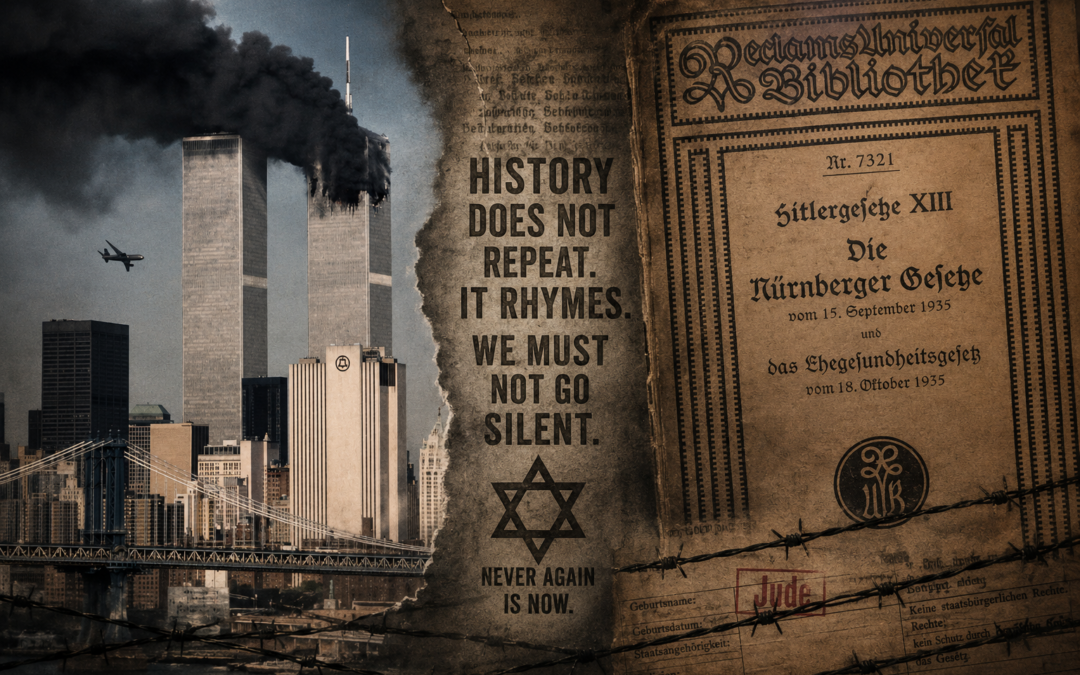
On Friday, September 11, 2026, America will spend the daylight hours remembering the dead.
At sundown, Jewish families will light candles for Rosh Hashanah, welcoming the year 5787. The Jewish New Year does not merely occur near the twenty-fifth anniversary of 9/11. It begins as that anniversary day comes to an end. Grief and renewal will occupy the same date, separated only by sunset.
Calendar coincidences are not prophecies. But sometimes they impose a moral clarity that politics has tried to avoid.
Twenty-five years ago, al-Qaeda turned passenger aircraft into weapons and attacked the economic and military symbols of the United States. Nearly three thousand human beings were murdered. They were not abstractions, representatives of a foreign policy or pieces on a geopolitical chessboard. They were passengers, office workers, flight crews, firefighters, police officers, soldiers, parents, children and strangers who attempted to save one another.
September 11 was not an accident of history, nor an impersonal eruption of “grievance.” It was a calculated operation conceived and directed by al-Qaeda. It was a declaration of war by a totalitarian ideology that claimed religious sanction—not by Islam as a faith, and not by Muslims as a people, but by jihadist extremism—against the open society and the values on which it depends.
Its targets were American, but its enemy was larger than America. Its enemy was the proposition that people of different religions can live under a common law; that women possess equal dignity; that minorities need not submit to the majority’s theology; that thought may be free, enterprise may flourish and political authority may be challenged without bloodshed.
Twenty-five years later, the West increasingly hesitates to defend that proposition.
When Explanation Becomes Exoneration
Every serious society must examine the conditions in which terrorism develops. Foreign policy must be scrutinised. Military interventions must be judged. Governments must be held accountable for errors, abuses and catastrophes.
But explanation is not exoneration.
There is a moral line between examining the circumstances that preceded an atrocity and transferring responsibility from those who committed it to those they murdered. That line is crossed when terrorism is described as “inevitable,” when mass murder is treated as an understandable reflex, or when the victims are told that their society invited its own destruction.
In the 2026 American election cycle, antisemitic conspiracy theories and dehumanising rhetoric have appeared around candidates and campaigns across ideological lines. A victorious congressional primary candidate also attracted criticism after describing 9/11 as “inevitable” in light of American foreign policy, while another candidate promoted allegations that Israel had orchestrated or possessed advance knowledge of the attacks.
This is not historical analysis. It is moral laundering.
It removes agency from the terrorist and places guilt upon the society he attacked. It transforms murder into consequence, fanaticism into protest and the dead into defendants at their own trial.
A civilisation that can no longer say that the deliberate murder of civilians is evil—without immediately adding a qualifying but—has begun to lose the language required to defend itself.
Four Days Later: Another Anniversary
Four days after the twenty-fifth anniversary of 9/11, the world will reach another date that should disturb the conscience: September 15, 2026, the ninety-first anniversary of the Nuremberg Race Laws.
On September 15, 1935, during a special session of the Reichstag, the Nazi regime enacted the Reich Citizenship Law and the Law for the Protection of German Blood and German Honour. German Jews were deprived of full citizenship. Jewishness was transformed from religious identity into a racial classification determined by ancestry. The state established the legal and bureaucratic categories that would be used to isolate, dispossess and persecute Jewish people.
The gas chamber was not the first instrument of the Holocaust.
The first instrument was the definition.
Before deportation came classification. Before the cattle car came the administrative file. Before mass murder came the respectable signature beneath a law explaining who belonged, who did not and whose rights could be withdrawn.
To remember September 15, 1935, is not to claim that Europe or America in 2026 is Nazi Germany. Such careless comparisons diminish the singular horror of the Holocaust. History does not repeat itself mechanically.
But its mechanisms remain legible.
Prejudice first seeks a vocabulary. Then it seeks social permission. Then it enters institutions. It is normalised through repetition, excused through political convenience and finally converted into policy by people who insist that they are merely responding to public sentiment.
The danger does not begin when everyone becomes an antisemite. It begins when too many people decide that antisemitism is no longer disqualifying.
The Oldest Hatred Learns New Languages
Antisemitism has not suddenly returned after ninety-one years. It never entirely disappeared. What has returned is permission.
The oldest hatred is remarkably modern. It speaks the language required by each audience. On the extreme right, Jews are portrayed as rootless manipulators who control nations from behind the scenes. On the radical left, Jewish national self-determination is treated as uniquely illegitimate, while Jewish identity is reduced to an accusation of power. Religious fanatics present Jews as theological enemies. Online influencers convert ancient conspiracies into profitable entertainment.
The Jew is condemned for being too foreign and Israel for being too national; for being too capitalist and too revolutionary; for being too influential and too isolated; for refusing to assimilate and for succeeding within society.
The contradictions are not a weakness in antisemitism. They are its strength. Antisemitism is not a coherent theory. It is a machine for assigning guilt.
The evidence cannot be dismissed as Jewish anxiety. The European Union Agency for Fundamental Rights reported in 2026 that 96 per cent of Jewish respondents in its latest survey had encountered at least one form of antisemitism during the preceding year—and that survey was conducted before the attacks of October 7, 2023, and their aftermath.
Criticism of the Israeli government is legitimate. Opposition to a particular Israeli policy is legitimate. Advocacy for Palestinians is legitimate. No democratic state is above scrutiny, including the Jewish state.
But the collective indictment of Jews is not criticism. Holding Jewish citizens responsible for the actions of Israel is not human-rights advocacy. Applying to Israel a right to existence, security or self-defence that is denied to no other recognised people is not universalism.
A simple standard is enough: criticise governments, not peoples; judge individuals, not ancestries; apply principles universally, not selectively.
When Success Becomes Evidence of Guilt
Another element has entered contemporary politics: the growing suspicion of success itself.
The successful person is presumed to have stolen. Wealth is treated as proof of corruption. Influence is recoded as conspiracy. Achievement becomes morally suspect, particularly when it belongs to a minority that prejudice has already taught society to distrust.
Concentrated power must, of course, be scrutinised. Monopolies must be challenged. Corruption must be punished. Capitalism without competition, responsibility or law can become exploitation.
But envy is not justice.
When achievement is treated as evidence of manipulation, the oldest conspiracy has merely found a modern economic vocabulary. The accusation is no longer that a particular person abused power. It is that prosperity itself reveals a hidden system of control.
America must not apologise for the freedom to build, invest, invent, own, exchange, prosper, fail and begin again. These freedoms do not excuse inequality or absolve the powerful of responsibility. They are nevertheless among the foundations of American strength.
Economic dynamism financed the universities, laboratories, armed forces, technologies, media institutions and philanthropic networks through which the United States became the most influential country of the modern era. An America ashamed of achievement will not necessarily become fairer. It may simply become poorer, angrier and easier to radicalise.
Jewish Survival Cannot Be Outsourced
For Jewish communities, the lesson is particularly severe.
Jewish security cannot be outsourced to the goodwill of politicians. Political sympathy is temporary. Electoral calculations change. Coalitions dissolve. Leaders who attend memorial ceremonies when solidarity is fashionable may disappear when standing beside living Jews carries a political cost.
Disappointment in politicians is understandable. Dependence is naïve.
Jewish communities require more than sympathetic statements after an attack. They require secure institutions, independent media, legal capacity, political education, diplomatic access, serious philanthropy and a new generation of leaders prepared to accept public responsibility.
Economic strength is not something for which Jewish organisations should apologise. Nor should influence be confused with domination. Democratic influence means the legitimate capacity to participate, persuade, organise, publish, litigate, vote, invest and build alliances.
A community that possesses resources but lacks the courage to deploy them will eventually discover that nominal access is not power. The number of invitations to official receptions is irrelevant if those invitations cannot alter a decision, prevent discrimination or protect a child entering a Jewish school.
The World Jewish Congress at the Threshold
Nowhere is the need for reinvention more urgent than at the World Jewish Congress.
Ambassador Ronald S. Lauder has served as its president since 2007. He has no choice than to stay until WJC becomes the powerhouse jews around the world deserve.
This is not merely a succession problem. It is an institutional question.
Ronald Lauder must define what the World Jewish Congress is to become in the next 90 years. This will become his real legacy, not the past he created, but the vision he will provide for the future.
The WJC cannot survive as another venerable organisation that convenes conferences, circulates declarations and responds to each outrage after the narrative has already hardened. It must become a diplomatic powerhouse: permanent, professional, multilingual and operational.
It should not compete with Israeli diplomacy. Israel represents a sovereign state and its citizens. The World Jewish Congress represents Jewish communities dispersed across many states, each with distinct legal, political and security concerns. These mandates overlap, but they are not identical.
The WJC should become a force multiplier for Israel’s legitimate place among nations while maintaining the institutional independence required to represent Jewish life throughout the diaspora.
That requires a global media command centre capable of answering lies before they become accepted history; a multilingual newsroom producing documentary, digital and cultural content; permanent representatives in strategic capitals; a legal and policy unit able to challenge institutional discrimination; and a strategic-analysis network identifying threats before they become crises.
A falsehood answered three weeks later has not been defeated. It has been archived.
The WJC already possesses consultative status with the United Nations Economic and Social Council—a standing first obtained in 1947—and operates a Jewish Diplomatic Corps. It should transform that inheritance from a badge of recognition into the foundation of a far more ambitious international presence.
The Sovereign Order of Malta, which holds permanent observer status at the United Nations, offers an example of the influence that institutional continuity, recognised international standing and permanent missions can create. Its unique legal and historical status cannot simply be copied by a non-governmental organisation. But the strategic lesson can be learned.
The WJC should seek every formal status international law permits: permanent consultative arrangements, structured agreements with governments and regional organisations, accredited envoys, crisis protocols and sustained representation where decisions are made.
The objective is not pseudo-sovereignty. It is durable diplomatic access.
America Must Be Reborn
The United States that came under attack on September 11 must also be reborn—not in vengeance, not in suspicion of Muslims and not in permanent war, but in moral confidence.
America must be unafraid to remember. Unafraid to identify jihadist extremism while defending the rights and dignity of peaceful Muslims. Unafraid to distinguish tolerance from surrender. Unafraid to defend capitalism while reforming its abuses. Unafraid of patriotism simply because national confidence can be misused.
A nation unable to name its enemy cannot protect its friends. A nation that mistakes self-accusation for virtue eventually teaches its adversaries that its self-doubt is a strategic vulnerability.
Europe faces the same test.
The security of Jewish life is not a private Jewish concern. It is a measure of whether European democracy still believes its own promises. The decisive question is not whether politicians attend Holocaust commemorations. It is whether they will stand beside living Jews when doing so may cost votes.
A continent that honours dead Jews while abandoning living ones has not learned the lesson of history. It has merely perfected the ceremony of remembrance.
The Sound of the Warning
As September 11, 2026, ends, Rosh Hashanah will begin.
In the days that follow, the shofar will sound. It is not background music for nostalgia. It is an alarm, a summons and a demand for moral accounting.
Then, on September 15, the anniversary of the Nuremberg Laws will remind us where administrative prejudice can lead when institutions surrender one compromise at a time.
Three dates stand before us: September 11, 2001; September 15, 1935; and September 2026.
Their histories are different. Their warning is shared.
Memory without institutions becomes ceremony. Morality without power becomes a plea. Influence without courage becomes decoration.
The Jewish future and the American future are intertwined because both depend upon the same civilisational conviction: that free people have the right to exist, to prosper, to defend themselves and to refuse the authority of those who seek to govern through terror.
When Jews can be safe only by becoming silent, the West is no longer free.
When America apologises for its ideals instead of correcting its failures, its enemies do not become more moderate. They become more confident.
Twenty-five years after 9/11, the answer must therefore be unmistakable:
We will not be afraid to remember.
We will not be afraid to identify hatred.
We will not be ashamed to build, to prosper, to influence and to defend.
History has given us the dates. The future will judge what we did with their warning.



Receive Breaking News
Sign up for our newsletter and stay up to date! Be the first to receive the latest news in your mailbox: