

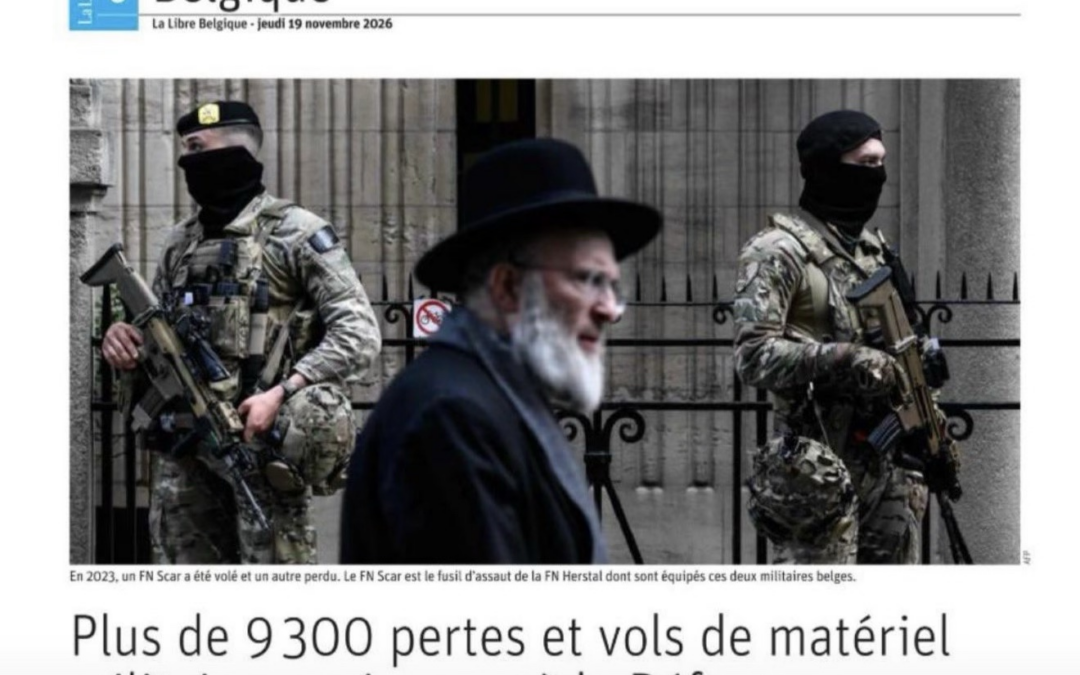
On page six of La Libre Belgique on 19 November, an elderly Jewish man in a black hat walks past two Belgian soldiers. Beneath him, in the largest type on the page, a headline announces more than 9,300 losses and thefts of military equipment in five years. What did this man have to do with any of it? As far as the newspaper’s own reporting establishes, he was walking down the street. The only connection between this man and the missing equipment was the one the newspaper created on the page.
The story itself concerns the Belgian state’s ability to account for its property. A member of parliament put questions to the defence minister. The minister supplied figures. The public had every reason to ask how weapons could go missing and who was responsible for keeping track of them. Yet the person given the most prominent place in the photograph was a passer-by who owed Parliament, the newspaper and its readers no explanation whatsoever.
Dorian de Meeûs apologised on behalf of La Libre. He explained that the editors wanted to illustrate the FN SCAR rifle, a weapon carried by Belgian soldiers protecting synagogues. He said there had been no malicious intent. The explanation is entirely plausible. It also exposes the failure of editorial judgment. The editors could identify the model of rifle carried by the soldiers in the background. How did they overlook the man occupying the foreground?
Consider that explanation from the perspective of a Belgian Jew. A newspaper reaches for a photograph of soldiers guarding a synagogue because Belgian Jews require armed protection to worship in safety. It then takes that image out of the context that gives it meaning and places it above a headline about theft. An image drawn from the protection of Jewish life has become a vehicle for suspicion. A reader who glances at the page may never read the small caption identifying the rifles. That reader has already seen the man and the headline.
The reference to the 1930s has a specific Belgian history. In June 1932, the Jewish Telegraphic Agency reported that an Antwerp daily had published an editorial portraying Jews collectively as political subversives and swindlers. A Jewish reader opening that paper could find himself accused of dishonesty by the simple fact of belonging to the community under discussion. In 2026, La Libre made no such explicit accusation. What survived on page six was the old association between Jewish identity and dishonesty, conveyed this time by the distance of a few millimetres between a photograph and a headline.
That is why the apology matters, and why its wording deserves scrutiny. La Libre apologised for failing to anticipate the interpretation readers might draw. But readers had no say in choosing the photograph, sizing it or placing the headline beneath it. Those were editorial decisions. A fuller acknowledgment would have been one any reader could understand. We placed an identifiable man above a headline about theft. He had no connection to the story. We should have chosen another photograph.
Every Belgian editor knows the question to ask before printing a name in connection with a crime. What evidence justifies putting this person in the story? A face deserves the same care as a name. The man on page six had as much right as any other Belgian to walk past a camera without becoming the face of someone else’s wrongdoing.



Receive Breaking News
Sign up for our newsletter and stay up to date! Be the first to receive the latest news in your mailbox: