

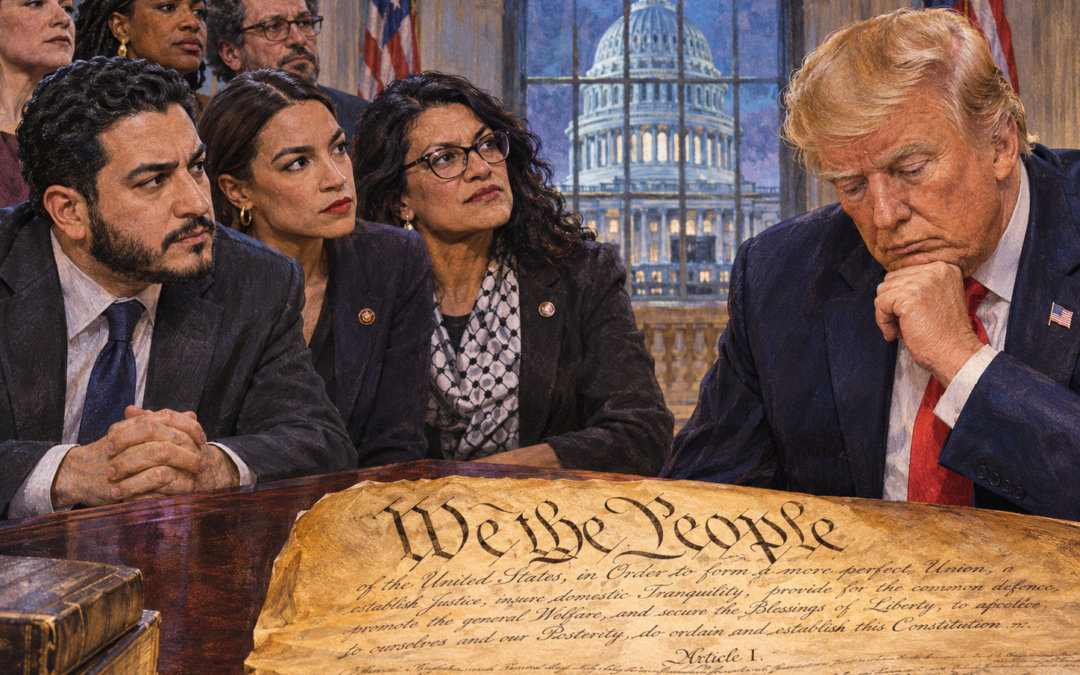
The morning after an American midterm election, the electoral map can suggest that power has changed hands more completely than it actually has. A president loses his congressional majority, opponents prepare investigations, and attention turns towards his successor. Yet the same president still commands the armed forces, directs American diplomacy and possesses a veto capable of frustrating the new majority. For Europe, understanding this division of authority is essential to judging what comes next in Ukraine, Iran and the transatlantic relationship.
As of 4 November 2026, reporting indicates that Democrats have won both chambers of Congress. The new congressional terms begin on 3 January 2027. Until then, the outgoing legislature retains its authority. The political consequences of the election are immediate; the institutional transfer follows the constitutional timetable.
Congress comprises the House of Representatives and the Senate. Their opposition to the president creates divided government, a familiar feature of the American system. Unlike a prime minister who depends on parliamentary confidence, an American president does not have to resign after losing a legislative majority. His Cabinet does not automatically fall, and executive authority does not pass to the opposition. Equally, the president cannot dissolve Congress and call new elections to recover control.
This arrangement distributes power without ensuring agreement. The president needs Congress to enact new legislation and provide funding. Congress needs either presidential consent or the votes to overcome a veto. Neither side can simply assume the functions of the other.
Calling a president a “lame duck” can therefore obscure more than it explains. The expression describes declining political influence, particularly as a final term approaches its end. It does not identify a constitutional reduction in presidential powers. Donald Trump may find legislators less obedient and potential successors more independent, while continuing to exercise substantial authority abroad.
The distinction is between possessing powers and securing cooperation. An election can weaken the second without removing the first.
Presidents govern through a combination of constitutional authority and powers delegated by legislation. Executive orders are one instrument for exercising those powers. They can direct agencies, alter administrative priorities and change policies where the law permits. They cannot generally repeal a statute, create an appropriation or transform a presidential preference into legal authority.
Justice Robert Jackson’s influential framework in the Supreme Court’s Youngstown case remains useful. Presidential authority is strongest when Congress authorises the action. Where Congress has neither authorised nor prohibited it, the legal position can be uncertain. Where presidential action conflicts with Congress’s legislative position, the president must identify an exclusive constitutional power that Congress cannot restrict.
Political obstruction does not create additional executive authority. Nevertheless, previously enacted laws can leave extensive discretion in presidential hands. Sanctions waivers, emergency provisions and decisions about implementing funded programmes may allow an administration to continue pursuing its objectives despite a newly hostile legislature. The legal wording matters as much as the political announcement.
The veto strengthens this position. A president may reject legislation because he objects to its policy or cost; he need not establish that it is unconstitutional. Congress can override a regular veto only with two-thirds of members present and voting in each chamber, provided a quorum is present. When everyone votes, that means 290 representatives and 67 senators. The president needs enough support in only one chamber to prevent an override.
The power is substantial but bounded. The president normally has ten days, excluding Sundays, to sign or return legislation. If he does neither and Congress remains able to receive its return, the bill becomes law without his signature. A pocket veto applies when adjournment prevents return and the president does not sign within the constitutional period. A valid pocket veto cannot be overridden, although not every congressional recess qualifies.
There is also no general federal line-item veto. A president cannot accept a defence appropriation while deleting an unwanted condition attached to it. He must accept or reject the bill as presented, subject to lawful discretion within its provisions. The Supreme Court invalidated the statutory line-item veto in 1998.
Nor can the president veto an investigation, the rejection of a nominee or impeachment. He can contest particular demands on constitutional grounds, but these are separate disputes. A veto prevents legislation from becoming law; it does not erase existing law or compel Congress to provide money.
An opposition Senate can also obstruct the appointment of judges, ambassadors and senior officials who require confirmation. Existing officials do not automatically lose their positions, and lawful acting appointments provide some flexibility, but temporary appointments are subject to eligibility and time limits. Losing the Senate therefore affects the president’s ability to staff his administration as well as his legislative prospects.
These constraints help explain the recurrent attraction of foreign affairs during the later part of a presidency. Domestic reforms usually require legislation, appropriations and complicated congressional coalitions. Diplomacy offers more opportunities for direct initiative. The president can open negotiations, convene a summit, change diplomatic emphasis and direct much of the national-security apparatus without first passing a new bill.
There is a personal incentive as well. A president approaching the end of his final term may seek an internationally visible achievement. A peace settlement, strategic agreement or successful crisis negotiation can promise a legacy that domestic legislative deadlock appears to deny.
That incentive does not necessarily favour war. George W. Bush announced the Iraq troop surge in January 2007 after Republicans lost Congress, operating within an existing authorisation for that war. Barack Obama reached the Iran nuclear agreement in 2015 while Republicans controlled both chambers. Congressional opposition can coexist with military escalation or ambitious diplomacy.
Foreign governments, however, can distinguish between an agreement a president can announce and one he can sustain. A commitment requiring future appropriations or permanent sanctions relief may be less credible if Congress is unwilling to cooperate. Greater freedom to begin negotiations does not guarantee greater ability to deliver their outcome.
Not every international agreement requires the Senate’s two-thirds consent applicable to treaties under Article II. Executive agreements may rest on existing legislation, an earlier treaty or the president’s own constitutional authority. Political commitments offer another route. None automatically supplies missing appropriations or permits the president to disregard domestic statutory restrictions.
Military action exposes the sharpest tensions in this system. The Constitution makes the president commander-in-chief while assigning Congress powers over declaring war, raising and supporting armed forces, and financing their operations. Modern practice has left an extensively contested boundary between presidential initiative and legislative authorisation.
Successive administrations have argued that certain limited operations fall within presidential authority without advance congressional approval. Their analysis considers national interests and the anticipated nature, scope and duration of the operation, including risks to American personnel and the danger of escalation. The Justice Department relied on this reasoning when defending the 2018 strikes against Syrian chemical-weapons facilities.
This is an executive-branch interpretation, not a general Supreme Court licence for short wars. A narrowly defined strike presents a different constitutional case from an invasion intended to overthrow a government. Yet duration alone cannot settle legality. A brief attack may provoke a prolonged conflict, and describing an operation as limited does not determine its actual consequences.
The War Powers Resolution adds statutory requirements. It calls for consultation with Congress before hostilities whenever possible, notification within 48 hours of entry into hostilities or clearly imminent hostilities, and termination within 60 days after the relevant report was submitted or required, whichever comes first, unless Congress authorises continuation or another statutory exception applies. Up to 30 additional days are available only on a certification of military necessity concerning the safety of forces during their prompt removal.
The sixty-day period is not permission to fight any war for sixty days. The operation still requires a legal foundation from the outset. Nor are “war” in constitutional analysis and “hostilities” under the statute identical thresholds. An operation may fall below one threshold while crossing the other. Renaming successive attacks does not automatically restart the clock.
Enforcement remains difficult. An initial strike may be over before Congress can respond. Legislators may disagree about the operation but also disagree about ending it. Judicial challenges can fail on standing or other jurisdictional grounds without resolving the underlying legality. These realities give the president an advantage in acting first, even where his legal justification remains disputed.
Congress’s response also depends on the instrument it chooses. A concurrent resolution adopted by both chambers without presentation to the president differs from a law. The War Powers Resolution’s concurrent-resolution withdrawal mechanism has been constitutionally disputed since the Supreme Court’s decision in INS v. Chadha. An enacted withdrawal requirement or funding restriction has a firmer procedural foundation, but ordinarily faces a potential veto.
That distinction matters for the resolution Congress agreed on 23 June 2026 directing withdrawal from hostilities against Iran, subject to specified defensive exceptions. Its concurrent-resolution form must be considered when judging its enforceability. It should not be treated as equivalent to an enacted prohibition on expenditure.
Funding is Congress’s strongest practical instrument against a prolonged campaign, but it is not an immediate switch. Previously appropriated balances may remain available. A carefully drafted restriction can close routes that a vague prohibition leaves open. Conversely, a president who vetoes new restrictions still cannot turn a congressional refusal to provide further funds into fresh spending authority. Ordinary appropriations are also not automatically specific authorisation for hostilities under the War Powers Resolution.
International law imposes a separate test. Domestic presidential authority does not itself justify force against another state. The UN Charter’s restrictions, including the requirements associated with self-defence and Security Council authorisation, remain relevant. European participation requires an independent legal assessment; an American description of an operation as defensive is not sufficient by itself.
For Ukraine, the incoming Congress’s influence will depend heavily on the difference between supporting a policy and requiring its implementation. Legislators can seek additional assistance, investigate delays and constrain sanctions relief. The administration nevertheless remains central to weapons delivery, intelligence cooperation and negotiations.
A statutory power that the president may exercise differs from a duty he must perform. Neither should implementation discretion be mistaken for unlimited permission to withhold funds. In 2020, the Government Accountability Office concluded that withholding Ukraine security assistance for a policy reason violated the Impoundment Control Act.
A contemporary example illustrates the other side of the equation. On 16 October 2026, Trump waived major provisions of the recently enacted Lindsey O. Graham Sanctioning Russia and Iran Act, using authority Congress had included in the legislation. The order expressly preserved certain pre-existing Russia sanctions. It did not abolish all American sanctions against Russia.
The lesson is that a law announcing strong measures can leave the president substantial room to manoeuvre if it contains broad waivers. A Congress seeking to constrain policy must examine the exceptions as carefully as the obligations.
Trump can continue negotiating over Ukraine without a new congressional negotiating mandate. He cannot legally dispose of Ukrainian territory on Kyiv’s behalf or bind European governments to concessions they have not accepted. His leverage lies in American assistance, sanctions and security commitments. Democratic control of Congress creates more opportunities to challenge his choices, but does not guarantee a return to the policies Ukraine or Europe would prefer.
Iran presents a different combination of incentives. A president can seek a negotiated settlement, maintain pressure through sanctions and limited operations, or consider escalation. The election does not predetermine his choice. Reuters reported on 3 November that Trump said the United States had no immediate plans to strike Iran. That is a statement of current policy, not an irrevocable commitment.
An agreement relating to Iran’s nuclear programme would also encounter the Iran Nuclear Agreement Review Act. Covered agreements must be submitted to Congress, with a normal thirty-day review period during which specified statutory sanctions relief is restricted. Calling an arrangement an executive agreement does not automatically remove these requirements.
The political costs of conflict can encourage negotiation as readily as a weakened president’s desire to demonstrate resolve can encourage pressure. A sound assessment must separate the options available to him from speculation about his intentions.
Impeachment is the legislature’s most serious response to presidential misconduct. It is not a parliamentary vote of no confidence. Its constitutional grounds include treason, bribery and other high crimes and misdemeanours. These can encompass serious abuse of office without requiring a prior criminal conviction. Electoral defeat or disagreement over foreign policy does not itself establish the case.
The House can impeach by a simple majority, but impeachment is an accusation, not removal. The president remains in office unless the Senate convicts on at least one article by two-thirds of senators present. With all one hundred senators attending, sixty-seven votes are required. The Chief Justice presides over a sitting president’s trial; senators determine the result.
Conviction brings removal, and the Senate may subsequently impose disqualification from covered future federal offices through a separate majority vote. It cannot impose a prison sentence through impeachment. Removal normally elevates the vice-president rather than transferring the presidency to the party controlling Congress. Even this constitutional earthquake would therefore not necessarily produce the foreign-policy reversal European observers might expect.
A president cannot veto impeachment or pardon its consequences. The Constitution expressly excludes impeachment from the pardon power. Yet that leaves a substantial independent authority to relieve individuals of federal criminal liability.
A pre-emptive pardon may be granted before indictment or conviction, but only for offences already committed. It cannot authorise future crimes. Ford’s pardon of Nixon in September 1974 remains the classic example of broad protection for past federal conduct before prosecution. A pardon need not be limited to an offence already charged.
The president does not need congressional consent and is not constitutionally bound by the Justice Department’s ordinary application process. However, a pardon does not cover state offences, automatically extinguish civil claims or erase the historical facts. Nor does it cancel a congressional subpoena. Where criminal exposure is fully removed, it may narrow a witness’s ability to invoke the Fifth Amendment, although exposure to state or unpardoned federal offences can preserve that privilege.
These powers can therefore protect associates without preventing Congress from investigating what happened. A valid pardon may remain effective while the circumstances surrounding its grant become evidence of presidential abuse. Protecting its recipient and holding its issuer accountable are separate constitutional questions.
A self-pardon is more uncertain. The Justice Department’s Office of Legal Counsel concluded in 1974 that a president cannot pardon himself, relying on the principle that nobody should judge his own case. The constitutional issue remains unresolved by a controlling Supreme Court judgment. It should not be presented as an established presidential entitlement.
Presidential criminal immunity is a further, distinct protection. In Trump v. United States in 2024, the Supreme Court recognised absolute immunity for conduct within exclusive presidential constitutional authority, at least presumptive immunity for other official acts, and no presidential immunity for unofficial acts. It also rejected the claim that impeachment and conviction must always precede criminal prosecution. The decision complicates criminal accountability; it does not abolish impeachment or make all presidential conduct lawful.
For Europe, the practical consequence of these overlapping powers is a need to deal with Washington through more than one institutional channel. Congress can strengthen commitments, attach conditions and investigate failures. The White House remains indispensable for immediate decisions. European governments gain potential partners in the legislature without acquiring a substitute for presidential cooperation.
Ukraine’s support illustrates this dual dependence. NATO’s PURL mechanism enables allies and partners to finance American equipment for Ukraine. Reduced American financing therefore need not mean an end to American-sourced deliveries. It still leaves questions of availability, approvals and delivery schedules that money alone cannot answer.
NATO itself benefits from a statutory barrier to unilateral American withdrawal: existing law requires either two-thirds Senate consent or an Act of Congress and restricts spending in support of unauthorised withdrawal. Yet formal membership is only part of deterrence. Presidential statements, deployments and crisis decisions can strengthen or weaken confidence without an official departure from the alliance.
Europe also faces the interaction between Ukraine and the Gulf. Further disruption around Iran could increase energy costs and intensify competition for air defence and munitions. A settlement could ease those pressures. Congressional opposition may raise the political cost of escalation, but it does not remove the possibility of a rapid presidential decision with wider consequences.
Trade presents another reminder that presidential power depends on particular legal authorities. The Supreme Court’s February 2026 decision in Learning Resources v. Trump held that IEEPA did not authorise the tariffs at issue. It did not abolish tariff powers available under other legislation. Neither congressional control nor a judicial setback eliminates every executive instrument.
The midterms change the balance of bargaining power inside the American state. They can obstruct new initiatives, expose misconduct and make long-term commitments harder to secure. They leave a president capable of diplomacy, vetoes, lawful executive action and potentially consequential military decisions.
Europe must therefore judge an American commitment by the authority supporting it, the money attached to it, the institutions required to implement it and the ease with which it can be reversed. The electoral map is the beginning of that assessment. The constitutional system determines what can happen next.

Receive Breaking News
Sign up for our newsletter and stay up to date! Be the first to receive the latest news in your mailbox: