
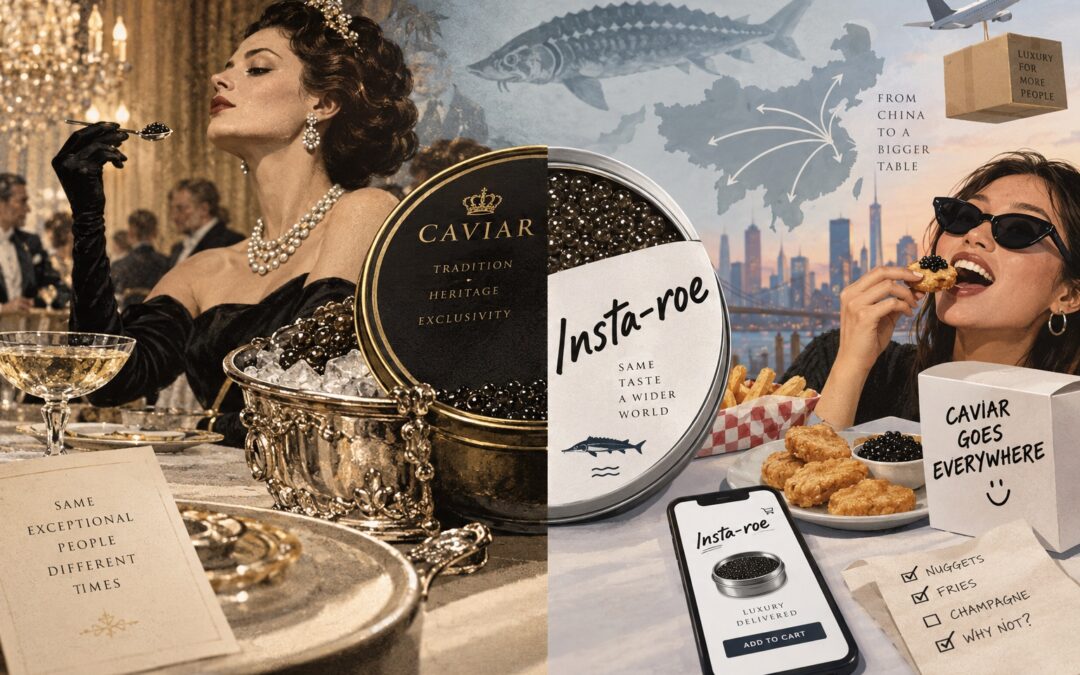
A diamond survives its owner. Caviar seldom survives the evening. Yet these two very different luxuries have long performed much the same social function: they have made privilege visible. One catches the light on a finger; the other rests in a small tin surrounded by a ceremony disproportionate to its size. Both promise something beyond beauty or pleasure. They suggest admission to a world from which others remain excluded.
The diamond industry has already discovered how vulnerable that promise can become. Laboratory-grown stones have helped unsettle a business built around the distinction between the extraordinary and the obtainable. The consequences are not merely philosophical. Anglo American’s 2025 results included another $2.3 billion writedown of De Beers, against a background of competition from laboratory-grown diamonds and weak consumer demand. Technology is not the only cause of the industry’s difficulties, but it has made the old assumptions about value harder to defend.
Now caviar faces its own encounter with abundance.
The resemblance is compelling, although the distinction matters. Laboratory-grown diamonds are not glass imitations: they are diamonds produced through a different process, sharing many of the properties of their natural counterparts and often requiring sophisticated analysis to establish their origin. The challenge they pose is therefore more unsettling than the arrival of an obvious counterfeit. They oblige the buyer to decide how much the story of origin is worth.
In caviar, the present disruption is not primarily a triumph of artificial substitutes over genuine roe. It is the expansion of genuine caviar from farmed sturgeon, sold through businesses less attached to the traditional choreography of luxury. Indeed, aquaculture had already become the source of nearly all commercially available sturgeon caviar when the European aquaculture federation summarised the European Union’s market study in 2021. This is not a simple contest between authentic old houses and inauthentic newcomers.
What is being substituted, increasingly, is the route to the customer—and the explanation for the price.
The price beneath the ceremony
The emerging price landscape exposes the scale of the challenge. Quince’s Royal Osetra was reviewed by Eater in May 2026 at $125 for a 100-gram tin. Caviar Russe currently lists its Classic Osetra at $495 for 125 grams. Expressed in the same unit, those prices are $1.25 and $3.96 per gram respectively. The difference is substantial even after correcting for the unequal tin sizes.
Such comparisons require care. They are not proof that identical caviar has suddenly become two-thirds cheaper, nor that every expensive tin is an exercise in overcharging. Caviar Russe itself distinguishes its grades by characteristics including grain size, colour and flavour. A price comparison can establish the breadth of the market without establishing equivalence between its products.
Nevertheless, a much cheaper entry point changes the conversation. A customer no longer needs to believe that several hundred dollars is the unavoidable admission charge. Once that belief weakens, every premium above the new reference price must find a more persuasive explanation.
The uncomfortable question is no longer simply whether the caviar is good. It is whether the difference is worth the difference.
Nor does “farmed” offer the established trade a useful dividing line. Caviar Russe identifies its Classic Osetra as farmed in Germany and the European Union. Roe House identifies China as the origin of its farm-raised Kaluga Hybrid. The contest is taking place within aquaculture, across different producers, species, selections and commercial models—not between nature on one side and a laboratory imitation on the other.
For the old luxury economy, that is a more difficult argument to win. A counterfeit can be dismissed. A genuine product sold under a less expensive label has to be answered.
A revolution years in the making
The apparent suddenness of “Insta-roe” conceals a much longer transformation. In December 2016, Reuters was already reporting that increased production had brought caviar into discount supermarkets. Petrossian said prices had halved over the preceding five years; Lidl had sold 15-gram tins of Italian caviar for €9.99. The present upheaval is therefore not the beginning of accessible caviar. It is a new commercial and cultural phase of a supply revolution already well under way.
China has become central to that revolution. In December 2025, the Financial Times reported that the country accounted for the majority of global caviar production and exports, with Kaluga Queen alone supplying approximately 35 per cent of world output. A delicacy whose imagined geography still gravitates towards the Caspian Sea now belongs to a very different production map.
There is an irony here that extends beyond food. Luxury marketing asks the customer to look backwards, towards heritage, ancestral expertise and places steeped in legend. Competitive production looks forwards, towards capacity, consistency and distribution. The label may evoke a vanished court; the business beneath it must still manage its stock.
But caviar cannot be produced at the speed of an advertising campaign. Sturgeon mature slowly, a biological characteristic that also makes wild populations difficult to restore. For a producer, that means years of expenditure before the hoped-for return. The commercial implication is important: investments made under one set of price expectations may reach maturity in a very different market.
When more farms bring their roe to market, the resulting supply cannot simply be wished away. Nor can a perishable delicacy be held indefinitely while its owner waits for prestige to recover. Unlike a diamond, caviar has a deadline. The seller must find another buyer, another occasion or another price.
This is where the new brands enter. They do not need to invent the egg. They need to invent more reasons to eat it.
There is also a moral complication in mourning the retreat of the old scarcity. The historical association between caviar and rarity is inseparable from the exploitation of wild sturgeon. IUCN identifies demand for caviar, poaching and overharvesting as major threats to their survival. Its conservation programme describes 25 of 27 species as threatened with extinction, with two already lost. Whatever legitimate questions remain about individual farming practices, the romanticisation of wild caviar cannot erase that ecological bill.
An industry should not have to depend on the disappearance of its source to preserve the exclusivity of its product.
From aristocracy to the algorithm
The new sellers are changing more than distribution. They are changing the manners of consumption.
The Wall Street Journal’s recent examination of direct-to-consumer caviar describes a category entering the familiar world of promotional offers, cheerful packaging and online convenience. Cavi makes the proposition explicit in its own branding: “The People’s Caviar.” Its website offers tasting kits, bundles and overnight delivery, presenting the product as something approachable rather than something requiring initiation. The Wall Street Journal
Roe House goes further in dismantling the ritual. Its serving suggestions include chicken nuggets, fries and other deliberately informal companions. The traditional accompaniments remain available, but they no longer monopolise the occasion. Caviar is invited to brunch, to a casual gathering, to an evening that has not bothered to dress for dinner. Roe House
The chicken nugget is not merely a culinary joke. It is an argument about who gets to decide what luxury means.
For one customer, the incongruity is liberating: something formerly intimidating becomes enjoyable. For another, it is the erosion of the very distinction that made the purchase attractive. If caviar can sit comfortably beside fast food, what becomes of its authority as a symbol of refinement?
Yet the apparent rebellion contains its own dependence. The pairing attracts attention because caviar still signifies extravagance. Without that inherited prestige, a spoonful on a nugget would be an ingredient rather than a statement. The new brands are challenging the old symbolism while drawing much of their appeal from it.
This is the delicate bargain of accessible luxury: it must become available without becoming insignificant.
For the trade, however, a loss of social distance need not mean a loss of customers. Lower prices and less formal presentation could increase the number of people who buy caviar and the frequency with which they buy it. The market can grow in volume even while some producers and intermediaries earn less on each gram. Commercial expansion and the dilution of prestige are not contradictory outcomes. They may be two descriptions of the same process.
And “accessible” remains relative. A $125 tin is not an everyday purchase for most households. The change is less the arrival of caviar on every table than the broadening of the audience able to contemplate it: from a remote emblem of wealth to an occasional indulgence.
What remains worth paying for?
The established houses are not necessarily condemned. But their strongest defence is unlikely to be indignation at the price of someone else’s tin.
A premium can still be earned through discernible quality, consistent selection, careful handling, reliable provenance and service. The argument becomes weaker when the name of the category is expected to do all the work. “It is caviar” is less convincing once another seller can answer, truthfully, “So is this.”
The likely outcome is a more visibly divided market rather than the disappearance of luxury caviar. At one end, efficient suppliers and direct sellers may compete for the growing audience of occasional buyers. At the other, specialist houses may retain customers prepared to pay for exceptional selections and a trusted experience. The difficult territory lies between them: products insufficiently distinctive to justify a large premium, but burdened with costs that make price competition painful.
The newcomers face their own test. A fashionable tin and an irreverent photograph may secure a first purchase; neither guarantees a second. Online attention has a cost, delivery has a cost, and disappointment travels as quickly as enthusiasm. Removing an intermediary does not abolish the work that intermediary once performed. It redistributes the work—and sometimes merely replaces one expense with another.
That is why the caviar story should not be reduced to a simple morality play in which honest newcomers expose fraudulent tradition. Expertise can be real. So can excessive markups. The question is which parts of the premium survive when customers acquire alternatives.
Here, the comparison with diamonds returns in its most revealing form. Neither beauty nor pleasure necessarily diminishes when production expands. What weakens is the certainty that the object provides reliable evidence of exceptional wealth. The buyer who wanted the experience may welcome the change. The buyer who wanted the distance may begin looking elsewhere.
Caviar may therefore lose some of its aristocratic lustre without losing its culinary worth. Perhaps it will be judged more closely, not less: by what is in the tin rather than by the atmosphere surrounding its arrival.
For those who love the taste, that need not be a tragedy. For those who loved what the price said about them, it is a more serious disturbance.
Caviar will not disappear from the tables of the rich. What may disappear is the comfortable certainty that its presence proves anything about the people sitting around them.


Receive Breaking News
Sign up for our newsletter and stay up to date! Be the first to receive the latest news in your mailbox: