
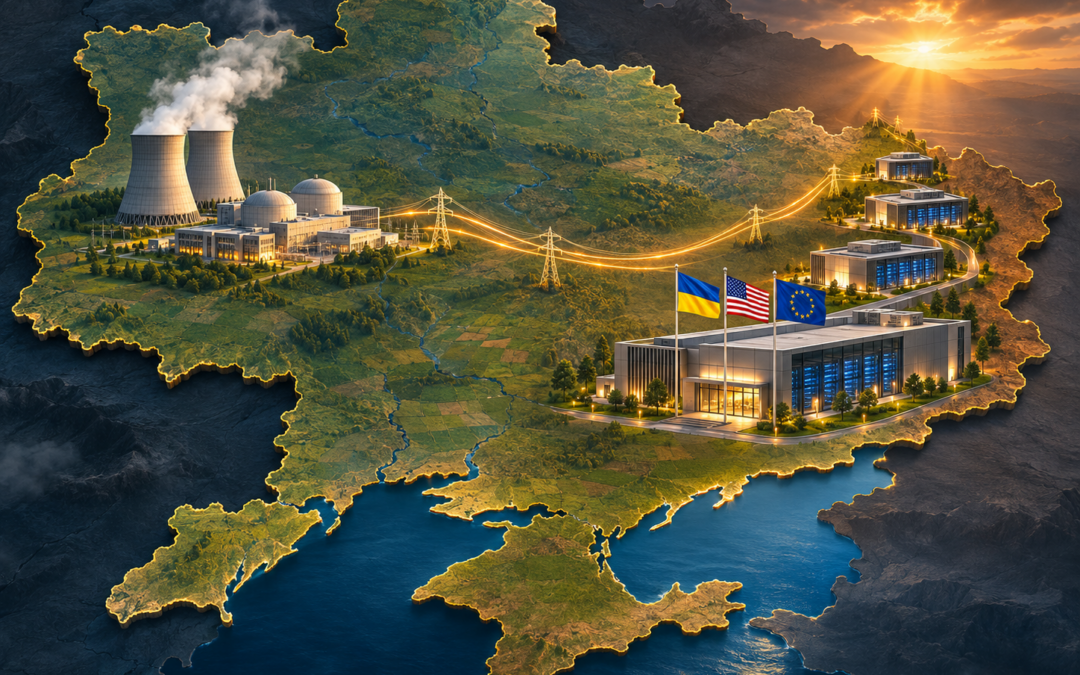
Everyone wants to use synthetic intelligence, but nobody wants it in their backyard. Enthusiasm for AI collides with resistance to its electricity demands, cooling requirements and physical infrastructure. Elon Musk’s proposal to put AI data centres in space illustrates the scale of this challenge. Ukraine offers a compelling answer on Earth: connect its nuclear energy resources to the technological future of Europe and the United States, and make that partnership part of the architecture of peace.
Kazakhstan is demonstrating the commercial logic. In June 2026, its government announced a $10 billion package of AI infrastructure agreements involving Firebird and NVIDIA technology. In October, Firebird announced US export approval for 45,000 NVIDIA Grace Blackwell GPUs, with its first phase targeting commercial operation in 2027. The wider Data Center Valley campus is designed to expand towards one gigawatt. Energy resources are becoming the foundation of a new computing export industry.
Ukraine can take this model further by giving it a diplomatic purpose. A negotiated corridor of American and European data centres in the Donbas, supplied by nuclear electricity and protected through international agreements, would establish a lasting Western economic presence in a region central to the peace settlement. These facilities would function as economic and technological embassies, connecting Ukraine’s security directly to the interests of its international partners.
Together, they would form a diplomatic wall between Ukraine and Russia.
The strength of this wall would come from explicit protection commitments. Participating governments would designate the facilities as protected strategic infrastructure and agree in advance how to respond to an attack. A deliberate strike would confront the publicly stated commitments of Washington and European capitals, alongside threatening their investments, personnel and digital services. The deterrent would be written into the settlement through defined obligations and the capacity to enforce them.
Data embassies provide a legal starting point. Estonia’s arrangement with Luxembourg demonstrates how a treaty can protect state data and systems hosted abroad while preserving sovereign control. Ukraine can develop this principle through a dedicated framework covering protected premises, commercial rights, data sovereignty and security responsibilities. The settlement should affirm Ukrainian sovereignty and define the obligations of Ukraine, Russia and the participating guarantor states.
Nuclear energy provides the economic foundation. Major European data-centre hubs face lengthy grid-connection queues, while American developers are seeking additional sources of reliable power. Ukraine brings an established nuclear industry, technical expertise and proximity to European customers. Long-term electricity contracts can translate these strengths into dependable revenues for energy producers and predictable supplies for technology companies.
Ukraine’s European location adds a valuable commercial advantage: lower latency. Latency is the delay between sending a request and receiving a response. Efficient fibre routes from Ukraine to European customers can shorten that journey compared with distant overseas facilities. Direct terrestrial connections also avoid dependence on orbital links and the substantial propagation delays associated with higher-orbit systems. For interactive AI, business applications, video services and cloud computing, proximity improves responsiveness. Ukraine can therefore compete for both large-scale AI training and services that benefit from being close to their users.
The Ukrainian precedent already exists. In 2020, Energoatom, Bitfury and the Rivne authorities agreed to pursue a data centre initially envisaged at 250 megawatts, with potential expansion to 500. Energoatom and Westinghouse are also pursuing plans for nine AP1000 reactors. The next step is to connect computing demand, nuclear development and reconstruction through a coordinated investment programme.
Investment in the nuclear facilities should become a binding obligation of the partnership. Long-term power contracts should be accompanied by committed capital, dedicated maintenance reserves and guarantees covering an agreed programme of nuclear investment. This would secure funding for equipment replacement, safety upgrades, staff training, emergency systems and regulator-approved life extensions. Independent audits would track expenditure against defined milestones. The companies purchasing reliable electricity would thereby help finance the infrastructure and expertise required to sustain its safe production.
This creates a durable alignment of interests. Technology operators need dependable power over many years; nuclear operators need predictable revenues and sustained investment. Contracts can connect those requirements, supporting both existing reactors and new capacity. The International Energy Agency identifies predictable cash flows as central to nuclear financing, while the International Atomic Energy Agency places maintenance, inspections and ageing management at the heart of safe long-term operation.
For the Donbas, the model would connect data centres to licensed nuclear generation through a rebuilt, resilient grid, supported by redundant electricity and fibre connections. Investment should strengthen supplies for Ukrainian households and recovering industry alongside international clients. Local businesses, workers and universities would gain opportunities in construction, engineering, maintenance, research and digital services.
Western reconstruction instruments offer a financial foundation. The EU’s Ukraine Investment Framework provides guarantees and grants to mobilise investment, while mechanisms involving the US Development Finance Corporation and the World Bank Group’s MIGA support political-risk insurance. A dedicated programme could combine these instruments with private capital, Ukrainian energy partnerships and long-term computing contracts.
The practical agenda is to prepare sites, electricity contracts, investment commitments and the protection framework during peace negotiations. Construction would proceed under the agreed settlement, following demining and secure access. Each stage would connect reconstruction to measurable commitments by Ukraine and its partners.
Ukraine’s energy infrastructure has been a central target of the war. It can become a central asset in building peace. Nuclear generation would power Europe’s digital economy; proximity would make that computing commercially attractive; binding investment commitments would sustain the nuclear facilities; and international protection would give the partnership strategic weight.
A diplomatic wall of data centres would make peace tangible: infrastructure to protect, investments to sustain and a shared economic future to defend.


Receive Breaking News
Sign up for our newsletter and stay up to date! Be the first to receive the latest news in your mailbox: