
Living in Belgium today means living inside the central contradiction of modern Europe. On paper, it is one of the most privileged places on Earth: reliable medicine, affordable education, functioning institutions, social protection, and the symbolic comfort of being at the heart of the European project. But beneath that civilized surface, the social order feels increasingly unstable.
Belgium works, but it weighs. It offers security, but often at the price of energy, ambition, and personal freedom. The productive middle is squeezed from every direction. Those who are not protected by government employment, not poor enough to receive extensive support, and not rich enough to move their capital or residence to lower-tax countries are expected to finance almost everything: healthcare, education, pensions, administration, migration, climate policy, debt, and now military urgency. This is not only a feeling. Belgium had the highest tax wedge in the OECD in 2025 for a single worker without children at the average wage: 52.5 percent of labour costs, against an OECD average of 35.1 percent.
At the same time, Europe’s social cohesion is visibly under strain. Immigration has changed cities, schools, housing markets, public services, and the sense of cultural continuity. The point is not to denounce immigrants as human beings. The point is to denounce a political class that has often managed mass immigration without honesty, capacity, or democratic consent. Citizens are asked to accept permanent transformation as if it were only an administrative detail. When they object, they are not always answered; they are morally classified.
This is where European politics has undergone a strange reversal. For years, “populism” was treated as a disease of the right: vulgar, emotional, dangerous, and marginal. But another form of populism has emerged from the left — more refined in language, but often more aggressive in practice. It does not always shout in the streets. It speaks from universities, media studios, NGOs, courts, corporate departments, and government offices. It presents itself not as politics, but as morality. Not as one worldview among others, but as a new civil religion.
Like every religion, it has sins, saints, heretics, rituals, and forbidden questions. It divides society between the enlightened and the guilty. It does not merely argue; it excommunicates. Immigration, climate, gender, race, colonial memory, inequality, and identity are no longer treated only as political questions. They become tests of moral purity. In this atmosphere, many ordinary people feel that they have lost not only purchasing power, but also permission to speak plainly about the world they inhabit.
Europe therefore finds itself in a paradox. It is highly regulated, highly educated, and morally ambitious, but increasingly unsure of its own future. Its traditional industries are under pressure. Its carmakers struggle against the speed and scale of Chinese electrification. Its digital economy remains dependent on American platforms, while its artificial intelligence sector lags behind the American and Chinese giants. The Draghi report on European competitiveness warned that Europe is failing to convert its strengths — education, welfare, research, industrial know-how — into globally competitive industries, especially in advanced technologies. China’s rise in electric vehicles underlines the pressure: the IEA reported that China overtook the European Union as the world’s largest car exporter in 2024, and that more than 35 percent of China’s car exports were electric vehicles in 2025.
Artificial intelligence is now changing the labour market at its core. The OECD describes AI as a force already reshaping employment, workplace practices, hiring, skills, and job quality. It may increase productivity, but it also creates new risks: automation, loss of agency, bias, surveillance, and job displacement. For a continent built around stable employment, social insurance, and regulated labour, this is not a marginal technological issue. It is a direct challenge to the European social model.
And then there is war. Europe is once again organizing itself around defence, ammunition, energy security, borders, and strategic autonomy. This may be necessary, but it is also revealing. EU defence spending reached €343 billion in 2024 and was projected to rise to €381 billion in 2025. A continent that once promised peace, prosperity, and technological modernity now risks finding its next industrial purpose in weapons, emergency, and permanent mobilization.
This is the atmosphere in which SpaceX becomes more than a company. It becomes a psychological rupture.
For a European living inside managed decline, SpaceX represents something almost indecent: expansion, risk, grandeur, engineering, ambition, and escape. It does not speak the language of redistribution, regulation, guilt, or administrative survival. It speaks the language of destiny. It says that humanity’s future is not limited to maintaining overloaded welfare states, negotiating cultural fragmentation, paying taxes, and preparing for the next crisis. It says that the human story can still move upward.
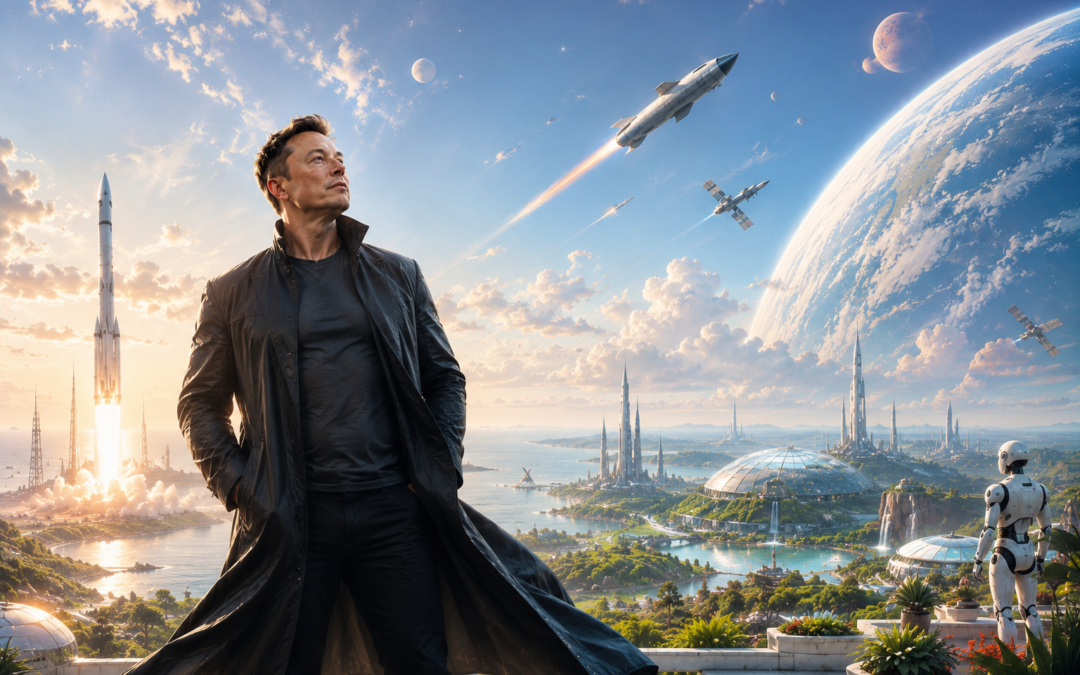
SpaceX offers space not only as a place, but as a liberation from the mental prison of Earth. It proposes the birth of a new human figure: Homo Astralis — the human oriented toward the stars, toward the heavens, toward higher aspirations. Not a new biological species, but a new spiritual and civilizational type. Homo sapiens survives. Homo Astralis transcends.
This is why the SpaceX IPO is not merely a financial event. It is a confession of faith.
According to Reuters, SpaceX planned to price its IPO at $135 per share, raise a record $75 billion, and target a valuation of roughly $1.75 trillion, with trading expected under the ticker SPCX. Morningstar reported that SpaceX disclosed a net loss of $4.9 billion on $18.7 billion in revenue last year. That means the valuation is not based on normal industrial arithmetic. It is based on belief in exponential growth, technological dominance, and radical “moonshots”: Mars, Starlink, reusable rockets, space-based computing, and eventually the industrialization of the solar system.
More than doing their accounts, investors buying SpaceX shares are buying into Elon Musk’s vision. They are not simply purchasing exposure to launch services or satellite internet. They are subscribing to a myth of human expansion.
The prospectus itself reads at times less like a corporate document than like a sacred text written by engineers. SpaceX says its mission is to make life multiplanetary, to understand the universe, and to “extend the light of consciousness to the stars.” That is not ordinary business language. It is metaphysical language. It asks investors to believe that a company can be not only profitable, but civilizational.
Yet the same document also contains the cold language of risk. SpaceX warns that it has “a history of net losses” and may not achieve profitability in the future. This contrast is exactly what makes the company fascinating. On one page, the stars. On another, losses. On one page, consciousness. On another, risk factors. SpaceX is both spreadsheet and scripture.
To a classical investor, this looks dangerous. To a believer, it looks historic.
The ambition goes far beyond rockets. SpaceX is increasingly presenting itself as a vertically integrated infrastructure company for the next phase of civilization: launch, satellites, connectivity, artificial intelligence, energy, data centers, and eventually non-Earth industry. Reuters reported that SpaceX executives are aiming to demonstrate space-based AI computing infrastructure by late 2027 and that the company has sought permission to launch up to one million space-based data-center satellites. The prospectus even links executive compensation milestones to non-Earth data centers capable of delivering 100 terawatts of compute per year.
This is no longer only the story of rockets going up and landing again. It is the story of moving computation, energy demand, machine intelligence, and eventually industrial production beyond Earth.
Musk often frames this mission in terms of species survival. Humanity should not remain trapped on one planet because one planet can be destroyed. The dinosaurs had no space program. Humans, if they are serious about survival, must become multiplanetary. The SpaceX prospectus itself says the company does not want humans to share the dinosaurs’ fate.
But for me, the deeper appeal of SpaceX is not only that it might save humanity from extinction. It is that it might save human life from becoming spiritually small.
Modern earthly life has become narrow for many people. We work, pay taxes, comply with rules, consume, worry, vote, complain, and repeat. Even in rich societies, the circle of life can feel strangely reduced. The great promise of progress has often become a promise of managed decline: better healthcare, slower growth, higher taxes, safer systems, fewer dreams.
SpaceX breaks this mood. It says that the future does not have to be administrative. It can still be heroic.
This is where Homo Astralis differs from Homo sapiens.
Homo sapiens is the human of Earth: intelligent, adaptive, tribal, anxious, political, and bound to survival. Homo sapiens builds states, pays taxes, fights wars, protects territory, and organizes scarcity. Homo Astralis is not a new biological species, but a new existential orientation. It is the human who looks upward. It is the human who refuses to believe that the limits of Earth are the limits of destiny.
Homo Astralis does not necessarily abandon Earth. But he no longer accepts Earth as the total horizon of human life. He does not deny terrestrial problems, but he refuses to let them define the full meaning of existence. He understands that a civilization obsessed only with redistribution, regulation, guilt, and security eventually becomes a civilization without vertical ambition.
That is the emotional genius of SpaceX. It makes the future feel large again.
Europe, and Belgium especially, can still offer a good life. But a good life is not always a great life. A safe society can become mentally suffocating when it no longer gives its people a horizon beyond maintenance. SpaceX offers such a horizon. It tells us that life may expand so radically that life itself can be redefined. Not merely better trains, better pensions, better hospitals, or better regulations — but new worlds.
Of course, there is danger in this dream. There is financial danger, technological danger, political danger, and moral danger. A civilization that dreams only of Mars could neglect Earth. A billionaire’s vision can inspire, but it can also dominate. A prospectus full of cosmic language can hide very earthly losses. Investors may discover that belief is not the same as return.
But every major human leap has contained this tension between madness and necessity. Crossing oceans was once madness. Flying was once madness. Landing on the Moon was once madness. Artificial intelligence once belonged to science fiction. The future often begins as an irresponsible sentence before it becomes infrastructure.
SpaceX is therefore more than a company. It is a referendum on whether modern humanity still wants transcendence. In Europe, where so much intelligence is spent on managing limits, SpaceX speaks the forbidden language of expansion. It does not ask merely how to preserve what exists. It asks what kind of human being might come next.
That human being is Homo Astralis.
Not the taxpayer trapped in a system he did not design.
Not the bureaucratic subject managed by permanent regulation.
Not the exhausted consumer moving from one crisis to the next.
Not the citizen condemned to live between war, debt, taxation, cultural fragmentation, and moral supervision.
But the human who looks at the night sky and sees not emptiness, but invitation.
And perhaps the most radical part of the SpaceX vision is not only that it offers humanity a future in a much wider universe. It also offers a way out of the growing restrictions of earthly life at the very moment when artificial intelligence and robotics are about to transform civilization.
On Earth, the AI revolution will be surrounded by regulation, political fear, labour conflict, energy constraints, lawsuits, taxation, and ideological supervision. Every robot, every autonomous factory, every data center, every artificial mind will become a battlefield between progress and control. Governments will seek to regulate it. Workers will fear displacement. Courts will litigate it. Activists will moralize it. Tax authorities will want their share. Local communities will oppose the power plants and data centers needed to run it.
Space changes that equation.
In orbit, on the Moon, on Mars, or in future space-based industrial systems, AI and robotics could develop beyond the tightest limits imposed by crowded states, anxious electorates, failing institutions, and territorial politics. Space could become the natural habitat of the robotic revolution: a frontier where machines build, mine, compute, manufacture, repair, explore, and prepare new worlds before fragile human bodies arrive.
The expansion into space is therefore not separate from the AI revolution. It may become its highest expression. The robot is the natural worker of space. The autonomous factory is the natural factory of space. The orbital data center is the natural brain of a civilization that has outgrown the electrical, political, and psychological limits of Earth.
The dream of SpaceX is not only to move human life away from Earth. It is to move human possibility beyond the permissions of Earth.
That is why SpaceX matters. It offers more than rockets. It offers more than satellites. It offers more than an investment case. It offers an exit from the mental, political, and material enclosure of the present age.
The creation of Homo Astralis begins not with a rocket launch, but with a refusal: a refusal to accept that humanity’s highest future is merely to administer decline; a refusal to believe that Earth’s routines are the final shape of life; a refusal to let war, taxation, stagnation, fear, and regulation define the human horizon.
Homo sapiens learned to survive on Earth.
Homo Astralis dreams of becoming worthy of the stars — and free enough to build among them.


Receive Breaking News
Sign up for our newsletter and stay up to date! Be the first to receive the latest news in your mailbox: