
The future has always attracted three kinds of people: those who seek to understand it, those who hope to profit from it and those who turn it into stories. Prediction markets are bringing all three together. At the intersection of cryptocurrency, geopolitics and entertainment, a new relationship with world events is taking shape—one in which the public becomes actively engaged in the uncertainty it once merely observed.
The appeal is straightforward. Will an election produce a change of government? Will a central bank cut interest rates? Will international negotiations deliver an agreement before a specified deadline? Prediction markets turn these questions into tradable contracts, allowing participants to put money behind their judgement.
Their attraction combines financial opportunity, curiosity and intellectual competition. Participants test their understanding against that of others. Every changing price reflects shifting expectations and invites a further question: what does the market know, and what might it be missing?
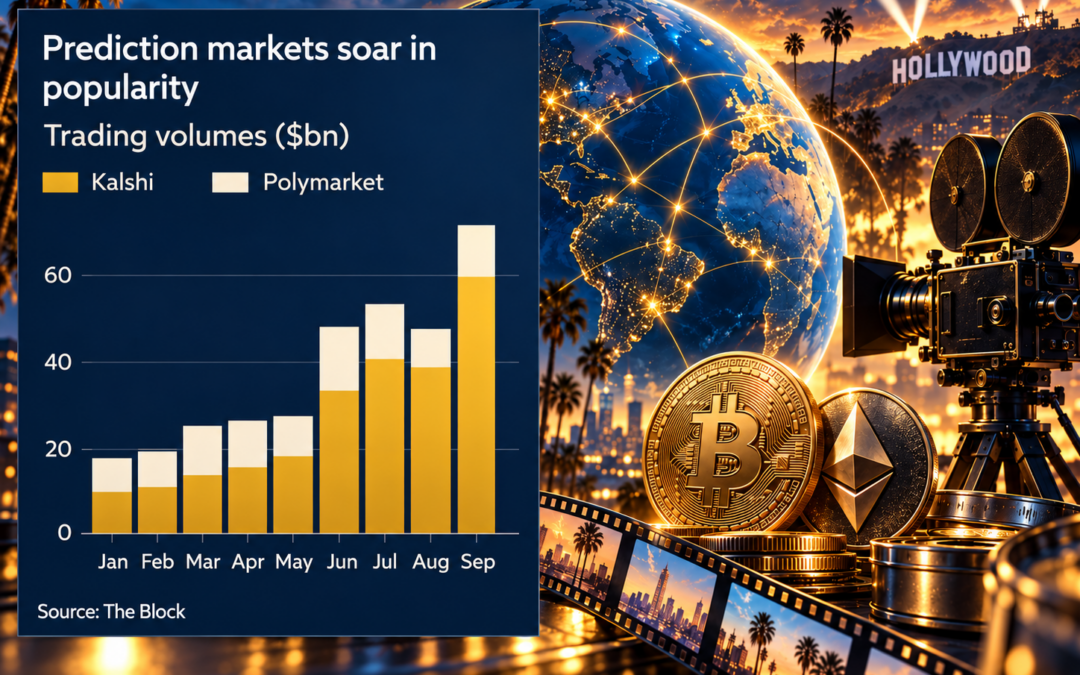
For crypto exchanges, this appetite has become a significant commercial opportunity. As digital assets endure a prolonged downturn, platforms are seeking revenue beyond token trading. The Financial Times reports that Blockchain.com and Binance US have sought US regulatory approval for prediction markets, joining a field that includes Coinbase, Crypto.com and Gemini. Figures from The Block cited by the newspaper show trading volumes on Polymarket and Kalshi rising from $17 billion in January to $72 billion in September.
Blockchain.com’s own announcement describes plans to bring regulated derivatives and prediction markets to American customers within its existing app. The ambition is to let users manage digital assets and take positions on real-world events in one place.
The commercial logic is compelling. Interest in a particular cryptocurrency may fade, but the world never stops producing questions. Elections, economic decisions, scientific discoveries and diplomatic negotiations provide a continuous stream of developments that people want to understand.
Yet the significance of prediction markets extends beyond transaction fees. Their educational potential deserves far greater attention.
A participant seeking an advantage has a reason to investigate. Someone betting on the outcome of international negotiations may need to examine domestic politics, economic pressures, military developments, diplomatic relationships and the interests of neighbouring states. A headline becomes the beginning of an inquiry.
Geopolitics, often presented as a distant contest between governments, becomes a practical exercise in understanding incentives. Why would a leader compromise? What would make an agreement politically survivable? How might an energy shortage alter a negotiating position? Which public statements represent genuine commitments, and which are intended to strengthen a bargaining position?
Those who take prediction betting seriously must examine the international environment in detail to improve their chances. They have an incentive to compare sources, question assumptions and distinguish what they wish would happen from what the evidence suggests is likely. A participant may strongly favour one outcome while recognising that another is more probable. That distinction is fundamental to clear thinking.
This educational function of prediction markets cannot be underestimated. They can give people a personal reason to follow developments closely, understand competing interests and revise their views when circumstances change. Even observers who never place a bet can use market movements as a starting point for asking why expectations have shifted.
The learning comes from the investigation. Betting alone does not create expertise, and a market price cannot guarantee an outcome. But when participation encourages research and intellectual discipline, it can make complex international affairs more accessible. Its strongest contribution may be teaching people to think in probabilities while remaining open to new evidence.
This relationship between uncertainty and attention also creates a natural connection with Hollywood.
Cinema has always depended on unanswered questions. Audiences follow characters because they want to discover what happens next. Suspense grows when the outcome matters, the evidence is incomplete and each revelation changes what seems possible. Prediction markets draw on a similar fascination, adding the opportunity to take a financial position on a real-world question.
Billions Magazine is currently developing a film that brings these worlds together, making prediction betting a central theme of its story while connecting it with real-life betting on one of humanity’s biggest questions. The project explores a powerful cinematic possibility: a story whose central uncertainty extends beyond the screen, inviting audiences to investigate, debate and form their own judgement about the real-world issue at its heart.
The creative potential is considerable. A film can introduce an unfamiliar question through characters, conflict and emotion. The audience’s curiosity can then carry into the wider world, prompting viewers to examine evidence and follow developments long after the closing credits.
This creates an opportunity for a deeper relationship between entertainment and public understanding. The drama draws people in; the underlying question gives them a reason to keep thinking. A viewer’s interest in the story can become an interest in science, international affairs or the decisions shaping humanity’s future.
For filmmakers, prediction markets also offer rich dramatic material. A character who stakes money on a conviction must confront the possibility of being wrong. New evidence can threaten both financial security and personal identity. The tension between belief, ambition and reality is already the substance of compelling cinema.
For crypto exchanges, the convergence suggests an audience whose interests extend beyond conventional finance. For publishers and producers such as Billions Magazine, it opens a way to connect storytelling with sustained engagement in consequential questions. For the public, it provides another route into subjects that might otherwise appear remote or intimidating.
Prediction markets, crypto exchanges and Hollywood share an interest in how people confront the unknown. Exchanges provide a mechanism for participation. Cinema gives uncertainty a human face. Research turns curiosity into understanding.
Their meeting point could become culturally significant: a place where people are entertained by a story, challenged by a question and motivated to learn more about the world. The greatest value may ultimately lie in that final step—the moment an audience becomes curious enough to look beyond the screen.


Receive Breaking News
Sign up for our newsletter and stay up to date! Be the first to receive the latest news in your mailbox: