
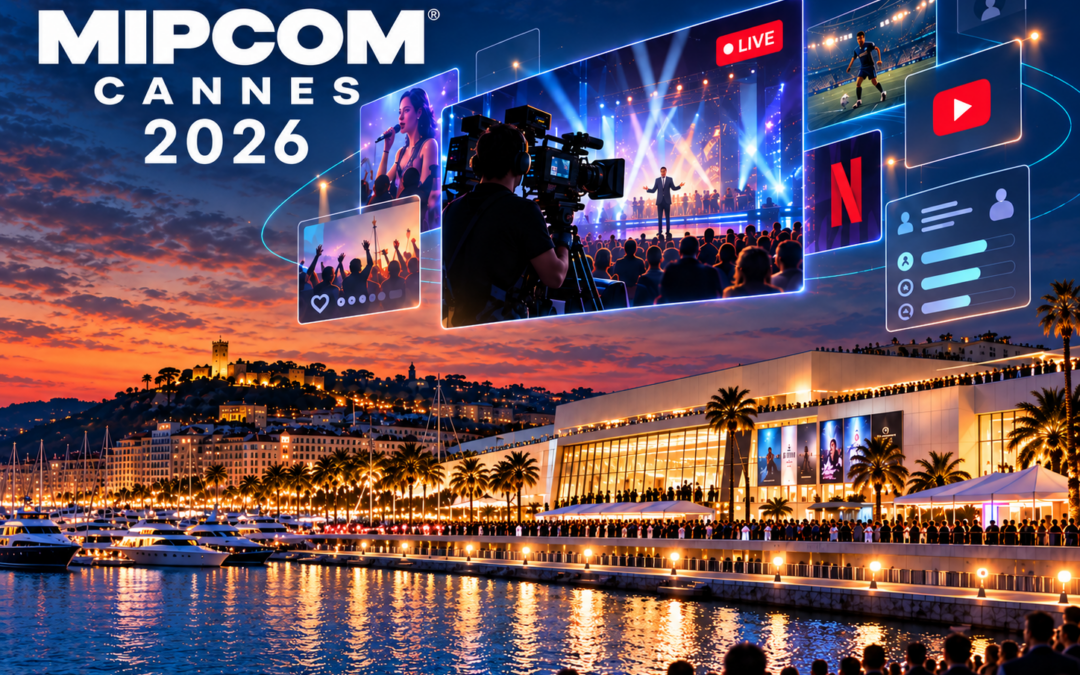
Television has always understood the power of a shared moment. Now, streaming is discovering how much that moment could be worth.
MIPCOM Cannes 2026 offered an encouraging vision of an industry reinventing its business. Bringing together 10,100 delegates, including 3,150 buyers, from 104 countries, the market connected established television companies with creators, platforms, brands and technology businesses. The opportunity emerging from these encounters extends beyond selling programmes: it is about finding more ways for exceptional content to reach audiences and generate income.
The financial pressure behind this transformation is real. Netflix, like its competitors, faces the challenge of developing new sources of revenue while sustaining growth. Even for the streaming leader, that process is proving demanding. Its third-quarter revenue rose 12% to approximately $12.9 billion, yet it reduced its 2026 advertising revenue forecast from approximately $3 billion to $2.7 billion, citing a slower rollout of certain advertising capabilities. A growing business can still struggle to develop its next growth engine.
MIPCOM’s positive message was that the industry has possibilities to pursue—and partners with whom to pursue them.
Among the most promising is live entertainment. The market’s programme included “LIVE: The New Prime Time,” reflecting renewed interest in programming that brings audiences together at a particular moment. Meanwhile, Netflix’s expanding live schedule illustrates how streaming platforms are embracing appointment viewing alongside their established libraries of films and series.
The commercial logic is compelling. A programme available to watch tomorrow offers convenience. An event unfolding now offers urgency, anticipation and a shared conversation. For the right format, that combination can support premium advertising, sponsorship, commerce and paid participation—potentially generating substantially more revenue during the live experience than through subsequent viewing alone. The advantage is not automatic: rights, production costs and audience scale determine whether it translates into profit.
We are standing at the beginning of a new live era of television, in which participation could become an increasingly valuable part of entertainment.
Billions Magazine has spoken with producers working on integrating prediction markets into television series. These discussions point towards a further evolution of the relationship between a programme and its audience: viewers following a story while actively expressing expectations about what happens next.
The possibilities are intriguing. Prediction-based experiences could give audiences another reason to return for each episode, deepen discussion between broadcasts and encourage viewing before an outcome becomes widely known. These remain emerging concepts, rather than an established revenue model. For scripted or prerecorded programmes, protecting undisclosed outcomes would be particularly important, alongside appropriate safeguards for any participation involving money.
Yet the broader creative opportunity is clear: television can build experiences around anticipation as well as around the programme itself.
YouTube’s presence at MIPCOM offered a more immediate example of how new revenue opportunities are taking shape. Its expanded programme focused on practical questions of distribution, monetisation, connected television and partnerships between creators and established media companies.
The examples were tangible. RTL described how bringing its long-running action series Cobra 11 to YouTube attracted 30 million views in 12 months and helped direct new audiences towards RTL+. YouTube and NBCUniversal also discussed a partnership spanning advertising-supported content, subscription bundles and streaming services, with attracting Peacock subscribers among its objectives.
For producers, these developments suggest that a television property can have several complementary commercial lives: a series, a live occasion, a creator collaboration and an ongoing audience community. Each can strengthen the others when the content and distribution strategy fit.
This is why MIPCOM matters. It gives the industry a place to turn uncertainty into partnerships, experiments and business opportunities.
Streaming will change. The next phase will reward compelling stories, inventive distribution and experiences audiences want to join as they happen. Cannes showed an industry with the imagination—and an expanding range of partners—to make that future possible.


Receive Breaking News
Sign up for our newsletter and stay up to date! Be the first to receive the latest news in your mailbox: