
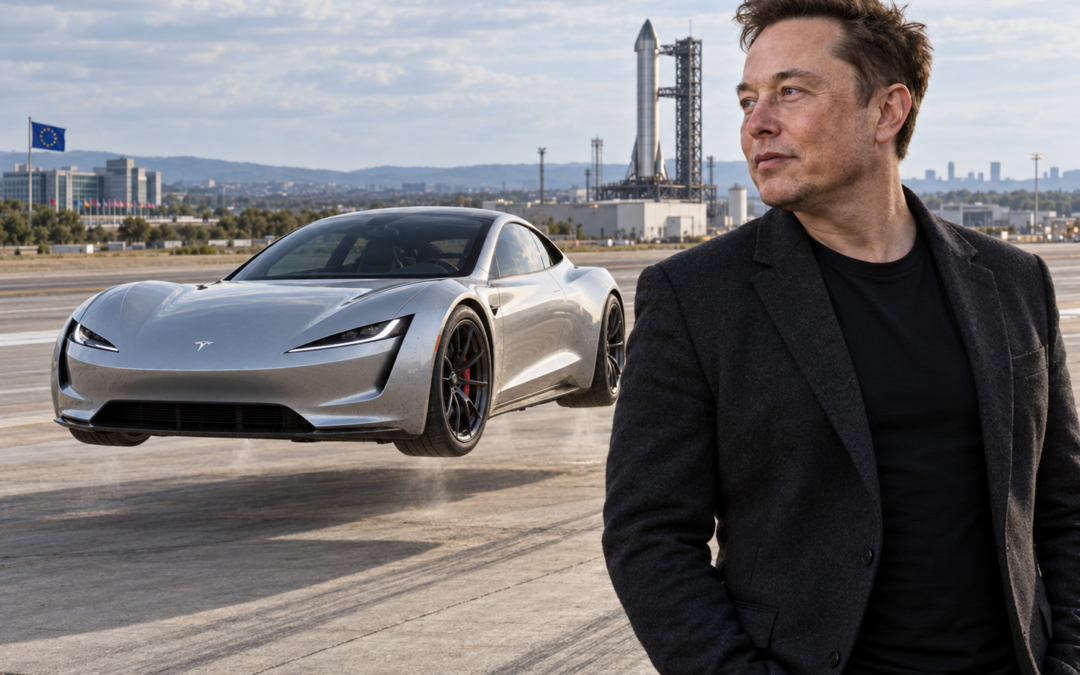
At a test site in Texas, the distance between an idea and a machine briefly became visible. On 15 October, Tesla demonstrated its new Roadster prototype leaving the ground and manoeuvring in the air. The spectacle took place at SpaceX’s McGregor facility. Production is promised for 2028; commercial delivery remains unproven.
Tesla’s own description of the airborne Rocket version includes a sobering qualification: “Not approved for public road use.” That boundary matters. A controlled demonstration cannot establish that flying cars are ready for ordinary life.
Yet the image deserves attention beyond its entertainment value. Inside this extravagant machine, three different sources of power meet: space technology, software and capital markets. Aerospace knowledge supplies new physical possibilities. Software coordinates them. Finance gives the people attempting the combination the resources and time to continue.
Together, they explain something larger than a car. They show how an engineer’s dream can acquire the means to become an American dream.
For Europe, that is the uncomfortable part of the picture. The continent possesses formidable engineering traditions, wealthy consumers and institutions devoted to scientific progress. Its recurring difficulty is connecting those advantages into an enterprise capable of growing at the speed and scale of its ambition. The Roadster gives that divide a visible form. The deeper evidence lies in the institutions that helped bring it to the test site.
The dream comes before the business plan
A remarkable machine begins before anyone knows whether a sensible market exists for it. Someone looks at a familiar object and refuses to accept its boundaries. A car might borrow the capabilities of a spacecraft. A factory might become programmable. A product sold today might acquire new functions tomorrow.
The first act is imaginative. The next acts are organisational. People must be recruited, equipment ordered and experiments financed. Eventually, the dream must survive a customer’s judgment.
This passage from imagination to enterprise is where the American model becomes especially powerful. A founder can assemble a company around a proposition whose value lies largely in the future. Investors can compete to support it. Engineers can receive ownership alongside salaries, giving them a financial interest in solving the problem. An uncertain invention becomes a shared undertaking with a possible reward large enough to justify years of effort.
There is nothing exclusively American about the intelligence involved. The relevant distinction concerns the opportunities available to intelligence. An idea can originate anywhere; the economic value it creates tends to accumulate where it finds the strongest conditions for development.
Freedom of enterprise matters because nobody can reliably identify every useful invention in advance. A system that allows several teams to try different approaches gives discovery more chances. It must also allow investors to withdraw support and unsuccessful companies to fail. Otherwise, ambition becomes an entitlement to permanent subsidy.
The dream therefore needs both encouragement and an eventual test. Capital markets are valuable when they can finance uncertainty while preserving that test. Europe’s challenge is to make the entire passage easier, from the first unconventional proposal to the company that can sell and compete across a continent.
Space technology crosses the factory gate
The Roadster’s aerospace connection is tangible. Tesla describes SpaceX components, cold-gas thrusters and a fan-assisted suction system. The airborne version places thrusters around the vehicle to produce upward and forward movement and rotation.
Cold-gas propulsion has a straightforward physical basis. Stored gas escapes through a nozzle, generating thrust without combustion. NASA describes the technology as useful for precise spacecraft manoeuvring, while also emphasising its limited total impulse. A finite supply of compressed gas cannot provide unlimited lifting force over time. Storage brings its own demands for space and mass.
The engineering achievement lies in making such capabilities work inside a different machine. Pressure storage, valves, structural loads and control systems must be considered together. A component familiar to an aerospace engineer becomes part of an unfamiliar proposition for an automotive engineer. The boundary between industries becomes a place where a new product can emerge.
This is why the connection between Tesla and SpaceX matters beyond the personality of Elon Musk. It illustrates the value of bringing distinct bodies of knowledge within reach of one another. Experience paid for in one field can reduce the cost of attempting something in another. The dream becomes more plausible because some of its hardest ingredients already exist.
Such combinations reward organisations willing to give an engineering team authority across conventional departmental boundaries. A new capability may require changes to the whole machine. If every department can defend its existing design while nobody owns the complete result, technical excellence in each component can still produce an inadequate system.
Europe’s space institutions reveal a related tension at a larger scale. ESA’s procurement policy explicitly includes geographical return, intended to distribute industrial work among participating countries. That helps sustain political support and national capabilities. It also means procurement must reconcile geographical participation with technical and economic objectives.
The resulting institutional trade-off is clear. A commercial venture can organise suppliers around a particular product and timetable; a multinational public programme must also preserve the coalition that funds it. The latter can achieve extraordinary things, but the need to satisfy several objectives can complicate rapid commercial decisions. This is an argument about institutional design, not the ability of European scientists.
Europe is already changing parts of that design. ESA’s European Launcher Challenge is intended to make the agency a customer of new commercial launch services and increase competition alongside established launch families.[5] The direction is promising. The larger question is whether competitive procurement, private investment and industrial cooperation can become normal conditions for new European ventures.
Software makes the parts work together
The most consequential part of a spectacular machine may be invisible.
A thruster produces force. To use that force effectively, a control system must decide when and how to apply it, alongside the vehicle’s other functions. Tesla describes electrically actuated thrust adjustments occurring within fractions of a second to help stabilise the Roadster in flight. That description points towards the central engineering issue: coordination.
In a machine combining propulsion, suspension and aerodynamic systems, capability depends on their behaviour as a whole. Software translates intentions and measurements into instructions. Its quality affects whether expensive hardware acts coherently under changing conditions. A collection of impressive components becomes a useful product only when their interactions are understood and controlled.
This helps explain why the software transition has disturbed the established hierarchy of the car industry. The company that controls the vehicle’s computing and electrical architecture can shape how new functions are introduced and how the product develops. Mechanical manufacturing remains essential, but it now shares authority with disciplines that work through code, simulation and continuous revision.
Tesla’s existing vehicles already receive wireless software updates that add or modify features. More broadly, an updatable product creates a continuing engineering relationship with its owner. Development can continue after delivery, subject to the limits of the hardware and the requirements of safety. The fixed cost of developing an improvement can be spread across many compatible vehicles. That changes the commercial value of controlling the underlying software.
Volkswagen’s relationship with Rivian offers a revealing illustration. In November 2024, the companies announced a transaction of up to $5.8 billion encompassing their partnership, built around Rivian’s electrical architecture and software technology. Volkswagen brought capital, manufacturing expertise and global scale.
The exchange is significant precisely because Volkswagen remains an industrial giant. A young American company had developed capabilities sufficiently valuable to become central to a major European manufacturer’s next generation of vehicles. At the same time, Rivian needed strengths that Volkswagen could supply. The episode shows how technological authority can shift within an industry long before its established manufacturers disappear.
European companies are responding. BMW’s Neue Klasse architecture, announced in 2025, concentrates major functions in four central computers and is designed for continuing software development. Europe clearly has the talent to compete. The harder task is creating conditions in which new firms, as well as established groups, can repeatedly combine software expertise with manufacturing resources and substantial funding.
For an established manufacturer, the transition also creates a difficult internal bargain. A new architecture must coexist with existing models, supplier agreements and investments that still need to earn their return. A younger entrant can organise around a different design from the beginning. Europe’s industrial inheritance supplies enormous resources, but it can also make abandoning familiar arrangements more costly. Renewal requires management willing to commit capital before the old model has exhausted its profitability.
The risk is gradual dependence. A company may retain the factory and the badge while purchasing increasingly important parts of the system that determine what its product can do. Preventing that outcome requires investment in the people and architecture that connect the whole machine.
Capital buys the time that invention requires
An engineer can understand how to build something long before the business can afford to build it.
Between the promising drawing and the reliable product lie prototypes, failed tests, specialist salaries and production equipment. Revenue may arrive late. Some of the knowledge acquired along the way cannot be sold separately or pledged as useful collateral. The project needs money that can tolerate uncertainty.
Conventional bank lending has limits here. A lender must have reasonable confidence that principal and interest will be repaid. Equity investors accept a different bargain: they own part of the business and participate in its possible future value. Venture capital can support uncertain projects without imposing the same immediate repayment burden, while also providing specialist judgment and commercial contacts.
This difference helps explain why access to finance can determine which engineering ambitions become companies. A profitable factory seeking a new machine and a team attempting an unproven technology need different kinds of money. A financial system excellent at funding the first may still underserve the second.
The scale of the American advantage is substantial. In its Economic Bulletin for 2026, the European Central Bank reports approximately €930 billion in total fund size among US-based venture capital funds, compared with about €150 billion among EU-based funds. The shortfall becomes more acute in later financing rounds. The ECB also identifies stronger participation by pension funds and foundations in the American investor base.
These figures concern venture funds, rather than the entire financial system. Even so, they expose a difficult moment in Europe’s innovation process: the point at which a company has demonstrated enough promise to need much more money. A 2024 European Investment Bank study found that EU scale-ups had accumulated 50 per cent less funding after ten years than comparable firms in San Francisco.
Europe can consequently find itself financing an invention’s childhood while its commercial adulthood develops elsewhere. When the largest funding rounds, senior management and eventual stock-market listing migrate abroad, the place that helped nurture an idea risks capturing less of its later value. The loss can extend beyond ownership to the experienced people who might otherwise have built the next local company.
The stock market extends this process. Investors can finance a company before it lists because they can envisage a later sale or public offering. A listed business can subsequently issue additional shares. A higher valuation, when supported by willing buyers, can let it raise a given sum while diluting existing shareholders less.
Tesla provides a concrete example. Its 2020 annual report records $12.27 billion raised through public common-stock offerings that year, after issuance costs. That was money received by the company. Trading existing shares between investors does not itself put cash into a manufacturer’s account; issuing new shares can.
The distinction is crucial. Market belief becomes productive when a company converts it into financing and then into engineering, equipment and operations. A rising quotation alone builds nothing. But a credible route from valuation to new investment gives a business an ability to undertake projects that current profits could never support.
The mechanism carries obvious dangers. Enthusiasm can outrun evidence, and investors can finance projects that never become useful. The Roadster’s commercial future remains to be demonstrated. Yet a system that tries to eliminate all such losses will also reject many worthwhile experiments before their value becomes visible.
Capital therefore performs an unusually human function in technological development. It gives a team time to be wrong, learn why and try again. The quality of the financial system helps determine how much of that time a society can afford.
Enterprise needs room to experiment
Money loses much of its power when an enterprise cannot act.
Every repeated application, uncertain approval and incompatible reporting requirement consumes the same scarce resource as an unsuccessful experiment: the period before the company runs out of cash. Engineering failure can at least produce knowledge. Administrative repetition often produces another version of the same document.
This is where the case for less bureaucracy becomes economically serious. Clear rules, proportionate requirements and decisions delivered within predictable periods allow businesses to plan. Permission to conduct a controlled test should be distinguishable from permission to sell a finished product to the public. Both need competent supervision, but they serve different purposes.
The European Commission’s 2025 entrepreneurship survey found regulatory complexity was a concern for nearly two-thirds of respondents. Reported obstacles to cross-border expansion included differing business environments, unclear rules and taxation. The significance lies in what these obstacles consume. Legal budgets and management attention are resources a young company also needs for product development and customers.
America has its own regulatory barriers, and a flying prototype remains subject to them. Its advantage should be understood through the combination of institutions available to a venture, rather than through a claim that government has disappeared.
Indeed, the history behind Tesla and SpaceX includes public support. Tesla received a $465 million US Department of Energy loan in 2010 and repaid it in 2013. NASA’s commercial cargo programme combined public funding with private investment and paid companies against development milestones.
These examples make the argument for enterprise more substantial. Public institutions can support research, share early development risks and become demanding first customers. Private firms can retain responsibility for execution, compete for subsequent business and raise additional capital. Government activity can help create a market in which enterprise has room to work.
For Europe, reducing bureaucracy should therefore mean removing duplication and making responsibility clearer. A genuinely common rule can liberate a company from multiple national procedures. Stronger European integration can deliver greater commercial freedom when it replaces repeated obligations with a workable shared system.
The ambition should be practical: a founder able to spend more time building, an investor able to assess a predictable approval process, and a regulator able to judge real evidence from controlled development. Freedom to attempt something difficult becomes valuable when it can lead to an accountable business.
How an engineer’s dream becomes American
The three elements reinforce one another.
Aerospace expertise makes an audacious proposal technically conceivable. Software makes different mechanisms controllable as a system. Capital finances the effort to bring them together. Enterprise gives that effort an organisation, and access to customers gives it an economic destination.
Their connection is what transforms the character of the dream. An idea held by a few engineers becomes a proposition in which other people can participate. An employee may accept shares because success could change their financial future. An investor may finance years of development because the potential market justifies the risk. A supplier may develop a new process because a growing customer could support it. Ownership allows the engineer to share in the value of the future being built.
As the venture succeeds, the possibilities spread beyond the original company. Experienced employees can establish businesses of their own. Investors can reinvest their returns. Suppliers can offer improved capabilities to other customers. The achievement leaves behind people, knowledge and capital that make a subsequent attempt easier.
This is the American dream in its industrial form: the prospect that building something valuable can enlarge both a person’s life and the economic possibilities around them. Its power comes from the connection between aspiration and participation. The engineer can hope to become a founder or an owner, and the investor can help bring into existence the future on which the investment depends.
The promise is unevenly fulfilled. Failure is common, ownership can be concentrated, and spectacular wealth does not establish broad social progress. But the opportunity to participate in an undertaking of consequence remains a powerful means of attracting effort and talent.
Europe’s challenge is to make that connection equally convincing. A well-trained engineer should be able to imagine founding a company, financing it through its difficult years and serving a continental market without concluding that its most ambitious future requires an American address.
The dream acquires its nationality through the place that gives it a workable future.
A continent must become a market
Everything ultimately returns to scale.
Large development costs become easier to justify when they can be spread across a large accessible customer base. The calculation begins before a factory is built. An investor deciding whether to finance the first prototype is already considering how many customers a successful business might eventually reach, how quickly it could reach them and what expansion would cost.
The Roadster itself is an exclusive product. Its significance here comes from the broader industrial and financial system supporting it. The argument concerns the conditions that sustain repeated technological ventures, including those intended for mass markets.
European firms can reach global scale through exports and international operations. A large domestic market is therefore no absolute prerequisite for success. But the ability to grow within one extensive operating market makes the process much easier to repeat. That repeatability is what matters when a continent wants to produce successive generations of major technology companies.
The EU has approximately 450 million consumers. Its single market is a substantial achievement.Yet many growing businesses still encounter that continental opportunity through national rules, tax systems and administrative procedures. The market encountered in practice remains less unified than the population figure suggests.
The ECB identifies persistent differences in national rules, cumbersome procedures and inconsistent implementation, including 27 national VAT frameworks. It also distinguishes relatively integrated manufacturing sectors, including motor vehicles, from more fragmented services. The contrast becomes particularly relevant as industrial products acquire more software, financing, installation and other services around them.
Language and customer preferences will always differ. Europe need not become culturally uniform to become commercially easier to serve. The avoidable burden is having to renegotiate administrative access to the same continental opportunity, country after country.
Capital faces a parallel problem. Europe has savings, banks and securities markets, yet its financing system remains divided in ways that constrain cross-border investment and growth. On 9 October 2026, the Council agreed key elements of its negotiating position on further capital-market integration and supervision reforms.The initiative recognises the problem. A negotiating position still has to become an effective operating system for investment.
The connection between the two markets is decisive. Fragmented consumer access reduces a company’s expected growth. Lower expected growth makes large investments harder to justify. Limited financing then leaves the company less able to overcome the obstacles to expansion. A divided market makes ambition harder to finance; fragmented finance makes the market harder to reach.
The reverse can also happen. Easier access to customers makes ambitious companies more attractive to investors. Larger pools of risk capital help those companies reach the market sooner. Successful businesses then supply the experience and wealth from which the next generation can grow.
Europe should give its engineers access to that entire process. It already possesses much of the underlying knowledge and purchasing power. What remains unfinished is the union that would allow those resources to work together with continental force: a consumer market that businesses can serve as one, supported by capital markets capable of financing them at the same scale.
The Roadster has left the ground. Its ultimate commercial significance will depend on what follows. For Europe, the lasting question is whether the next extraordinary machine conceived by its engineers can find its fullest future at home.
An engineer’s dream becomes an American dream when America provides the means to build it. Europe’s task is to give the same dream a future at home.


Receive Breaking News
Sign up for our newsletter and stay up to date! Be the first to receive the latest news in your mailbox: