
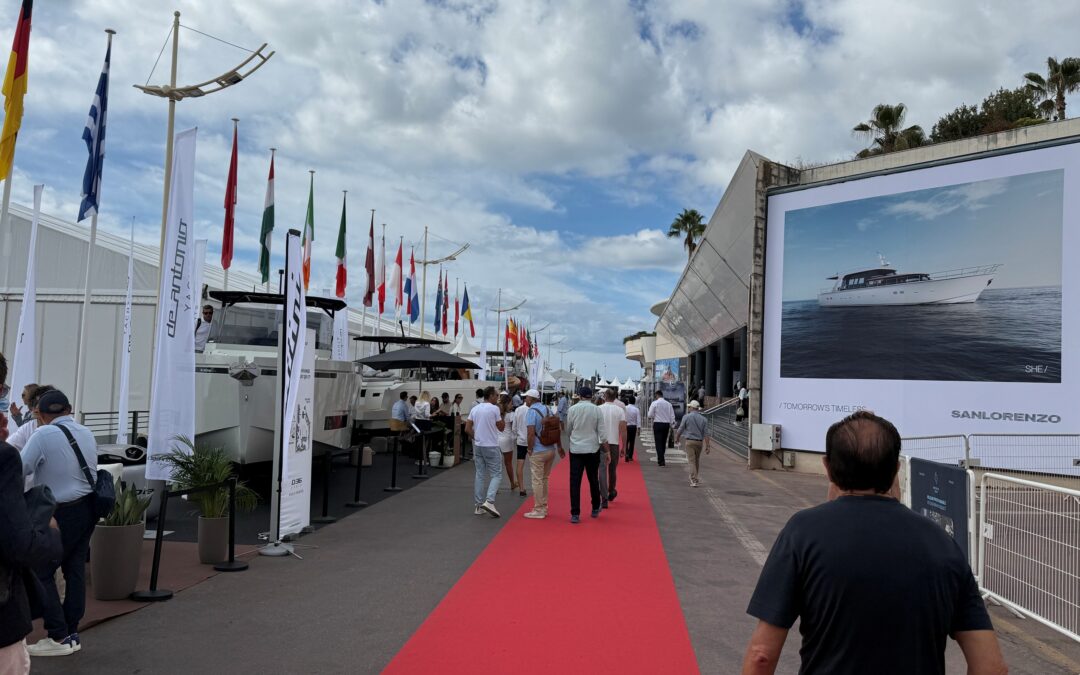
There are few places where the scale, confidence and sheer beauty of the international yachting industry can be experienced as intensely as Cannes.
The Cannes Yachting Festival 2026, running from 8 to 13 September across the Vieux Port and Port Canto, once again transforms the centre of Cannes into one of the great showcases of luxury, engineering and maritime ambition. More than 700 boats and yachts, from approximately five to 55 metres, are being presented, alongside hundreds of exhibitors from across the world.
Walking through the show, the first impression is simply one of scale. Yacht after yacht, shipyard after shipyard, world premieres sit alongside established names. The Vieux Port alone brings together more than 350 boats, while Port Canto’s Sailing Area has some 120 new sailing monohulls and multihulls on the water.
For an industry that has periodically faced questions about economic uncertainty, operating costs and changing attitudes towards luxury, Cannes delivers a rather convincing answer: the appetite for yachting remains enormous.
And perhaps more importantly, the industry is evolving.
Looking beyond size
I have always gone to events such as Cannes looking for innovation.
The largest yacht is easy to notice. So is the most expensive one. Beautiful interiors, increasingly spectacular beach clubs and ever larger entertaining spaces inevitably draw attention.
But I am usually more interested in something else: what is here today that could become normal tomorrow?
At Cannes this year, I believe I found one of those ideas.
Among the innovations presented at the show is a new yacht from the French company MODX Catamarans: the MODX 58.
MODX unveiled the new 58 during the Cannes festival on 8 September, describing it as the smaller sibling of its MODX 70 while retaining the same philosophy of efficiency, luxury and renewable energy. Most importantly, the company’s proposition is uncompromising: 100 per cent electric propulsion, renewable energy and no dependence on conventional fossil fuel propulsion.
That deserves attention.
Yachting has a fuel problem
For decades, the economics of yachting were relatively simple. If you could afford the yacht, you accepted the fuel bill.
That equation is becoming less attractive.
Fuel prices have risen dramatically over the longer term, while owners are increasingly conscious of running costs. At the same time, regulations, marina policies and public expectations are gradually pushing transport in a cleaner direction.
We have already watched this transformation take place on land.
The automobile industry once treated electric vehicles as an interesting niche. Today almost every major manufacturer has an electrification strategy.
Why should yachting ultimately be different?
The challenge, of course, is considerably greater. A yacht cannot simply stop at the maritime equivalent of a motorway charging station every few hours. The sea demands autonomy, reliability and an energy system capable of operating far away from infrastructure.
This is why the MODX approach becomes interesting.
Not simply an electric motor
MODX has been developing a wider renewable energy architecture rather than merely replacing diesel engines with electric ones.
Its larger MODX 70 demonstrated the concept by combining electric propulsion with Aeroforce automated wing sails, hydrogeneration and 70 square metres of solar panels. That yacht was subsequently recognised at the Cannes Yachting Festival’s Innovation Route Awards, giving the company credibility beyond the drawing board.
Now MODX is bringing that philosophy into a more compact 58 foot platform.
That matters because technological revolutions rarely occur at the extreme end of the market. They accelerate when a technology becomes available to a wider group of buyers.
A 70 foot experimental flagship demonstrates what is technically possible. A 58 foot yacht begins to ask a different question:
Could this become commercially normal?
MODX itself describes the new model as 100 per cent electric and powered through renewable energies. The detailed MODX 58 brochure is now being released by the company following its Cannes unveiling.
The significance is not merely environmental.
Electric yachting potentially changes the luxury experience itself.
No traditional engine noise. Less vibration. No smell of diesel around the stern. The possibility of sitting at anchor without the constant soundtrack associated with conventional power generation. Energy harvested from the sun, movement through the water and wind begins to turn the yacht from an energy consumer into something closer to an energy ecosystem.
For a luxury industry, silence may eventually become one of the ultimate luxuries.
Cannes is becoming a laboratory for tomorrow
This is also why the Cannes Yachting Festival remains so relevant.
It is certainly a spectacular commercial exhibition, but increasingly it is also a laboratory for the future of the sector.
Its dedicated Innovation Route specifically highlights technologies and vessels addressing innovation and sustainability, with MODX Catamarans appearing among the selected participants at SAIL035 this year.
Across Cannes there are electric systems, hybrid propulsion concepts, solar integration, new materials and increasingly sophisticated energy management solutions.
None of this suggests that diesel yachts are going to disappear tomorrow.
But technological transitions seldom happen overnight.
First comes the experiment.
Then comes the yacht that proves it works.
Then comes the yacht that makes people want it.
And eventually comes the moment when buyers begin asking why their next yacht isn’t electric.
The beginning of an electric yachting era?
Standing in Cannes surrounded by more than 700 yachts, it would be easy to conclude that the great story of the 2026 festival is abundance.
It certainly is impressive. The number of boats, shipyards, premieres and visitors makes Cannes one of the finest demonstrations of the strength and creativity of today’s yachting industry.
But I left with a different thought.
Perhaps the most important yacht at a boat show is not necessarily the largest yacht in the harbour.
Sometimes it is the one that introduces an idea capable of changing all the yachts that come after it.
The high cost of fuel, the demand for greater efficiency and a new generation of owners increasingly interested in technology make an electric revolution in yachting not only desirable, but increasingly inevitable.
In Cannes, a French company has presented what may be one of the missing pieces.
The MODX 58 combines the language of luxury yachting with a radically different proposition for how that luxury should be powered.
Will it be the yacht that changes the industry?
That remains to be seen.
But after Cannes 2026, the more interesting question may be:
How long will it be before electric yachting stops being called innovative and simply becomes yachting?


Receive Breaking News
Sign up for our newsletter and stay up to date! Be the first to receive the latest news in your mailbox: