
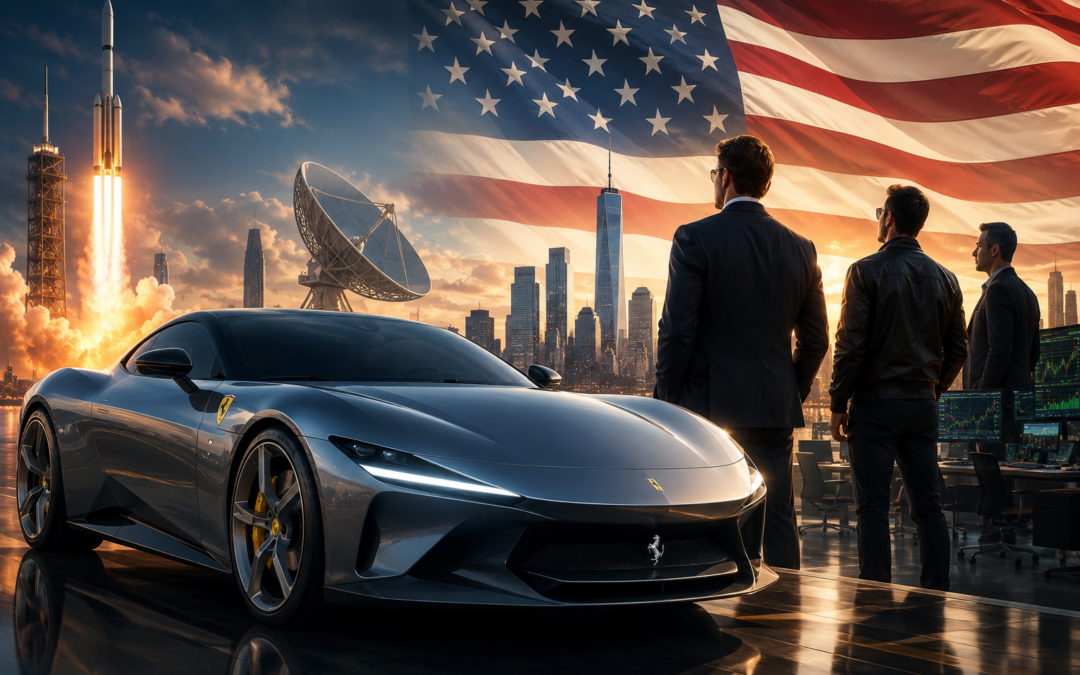
Ferrari’s first fully electric car is not only an automotive launch. It is a strategic message to a new class of buyers: the American super-rich created by artificial intelligence, space technology, financial markets and technological dominance. The Ferrari Luce EV, priced in Italy at about €550,000 and developed with design input from Sir Jony Ive and Marc Newson’s LoveFrom, is not aimed simply at traditional Ferrari collectors. It is aimed at the new elite for whom extreme wealth must be mobile, visible and modern.
This is why the Luce matters. Ferrari is trying to carry the Prancing Horse into a world where status is no longer expressed only through heritage, combustion engines and concours-level collecting. The highest level of luxury is moving toward another language: technological power, daily visibility, scarcity, and the ability to treat the extraordinary as ordinary.
The Luce is a Ferrari for a different kind of rich
The old Ferrari buyer often wanted rarity, racing history, mechanical purity and long-term collectability. The new buyer wants all of that, but also something else: public proof of success. For the AI founder, the space entrepreneur, the hedge-fund winner, the Nvidia-era investor or the young billionaire created by a liquidity event, the car is no longer merely a collector’s asset. It is external wealth. It is success made visible.
That is why the image of British collector Joe Macari using a roughly $3 million Aston Martin Valkyrie for a grocery run became so symbolically powerful. A Valkyrie is absurdly impractical for shopping. That is precisely the point. When a hypercar becomes a vehicle for buying avocados, the message is no longer “I own a rare car.” The message is: “My daily life operates at a level of excess that most people reserve for fantasy.”
Ferrari appears to understand this shift. The Luce is a four-door, five-seat electric Ferrari. That form is controversial because it breaks with the old low-slung sports-car image. But it also makes sense if the target buyer is not the museum collector, but the new super-rich individual who wants a Ferrari as daily transport: to the private airport, the AI conference, the family office, the Malibu house, the Manhattan dinner, the Miami penthouse, the Palo Alto campus or the Space Coast launch event.
The Luce is therefore not an electric Ferrari for environmental virtue. It is an electric Ferrari for a buyer who wants to look future-facing.
Why Jony Ive makes strategic sense
The involvement of Jony Ive is not a decorative detail. It is central to the strategy. Ferrari did not need Ive because it lacked car designers. Ferrari has its own design culture, engineering discipline and brand language. What it needed was someone who understands how technology becomes desire.
Ive’s career at Apple was built around transforming complex technology into objects of emotional and social significance. The iPhone was not simply useful; it became a cultural object, a wealth signal, a lifestyle symbol and a design language. Ferrari faces a similar challenge with electricity. An electric Ferrari cannot rely on the traditional theatre of combustion: the sound, the vibration, the mechanical drama, the smell, the ritual. It must invent a new form of desire.
That is the real reason Ferrari turned to Ive and LoveFrom. The problem was not just how to make an EV. The problem was how to make an electric object feel worthy of the Prancing Horse. Ferrari’s own site describes the Luce as designed with Ive and Newson, while coverage of the launch emphasised that LoveFrom’s role touched both the interior and exterior concept.
The risk is obvious. Apple-like minimalism can create purity, but it can also remove sensuality. Ferrari must not become too clean, too silent or too abstract. A Ferrari that needs explanation is already in danger.
The reaction: investors and purists were not convinced
The first response to the Luce was cold. Reuters reported that Ferrari’s Milan-listed shares closed down 8.4% after the reveal, while the New York-listed shares were down 5.1% during the session. Critics questioned whether the Luce looked enough like a Ferrari, and former Ferrari chairman Luca Cordero di Montezemolo reportedly said he hoped the company would remove the Prancing Horse badge from it.
That reaction matters because Ferrari’s stock-market value is not based on normal automotive logic. Ferrari is valued less like a carmaker and more like a luxury house with an engine division. Investors pay for scarcity, brand control, pricing power, personalisation, margins and the belief that the badge is almost untouchable.
Ferrari’s fundamentals remain strong. In Q1 2026, the company reported €1.848 billion in net revenues, €722 million in EBITDA, a 39.1% EBITDA margin and €413 million in net profit. It also confirmed 2026 guidance of about €7.5 billion in net revenues and at least €2.93 billion in adjusted EBITDA, with the order book extending toward the end of 2027.
Ferrari N.V. (RACE) is still priced like a premium luxury-growth business, not a cyclical automaker. Its NYSE shares recently traded around $366, and current market data puts its trailing P/E ratio in the mid-30s. That multiple reflects confidence in Ferrari’s ability to preserve scarcity and pricing power even as the product range changes.
Stock market information for Ferrari N.V. (RACE)
- Ferrari N.V. is a equity in the USA market.
- The price is 366.13 USD currently with a change of -2.88 USD (-0.01%) from the previous close.
- The latest open price was 369.0 USD and the intraday volume is 423149.
- The intraday high is 372.73 USD and the intraday low is 365.12 USD.
- The latest trade time is Wednesday, June 17, 01:15:28 +0200.
The share-price issue is therefore simple: the Luce does not have to sell in huge volumes to matter. It has to protect the mythology. If investors decide the Luce expands Ferrari’s addressable market without weakening the brand, the stock can defend its luxury premium. If they decide it confuses Ferrari’s identity, the multiple becomes vulnerable.
The real purchasing power is in America
Ferrari is Italian in origin, European in myth and global in appeal. But the strategic prize is increasingly American wealth. The United States is where the most powerful combination of financial markets, AI, private equity, venture capital, space technology and founder liquidity is concentrated. This is the wealth base that can turn a €550,000 electric Ferrari from a controversial experiment into a cultural object.
UBS reported that the US had 924 billionaires in 2025, accounting for almost a third of the global billionaire population, with US billionaires holding about $6.9 trillion in wealth. UBS also reported that 87 of the 196 new self-made billionaires globally were in the US, with $171.9 billion in wealth.
This is the market Ferrari wants to conquest. Europe has history, taste and old-money symbolism. But the most aggressive new purchasing power is in the United States. It is in AI equity, stock-market gains, private-company valuations, space infrastructure, software monopolies, semiconductor wealth and the new financial aristocracy around them.
Ferrari’s own Q1 2026 commentary supports the importance of the Americas. The company said earnings benefited from an “exceptionally strong country mix driven by Americas,” while regional data showed the Americas accounting for about 30% of Q1 deliveries.
That is why the Luce is not only about electrification. It is about positioning Ferrari where the next extreme luxury buyer lives: not only geographically in the US, but psychologically in the world of technological supremacy.
Luxury is moving above the millionaire
The luxury market is separating into layers. The millionaire can still buy luxury goods. The multimillionaire can buy supercars. But the very top of the market is being redesigned around billionaires and future trillionaire-scale fortunes. At that level, price is not the obstacle. Meaning is the obstacle.
The object must say something. It must say: I am not merely wealthy, I am exceptional. I belong to the small group that is shaping the future. I can buy heritage, but I also buy innovation. I respect the past, but I live in the next era.
That is the emotional space Ferrari is trying to occupy. The Luce is a car for people who do not want to choose between old-world prestige and new-world technological power. It is Maranello speaking to Silicon Valley, Wall Street, Austin, Miami, Cape Canaveral and the new geography of American wealth.
China is the danger Ferrari cannot ignore
The largest strategic danger is China. Chinese competition is no longer only about cheap electric cars. BYD has become one of the most important automotive forces in the world, and chairman Wang Chuanfu has said the company aims to become the world’s largest automaker within five years. Reuters reported that BYD sold 4.6 million vehicles in 2025 and that its exports rose 65% in the first five months of 2026.
China is also entering the theatre of the extreme. BYD’s Yangwang U9 Xtreme has claimed a Nürburgring electric super-sports-car record of 6:59.157, and the model reportedly sold for more than 20 million yuan, about $2.76 million, at the 2026 Beijing Auto Show.
That is a warning to Ferrari. China can build performance. China can build batteries. China can build speed, spectacle and increasingly expensive electric cars. It can attack Ferrari from the engineering side.
But China does not yet have what Ferrari has: the Prancing Horse. It does not have Enzo Ferrari, Maranello, Le Mans memory, Formula One mythology, decades of posters on bedroom walls, or the emotional inheritance of European racing aristocracy. At the highest level of luxury, the logo is not branding. It is the product.
This is Ferrari’s greatest advantage. It is also its greatest constraint. The stronger the badge becomes, the less room Ferrari has to make a mistake.
Heritage plus innovation: the only viable formula
Ferrari’s challenge is not to become Tesla. It is not to become BYD. It is not even to become Apple on wheels. Ferrari’s challenge is to combine heritage with innovation so convincingly that the new buyer sees the Luce not as a compromise, but as the next expression of superiority.
The Luce must satisfy three markets at once. It must reassure traditional Ferrari clients that the brand has not abandoned its soul. It must attract younger technology-rich buyers who see combustion-only luxury as nostalgic. And it must show Chinese competitors that Ferrari can compete in the electric age without surrendering the emotional value of its name.
That is a very difficult balance. The launch reaction shows how narrow the path is. If the car feels too traditional, it becomes irrelevant to the new wealth class. If it feels too futuristic, it risks alienating the old believers. If it feels too practical, it loses Ferrari magic. If it feels too strange, investors fear brand dilution.
The final question
The Ferrari Luce is a gamble on the psychology of the new super-rich. It assumes that the next generation of extreme buyers will not treat cars only as collectible assets. They will treat them as daily declarations of wealth, technological confidence and personal exceptionalism.
That is why the Luce is aimed less at the old European millionaire and more at the American billionaire shaped by AI, space, finance and technological power. The buyer Ferrari wants is not asking whether a €550,000 electric car is rational. He is asking whether it makes his success visible in the right language.
If Ferrari is right, the Luce will become the first true status EV of the ultra-luxury age: not a green Ferrari, but a Ferrari for the era of AI wealth. If Ferrari is wrong, the market will not punish it merely for going electric. It will punish it for something far more serious: making the Prancing Horse look uncertain about the future.


Receive Breaking News
Sign up for our newsletter and stay up to date! Be the first to receive the latest news in your mailbox: